
Foucault News

News and resources on French thinker Michel Foucault (1926-1984)

Miguel Vatter, Care of the Self and the Invention of Legitimate Government. Foucault and Strauss on Platonic Political Philosophy. In Jeffrey A. Bernstein and Jade Larissa Schiff, eds. Leo Strauss and Contemporary Thought : Reading Strauss Outside the Lines. Albany: State University of New York Press, 2021.

This chapter offers an interpretation of Michel Foucault’s last lectures at the Collège de France, The Courage of Truth : The Government of Self and Others II, by reading them against the backdrop of Leo Strauss’s conception of classical natural right formulated in such works as On Tyranny, Natural Right and History and What is Political Philosophy? The justification for what appears, at first blush, an unseemly and even shocking comparative exercise is that in these last lectures Foucault’s chosen theme is the one preferred by Strauss— namely, the opposition between Platonic political philosophy and democratic political life. His analysis coincides with the genealogy offered by Leo Strauss on several key points. Ultimately, Foucault and Strauss agree that “political philosophy” or “normative political thought” is not what the Western tradition has made of it: it is neither a discourse that seeks to understand the nature of political things, nor does it delineate a theory of justice for the sake of moralizing politics. For these two authors, “political philosophy” is a practice that seeks to replace the pre-philosophical practice of political life in democracies with a new practice of politics: the philosophically justified “legitimate government” of some over others.
[…]

Sfara, E. From technique to normativity: the influence of Kant on Georges Canguilhem’s philosophy of life. History and Philosophy of the Life Sciences, 45, 16 (2023).
https://doi.org/10.1007/s40656-023-00573-8

Abstract
Many historical studies tend to underline two central Kantian themes frequently emerging in Georges Canguilhem’s works: (1) a conception of activity, primarily stemming from the Critique of Pure Reason, as a mental and abstract synthesis of judgment; and (2) a notion of organism, inspired by the Critique of Judgment, as an integral totality of parts. Canguilhem was particularly faithful to the first theme from the 1920s to the first half of the 1930s, whereas the second theme became important in the early 1940s. With this article, I will attempt to show that a third important theme of technique arose in the second half of the 30s also in the wake of Kant’s philosophy, especially Sect. 43 of the Critique of Judgment. This section, which states that technical ability is distinguished from a theoretical faculty, led Canguilhem to a more concrete and practical conception of activity. I will then suggest that it was by considering technique that the concept of normativity, which characterizes Georges Canguilhem’s philosophy of life, also took shape.

Foeken, E. (2023). Embodied, caring and disciplinary: A Foucauldian reading of ‘process time’ as constitutive of the biopolitical institution of the family. Time & Society, https://doi.org/10.1177/0961463X231176434

‘Process time’ describes the recursive/fluid, social and embodied temporality that characterises much ‘women’s work’. Though this concept has proven highly useful to feminist analyses of caring and other feminised labour, there has arguably been a tendency for authors in this area to naturalise and valorise this temporality – particularly in relation to the abstract, economic and disciplinary time of the clock. I argue that this naturalisation or valorisation of process time flattens our understanding of feminised labour, and that a feminist social theory of time must recognise the potentially disciplinary forms process time can take. As such, this paper contributes to feminist analyses of time, gender and labour by arguing that the embodied, caring and processual temporality that circulates within modern families can be understood as fundamentally disciplinary. Drawing primarily on Foucauldian theory, as well as Sharon Hays’ concept of ‘intensive mothering’, the paper argues that process time is central to the functioning of the family as a biopolitical institution, just as clock time is integral to the disciplinary mechanisms of the school, prison, barracks, etc. Specifically, it argues that the unique relations of power that circulate within the biopolitical family rely on a unique use of time: one that is intensive and oriented towards the rhythms of the physical body – that is, processual. Further, this disciplinary time is deeply and fundamentally feminine, as it operates (in its ideal form) primarily through the mother.

Nicolas Gane, (2023). Neoliberalism and the Defence of the Corporation. Theory, Culture & Society, 40(3), 63–80. https://doi.org/10.1177/02632764221113727

Abstract
This article addresses a little-known event in the history of neoliberalism: a conference at Stanford University held in 1982 to reconsider Adolf Berle and Gardiner Means’ The Modern Corporation and Private Property 50 years after its initial publication. This event is important as it is where key members of the neoliberal thought collective sought to define and defend the powers and freedoms of the corporation. First, this article outlines the political commitments of Berle and Means by considering the core arguments of The Modern Corporation and Private Property; second, it addresses key papers from the event published subsequently in the Journal of Law and Economics; and third, it analyses the neoliberal defence of the corporation that emerged from these papers, and reflects on the limitations of the work of Berle and Means for developing a response to their neoliberal critics.

Robert S. Leib, Of other histories: philosophical archaeology, historiology, and paradigmatology, Parrhesia 37 · 2023 · 91-120

Open access

This article contributes to the discussion of philosophical archaeology in Foucault’s early works by reexamining its influences and recent developments using two concepts that appear in The Order of Things —a history of the Same and a history of the Other. Foucault viewed his work in The Order of Things as a departure from his earlier archival research into madness because madness is the object for a history of the Other, while order is the object for a history of the Same. A history of the Other, he says, is: “that which, for a given culture, is at once interior and foreign, therefore to be excluded (so as to exorcize the interior danger) but by being shut away (in order to reduce its otherness).” Eventually, Foucault would pursue this in his “Lives of Infamous Men” essay and Parallel Lives project. A history of the Same, by contrast, is “that which, for a given culture, is both dispersed and related, therefore to be distinguished by kinds and to be collected together into identities.” It is the history of a culture that does the Othering, deployed as a means of preserving that culture against the encroachment of “foreign” influences. I will use this distinction throughout the paper to figure various archaeological projects in relation to one another. I will reexamine philosophical archaeology through these two categories and the permutations that result when they are brought to bear on one another.
[…]

Lorenzini, D., & Tiisala, T. (2023). The architectonic of Foucault’s critique. European Journal of Philosophy, 1– 16. https://doi.org/10.1111/ejop.12877

Open access

Abstract
This paper presents a new interpretation of Michel Foucault’s critical project. It is well known that Foucault’s genealogical critique does not focus on issues of justification, but instead tackles “aspectival captivity,” that is, apparently inevitable limits of thought that constrain the subject’s freedom but that, in fact, can be transformed. However, it has not been recognized that, according to Foucault, critique can proceed along two distinct paths. In a key passage of “What Is Critique?,” Foucault states that critique is tasked with questioning truth about its effects of power and with questioning power about its discourses of truth. We show that this “double movement” organizes Foucault’s critical project as a whole, giving it a significantly wider scope and a more complex structure than has been previously acknowledged. At the heart of the above-mentioned bifurcation lies an apparent tension between two contrastive roles Foucault assigns to truth-telling in the context of critique: on the one hand, truth-telling (as avowal) is a target of critique; on the other, truth-telling (as parrhesia) is one of critique’s methods. We argue that combining these two dimensions in a unified account is crucial for understanding and re-evaluating Foucault’s critical project as a whole. By showing that truth-telling remains an essential element of Foucauldian critique, this paper also rectifies some influential misinterpretations according to which Foucault’s critical project seeks to eliminate truth from the picture.

CALL FOR PAPERS
The twenty-second annual meeting of the Foucault Circle

Emerson College
Boston, MA, USA
May 17-19, 2024

PDF of Call for Papers

We seek submissions for papers on any aspect of Foucault’s work, as well as studies, critiques, and applications of Foucauldian thinking.

Paper submissions require an abstract of no more than 750 words. All submissions should be formatted as a “.doc” or “.docx” attachment, prepared for anonymous review, and sent via email to the attention of program committee chair Patrick Gamez (pgamez@nd.edu) on or before December 18, 2023. Indicate “Foucault Circle submission” in the subject heading. Program decisions will be announced during the week of January 22, 2024.

We expect that the conference will begin Friday afternoon and will conclude around lunch time on Sunday morning. Presenters will have approximately 40 minutes for paper presentation and discussion combined; papers should be a maximum of 3500 words (20-25 minutes reading time).

Logistical information about lodging, transportation, and other arrangements will be available after the program has been announced.

For more information about the Foucault Circle, please see our website:
http://www.foucaultcircle.org
or contact our Coordinator, Edward McGushin: emcgushin@stonehill.edu

Vatter, M. (2019). Liberal Governmentality and the Political Theology of Constitutionalism. In B. Leijssenaar & N. Walker (Eds.), Sovereignty in Action (pp. 115-143). Cambridge: Cambridge University Press. doi:10.1017/9781108692502.006

Summary
‘The king reigns but does not govern’. This formula, which according to Carl Schmitt was coined by Adolphe Thiers, a French liberal historian and politician, enemy of Bonapartism yet suppressor of the Paris Commune, has become today the most important formula in the study of liberalism. Michel Foucault and Giorgio Agamben both understand this formula as capturing something essential about liberalism as a form of governmentality that guides the conduct of individuals either in the absence, or beyond the reach, of the sovereign power and its legislation through normative and normalizing orders that escape democratic control. Although not discussed as such, this formula also underlies recent attempts by jurists and historians of political ideas such as Martin Loughlin and Richard Tuck to bolster the sovereignty of the state against new forms of governing without the state that emerge in neoliberalism. This chapter proposes a new reading of this formula by situating it on the terrain of constitutionalism, rather than on that of sovereignty. In so doing, it seeks to bring together in a meaningful exchange these two different critical approaches to neoliberalism, and the emerging debates they harbour. One debate is between those who advocate a Foucauldian and biopolitical and those who adopt an Agambenian and politico-theological analysis of neoliberal governmentality. The other is the one between advocates of a republican, constitutional approach to democracy and those who argue for the revival of popular sovereignty on the basis of new ‘democratic’ interpretations of Bodin and Hobbes.

Keywords
Sovereignty, Constitutionalism, Political Theology, Neoliberalism, Governmentality, Ernst Kantorowicz

Lemm, Vanessa, and Miguel Vatter. “Chapter 4: Michel Foucault’s perspective on biopolitics”. In Handbook of Biology and Politics, (Cheltenham, UK: Edward Elgar Publishing, 2017) accessed Jul 26, 2023, https://doi.org/10.4337/9781783476275.00012

Abstract
Foucault’s discussion of biopolitics, a term that he began using in the mid-1970s, is closely related to his new theories of power, which have since revolutionized our understanding of this concept. This chapter explains Foucault’s conception of biopolitics, which is now widely adopted in all social sciences and humanities when discussing the relation between politics and biology, from the perspective of his account of power. The chapter explains that biopolitics, for Foucault, describes a new way to govern citizens by considering individuals part of ‘populations’ whose biological lives (from birth to death) need to be managed in order to maximize their strength, well-being, and now ‘resilience’. The chapter also details how, for Foucault, such biological government entails the real peril that certain ‘sub-populations’ may be considered dispensable in order to ‘strengthen’ other sub-populations, a phenomenon which has led in the past centuries to state-based racism, colonialism, and eventually totalitarian forms of absolute domination. The chapter concludes by discussing a more ‘affirmative’ understanding of biopolitics, where biological life is understood as something that resists political domination.

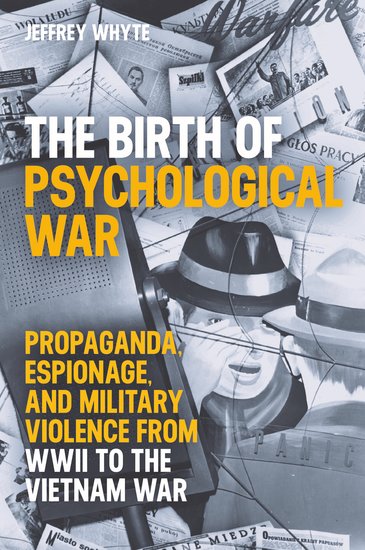
Jeffrey Whyte, The Birth of Psychological War. Propaganda, Espionage, and Military Violence from WWII to the Vietnam War. Oxford University Press, 2023

Open access

Description
The Birth of Psychological War explores the history, politics, and geography of United States psychological warfare in the 20th century against the backdrop of the contemporary ‘post-truth era’. From its origins in the Second World War, to the United States’ counterinsurgency campaigns in Vietnam, Whyte traces how the theory and practice of psychological warfare transformed the relationship between the home front and theatres of war. Whyte interrogates the broader political mythologies that animate popular conceptions of psychological war, such as its claim to make war more humane and less violent.On the contrary, The Birth of Psychological War demonstrates the role of psychological warfare in expanding the scope and scale of military violence amidst ostensible efforts to ‘win hearts and minds’. While casting a critical eye on psychological warfare, Whyte establishes its continued significance for the contemporary student of international relations.

This book makes use of both governmentality as a framework for thinking about psychological war in terms of the circulation of information, and also confession as a way of thinking about how US psychological warfare has constantly attempted to ‘make speak’ and tie individuals to the kinds of truths they are led to formulate about themselves.

Table of Contents
Introduction
1:’A New Geography of Defence’
2:Truth, Territory, Terror
3:Covert Crusade
4:Psywar in Vietnam

Dr Jeffrey Whyte is a Lecturer in International Relations at Lancaster University. He holds a PhD in Geography from the University of British Columbia, and an MA in Communications from Simon Fraser University. His work explores the political history of psychological warfare in the United States.