Foucault News

News and resources on French thinker Michel Foucault (1926-1984)

Lorenzo Petrachi, Michel Foucault’s «La croisade des enfants». Schérer, Rochefort and the Political Philosophy of Childhood, Filosofia politica 1/2026, pp. 121-140.
https://www.rivisteweb.it/doi/10.1416/119910

Article in Italian

Abstract
The essay offers an analysis of Michel Foucault’s previously unpublished manuscript, “La croisade des enfants”. After establishing its date and providing a description of the manuscript, the essay situates it within contemporary debates on childhood sexuality and power relations between adults and minors, paying particular attention to the work of René Schérer and Christiane Rochefort, whose writings intersect with Foucault’s project in several ways. In doing so, the article brings into focus the political and philosophical stakes of “La croisade des enfants”, illuminating aspects of Foucault’s thought that have thus far remained understudied.

Keywords
Foucault, Childhood, Schérer, Rochefort

Jessamine Giese, Megan Gibson, and Marie White, Navigating Policy Disconnect in Early Childhood: Teams Interpreting the NQF, EYLF, and Modern Awards. Australasian Journal of Early Childhood, First published online February 12, 2026
https://doi.org/10.1177/18369391261425987

Abstract
In Australia, early childhood education and care (ECEC) has experienced substantial policy reform in the past 15 years with major shifts in qualification requirements, a national prescribed curriculum, and increasing focus on quality. Teams of early childhood educators are expected to collaboratively navigate these reforms while making decisions that lead to quality. This paper draws on a PhD study that examined how teams of educators in ECEC make curricular and pedagogical decisions within a complex policy landscape. Three key national policy documents that govern educators’ work—Guide to the National Quality Framework (NQF), Early Years Learning Framework (EYLF), and modern awards—were closely analysed to make visible the complexities of how team decision-making is conceptualised in policy. Findings contribute to the global political attention on ECEC and offers ways forward for educators, organisations, and governments to re-align the reform strategy and strengthen policy implementation, leading to quality outcomes for children.

Jessamine Giese, (2025) Early Childhood Educators Producing Curriculum and Pedagogy: Discursive Possibilities of Team Decision-Making. PhD thesis, Queensland University of Technology.

Open access

Description
There is increasing political interest in Australia on early childhood education and care reforms requiring educators to collectively navigate, and translate, policies into practice. This thesis explores how teams of educators interpret policy for curriculum and pedagogy. Provocations and opportunities are presented to strengthen the implementation of reform, offering new insights into ways teams of educators work within the scope of contemporary policy intent. A theoretical lens inspired by Michel Foucault enabled a scrutiny of key policies alongside an analysis of how teams of educators interpret and enact these policies, offering productive ways of thinking and speaking about team decision-making.

Abstract
This study is an inquiry into how teams of educators produce curriculum and pedagogy in long day care. In Australia, early childhood policy reform has presented major shifts in qualification requirements, a national prescribed curriculum, and rising importance on the quality of curriculum and pedagogy as provided by teams of educators (ACECQA, 2024). As educators are expected to navigate these reforms collaboratively, teams in the early childhood education and care (ECEC) sector grapple with the changing regulatory landscape (Armstrong, 2023; Harrison et al., 2023; Phillips & Boyd, 2023) and challenges associated with attracting, retaining, and upskilling educators saturate the workforce (Commonwealth of Australia, 2024; Education Services Australia, 2021; Queensland Government, 2023). This study brings a new layer of insight to the Australian ECEC landscape, following the scrutiny of key policies alongside an analysis of documents and focus groups on how teams of educators interpret and enact these policies.

Michel Foucault’s (1972) set of ideas outlined in The Archaeology of Knowledge inspired both the theory and method elements of the research design for this qualitative study. A textual archive was created, consisting of data generated from policies and data collected from four long day care centres in Queensland, including centre documents and transcribed focus groups. The analytical tools applied in this study were informed by Foucault’s concepts of discourse (1972) and relations of power (1990; 1991), operationalised to look closely at the research question: How do teams of early childhood educators make curricular and pedagogical decisions in long day care?

A Foucault-informed theoretical lens enabled scepticism and critique (Gillies, 2013). Questioning the ‘rules’ which make possible the existence of policies and teams of educators enabled the taken for granted ways of doing curricular and pedagogical decision-making to be disrupted. As gaps and contradictions were located, “discovering new layers” (Foucault, 1981, p. 68) led to the identification of potential new paths for teams in ECEC. Drawing on Foucault’s work (1972), this study does not pose a singular and fixed response to the research question. Rather, use of Foucault’s concepts (1972; 1990; 1991) interrogated normalised discursive practices, and presented productive ways of thinking and speaking about team curricular and pedagogical decision-making.

Therefore, this study offers “possible paths of attack” (Foucault, 1996, p. 262) to encourage government policymakers and ECEC providers alongside their teams to “think otherwise” (Ball, 1998, p. 81) about the assumed ways teams of educators work to understand, and implement, policy. Overall, three key provocations are presented. First, this study makes visible disconnections between policies and the ways teams of educators enacted curricular and pedagogical decision-making, probing a revisit to the cluster of policies that govern educators’ work. Second, this study prompts policymakers to explore pathways to better harness the value of the degree-qualified teachers’ specialised curricular and pedagogical knowledge in teams. And third, this study presents opportunities to think differently about the position of the educational leader, a crucial role in leading quality curricular and pedagogical decision-making in Australia. Given the ongoing complexities of the ECEC workforce and the substantial political interest in the early years (both nationally and worldwide), this study opens up possibilities to strengthen the implementation of reform, through offering new insights into the ways teams of educators work within the scope of contemporary policy intent.

See updated post at https://michel-foucault.com/2026/04/18/phd-course-foucault-organization-technology-and-subject-formation-2026-2/

Milena Tekeste, Mustafa F. Özbilgin (2026), Misrecognition and Responsibilisation in Extreme Events: Towards Recognition-based Accountability in Academia. British Journal of Management, 37: e70032.
https://doi.org/10.1111/1467-8551.70032

Abstract
This essay interrogates how extreme events including the COVID-19 pandemic, climate disasters, and political conflict, amplify structural inequalities in academia. Drawing on critical autoethnographic material from an Early Career Researcher with intersecting marginalisations, we show how crises expose and intensify two mutually reinforcing dynamics: misrecognition (institutional neglect of care responsibilities, political vulnerability, and embodied identity) and responsibilisation (the shifting of crisis management onto individuals). We demonstrate how these processes operate through institutional silence and performativity mechanisms that simultaneously erase vulnerability and demand uninterrupted performance, making individual adaptability appear both natural and necessary. By situating these lived experiences within Honneth’s theory of recognition and Foucault’s concept of responsibilisation, we theorise how their interaction deepens disadvantage for vulnerable groups during and after crises. In response, we propose Recognition-based Accountability (RbA) as a framework for institutional reform. RbA shifts the emphasis from individual resilience to structural responsibility, outlining actionable, care-oriented pathways for embedding equity and recognition into crisis governance in management education. This essay thus contributes to debates on academic inequality and the future of work by revealing the embodied costs of institutional neglect and offering a model for reorienting crisis response toward justice, care, and accountability.

Giorgi Vachnadze, Our Machines Podcast, Interview with Riccardo Molin, Soundcloud, March 2026

Discussion of Giorgi Vachnadze, (2024) Christian Eschatology of Artificial Intelligence: Pastoral Technologies of Cybernetic Flesh. Berlin/Nicosia: Becoming Press. 978-9925-8118-8-5.

Pirkko Markula, Jim Denison, Poststructuralist Methodologies for Physical Activity Research Theory and Practice of Foucault, Deleuze, and Latour, Routledge, 2026

Drawing on the work of Foucault, Deleuze, and Latour, this book opens up a poststructuralist approach to sport, exercise, and dance research. It examines how to incorporate both articulable expression and visible material elements – theoretically and methodologically – to study the force of the moving body in practice.

This book employs critical concepts including the dispositive, assemblage, and actor network to interrogate and advance our understanding of theory and method in research of physical activity practice. It asks what a poststructuralist approach might mean, especially as it concerns themes such as the body in motion, physical activity practice, network of relations, knowledge, and power for physical cultural studies scholars. Presenting in-depth case studies of adult ballet, Barre, Pilates, coaching, ice-hockey, and cross-country running, this book also examines how researchers and practitioners can begin to collaborate to create innovative instruction, training, and coaching practices.

This is a fascinating reading for advanced students and researchers working in the physical cultural studies, sociology of sport and exercise, sociology of the body, sports coaching, physical education, or social theory.


Contents

PART 1

Theorizing Poststructuralism

1 What Is Poststructuralism?

2 The Dispositive: Foucault’s Articulable and Visible Elements in Power Diagrams

3 Assemblage Analysis: Deleuze’s Semiotic System, Pragmatic System, and Territoriality

4 The Actor‑Network Theory: Latour’s Methodological Moves

5 The Ethical Formation of the Self

PART 2

Practicing Poststructuralism

6 Foucault in Practice: Ethical Practices for a Recreational Ballet Class

PIRKKO MARKULA AND JODIE VANDEKERKHOVE

7 Practicing Foucault in a BarrePilates Class

PIRKKO MARKULA AND JOY CHIKINDA

8 Movement of Learning: Thinking Differently about Physical Activity Research Practice

9 The “Post” Project: What Else Can Women’s Naked Bodies Do?

PIRKKO MARKULA AND ALLISON JEFFREY

10 Poststructuralist Vision for Practice Design in Sport

11 Concussion Return to Play Policies and Protocols: An Actor‑Network Theory Approach

JIM DENISON AND DALLAS ANSELL

12 Running Fast: A Socio‑Material Perspective

13 The Air We Breathe

Finale: Concluding Moves

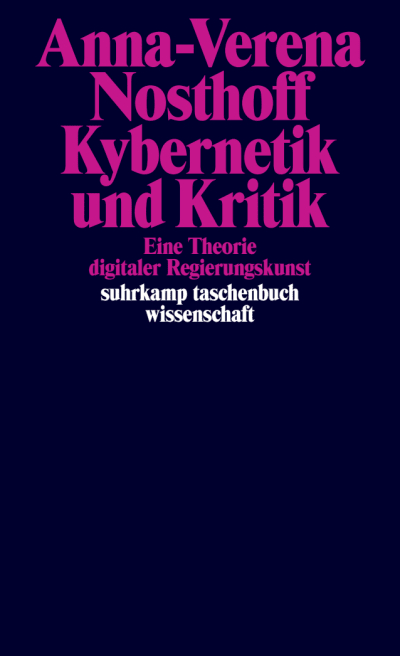
Anna-Verena Nosthoff, Kybernetik und Kritik. Eine Theorie digitaler Regierungskunst, Suhrkamp, 2026.

Elon Musk bezeichnet die Plattform X als »kybernetische Superintelligenz«, Mark Zuckerberg denkt Unternehmen als »lernende Organismen«, und der Erfinder der Datenbrille Google Glass sagt: »Die Kybernetik ist überall, wie Luft.« Diese Aussagen kommen nicht von ungefähr. Wer die Digitalisierung verstehen will, muss auf ihre kybernetischen Ursprünge schauen. In ihrem grundlegenden Buch zeichnet Anna-Verena Nosthoff ein umfassendes Panorama der Kybernetisierung der datafizierten Gegenwartsgesellschaft – von den ersten Prämissen der »Wissenschaft von Kommunikation und Kontrolle« über die Emergenz des Cyberspace bis hin zum aktuellen KI-Hype und zu technikautoritären Strömungen. Es zeigt sich: Die Kybernetisierung erfasst auch die Kritik – die sich daher neu erfinden muss, um zu überleben.

Anna-Verena Nosthoff ist Juniorprofessorin für Ethik der Digitalisierung an der Carl von Ossietzky Universität Oldenburg und Ko-Direktorin des Critical Data Lab (Humboldt-Universität/Universität Oldenburg).

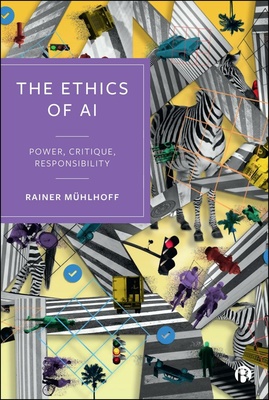
Rainer Mühlhoff, The Ethics of AI. Power, Critique, Responsibility, Bristol University Press, 2025

Available open access digitally under CC-BY-NC-ND licence.

In a world where artificial intelligence increasingly influences the fabric of our daily lives, this accessible book offers a critical examination of AI and its deep entanglement with power structures. Rather than focusing on doomsday scenarios, it emphasises how AI impacts our everyday interactions and social norms in ways that fundamentally reshape society. By examining the different forms of exploitation and manipulation in the relationship between humans and AI, the book advocates for collective responsibility, better regulation and systemic change.

This is a resounding manifesto for rethinking AI ethics through a power-aware lens. With detailed analysis of real-world examples and technological insights, it is essential reading for anyone invested in the future of AI policy, scholarly critique and societal integration.

Contents
Introduction: What Does It Mean to ‘Do’ a Power-Aware Ethics of AI? – A Note to Readers

Part I: The Power of AI
Chapter One: What AI Are We Talking About?
Chapter Two: Human-Aided AI
Chapter Three: Digital Counter-Enlightenment and the Power of Design
Chapter Four: Subjectivity and Power in the Ethics of AI

Part II: The Power of Prediction
Chapter Five: AI Systems as Prediction Machines
Chapter Six: Predictive Privacy
Chapter Seven: The Culture of Prediction – Ethics and Epistemology

Part III: The Power of Control
Chapter Eight: AI Cybernetics
Chapter Nine: Opacity in Machine Learning and Predictive Analytics
Chapter Ten: Bias in Cybernetic AI Systems
Chapter Eleven: Collective Responsibility in the Ethics of AI
Conclusion: Manifesto for a Power-Aware Ethics of AI

Author
Rainer Mühlhoff is Professor of Ethics and Critical Theories of Artificial Intelligence at the Institute of Cognitive Science and Institute of Philosophy at the University of Osnabrück.

Jan-Philipp Siebold, Annemarie Witschas, Rainer Mühlhoff, 2026. “ When the Future Feels Foreclosed: AI Resignation and the Power to Act.” Future Humanities 4: e70026.
https://doi.org/10.1002/fhu2.70026.

ABSTRACT
This article develops the concept of ‘AI resignation’ to capture how young people encounter AI not only as a helpful or flawed tool, but as an overpowering and seemingly inevitable force that can foreclose their sense of political and personal power to act in relation to the future. Building on qualitative work with high school students in Germany (ages 15–18), we conceptualize AI resignation as a future-oriented sensibility that emerges at the intersection of pervasive data-driven infrastructures and hegemonic narratives of AI inevitability. Drawing on Foucault’s late work on subjectivation and subjectivity, as well as extensions in media and affect theory, we identify four contradictory pulls that structure adolescents’ everyday engagements with AI—between enthusiasm and dependency, effortless access and eroded learning, self-governance and repeated failure, aspiration and foreclosed futures—and show how these double binds gradually hollow out experiences of self-efficacy. We further argue that AI resignation fulfils a strategic affective function within digital capitalism: by naturalizing dependence on predictive AI infrastructures and normalizing diminished expectations of the power to act, it stabilizes the very sociotechnical structures that produce it. The article concludes by outlining implications for re-politicizing AI and education, emphasizing power-critical curricula and collective spaces of reflection that enable young people to meaningfully participate in shaping sociotechnical futures.