Foucault News

News and resources on French thinker Michel Foucault (1926-1984)

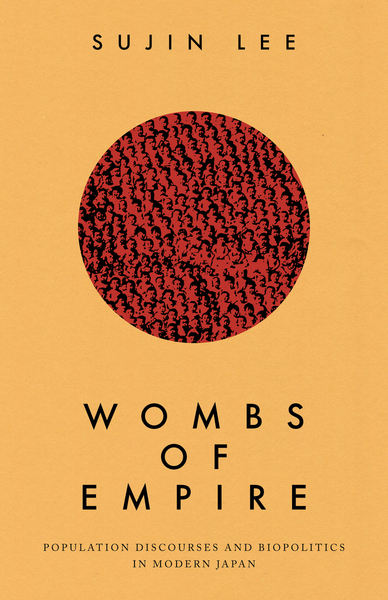
Sujin Lee, Wombs of Empire. Population Discourses and Biopolitics in Modern Japan, Stanford University Press, Forthcoming, October 2023

Japan’s contemporary struggle with low fertility rates is a well-known issue, as are the country’s efforts to bolster their population in order to address attendant socioeconomic challenges. However, though this anxiety about and discourse around population is thought of as relatively recent phenomenon, government and medical intervention in reproduction and fertility are hardly new in Japan. The “population problem (jinko mondai)” became a buzzword in the country over a century ago, in the 1910s, with a growing call among Japanese social scientists and social reformers to solve what were seen as existential demographic issues.

In this book, Sujin Lee traces the trajectory of population discourses in interwar and wartime Japan, and positions them as critical sites where competing visions of modernity came into tension. Lee destabilizes the essentialized notions of motherhood and population by dissecting gender norms, modern knowledge, and government practices, each of which played a crucial role in valorizing, regulating, and mobilizing women’s maternal bodies and responsibilities in the name of population governance. Bringing a feminist perspective and Foucauldian theory to bear on the history of Japan’s wartime scientific fascism, Lee shows how anxieties over demographics have undergirded justifications for ethnonationalism and racism, colonialism and imperialism, and gender segregation for much of Japan’s modern history.

About the author
Sujin Lee is Assistant Professor of Pacific and Asian Studies at the University of Victoria

Foucault News will be taking a short break for a few weeks. In the meantime, please avail yourselves of the extensive archives and resources.

Clare O’Farrell (Editor)

Walsh, J., Ferazzoli, M.T.
The Colonised Self: The Politics of UK Asylum Practices, and the Embodiment of Colonial Power in Lived Experience
(2023) Social Sciences, 12 (7)

DOI: 10.3390/socsci12070382

Abstract
This paper draws on empirical data generated in the ‘Everyday Bordering in the UK’ project, with a focus on the experiences of people seeking asylum and hoping to establish a safe life in the UK. Specifically, we show that during the process of claiming asylum, people’s experiences of waiting and displacement—practices inherent in UK immigration policies—work as time- and space-based dimensions of power that are imbued with colonial logic. Existing studies apply the lens of Foucault’s governmentality approach to politics regulating people seeking asylum. In particular, the international literature describes the policy of dispersal, and associated periods of waiting, as a dynamic of power used by governments to control and regulate behaviours. However, these time- and space-related experiences are often considered separately, focusing on the rationalities underpinning these politics. This paper, by contrast, develops Foucault’s theories by examining how these two characteristics interconnect in the lived realities of people waiting for an asylum decision in the UK to create racialised politics of power and privilege that reproduce the colonial origins of European migration governance. In doing so, we contribute by illustrating how practices within the UK asylum system can be embodied by people seeking asylum to create a subject that modifies behaviours in response to being positioned as ‘less deserving’ than UK citizens—the ‘colonised self’. © 2023 by the authors.

Author Keywords
claiming asylum; colonial logic; migration governance; technology of the self

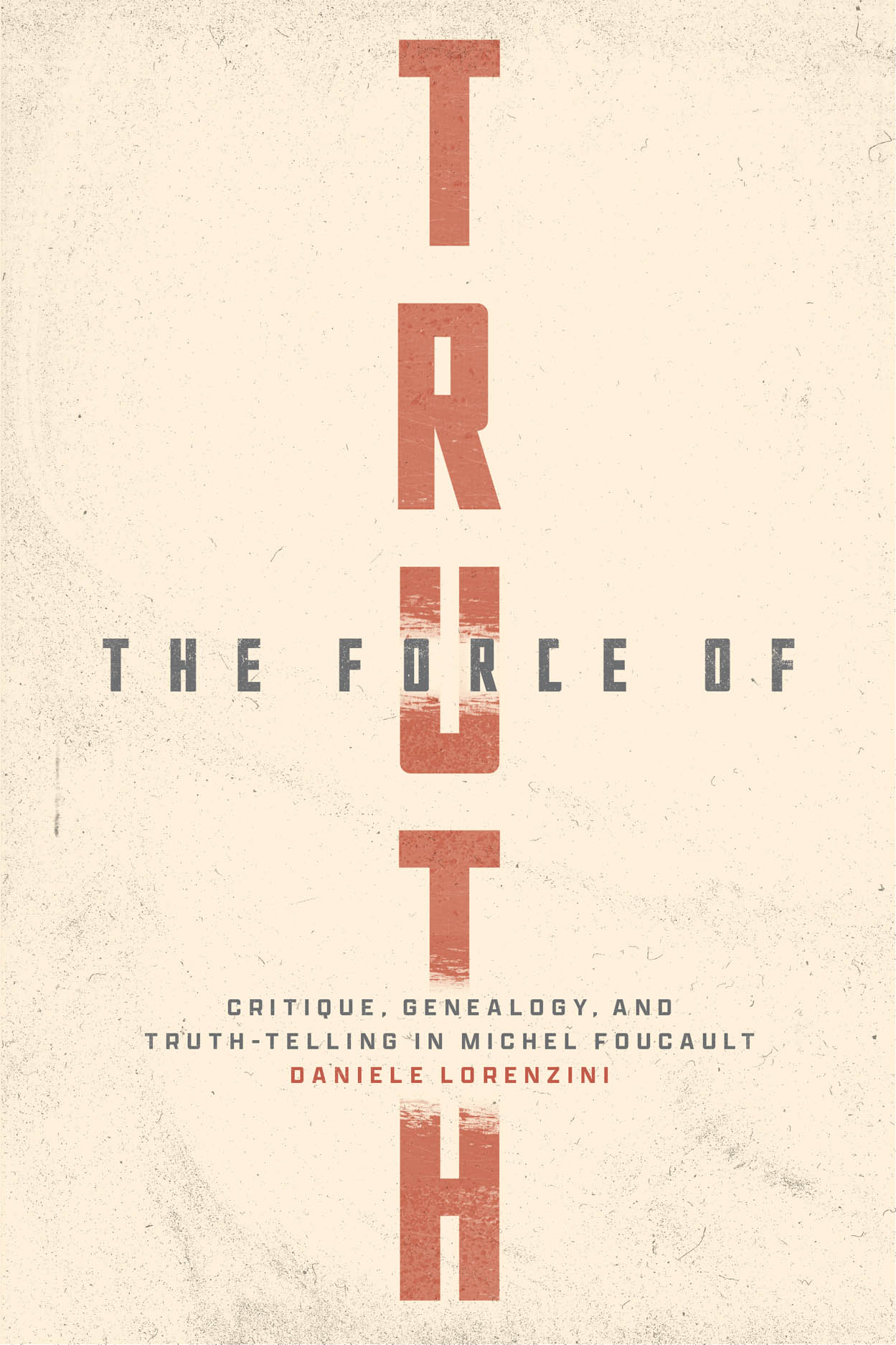
Daniele Lorenzini, The Force of Truth. Critique, Genealogy, and Truth-Telling in Michel Foucault, Chicago University Press, 2023

A groundbreaking examination of Michel Foucault’s history of truth.

Many blame Michel Foucault for our post-truth and conspiracy-laden society. In this provocative work, Daniele Lorenzini argues that such criticism fundamentally misunderstands the philosopher’s project. Foucault did not question truth itself but what Lorenzini calls “the force of truth,” or how some truth claims are given the power to govern our conduct while others are not. This interest, Lorenzini shows, drove Foucault to articulate a new ethics and politics of truth-telling precisely in order to evade the threat of relativism. The Force of Truth explores this neglected dimension of Foucault’s project by putting his writings on regimes of truth and parrhesia in conversation with early analytic philosophy and by drawing out the “possibilizing” elements of Foucault’s genealogies that remain vital for practicing critique today.

Table of Contents

Introduction: Writing the History of Truth
A History of Truth That Does Not Rely on “the Truth”
Toward an Ethics and Politics of Truth-Telling
The Force of Words and the Force of Truth

1. Truth-Event
“A Little History of Truth in General”
The Emergence of the Alethurgic Subject
Confessional Sciences

2. Regimes of Truth
Truth Obligations?
Games and Regimes of Truth
A Critical (An)archaeology
Language Games and Games of Truth
The Value of Truth
Regimes of Truth and Spirituality

3. Truth as Force
Cavell, Austin, and the Perlocutionary
Parrhesia as Speech Act
Unpredictability, Freedom, and Criticism
Risk and Courage
Transparency, or Parrhesia and Rhetoric

4. Dramatics of Truth
Alethurgy
Sincerity, Authenticity, Confession
Putting the Truth to the Test of Life

5. Critique and Possibilizing Genealogy
Beyond the Vindicatory-Subversive Dichotomy
Foucault, Habermas, and the Question of Normativity
The Genealogy of Critique
Genealogy and We-Making

Conclusion: Rethinking Critique

Scientia Sexualis and Historiography of Sexuality

Transversal: International Journal for the Historiography of Science will receive proposals for articles that seek to reflect on Scientia Sexualis for the issue of June 2024.

Sexual science began at the end of the 19th century with the ambitious undertaking of physicians such as Richard von Krafft-Ebing, Havelock Ellis and Magnus Hirschfeld, who set out to analyse the laws of the nature of sex. Based on the prestige of biological science, the thinking of these scientists is founded on the idea that there is a “sexual instinct” that influences the diversity of individual experiences. According to this rationality, this complex “sexual instinct” is considered a natural process, the understanding of which will provide a more enlightened view of the main challenges faced in the contemporary world. Relying on biological and psychological factors, sexologists have created a vast taxonomy of sexual behaviours and practices, emphasising their deviations, perversions and pathologies. Their theses proved influential not only in the medical field but also in the legal world. In the wake of these works, but also as opposition to them, Sigmund Freud contributed to a broadening of the understanding of sexuality as a founding element of human subjectivity while at the same time revolutionising the techniques for treating diseases linked to “sexual pathologies”. In Freud, Scientia Sexualis is investigated within medical but also philosophical rationality.

After these famous works of sexology and psychoanalysis, sexuality was consolidated as a distinctive field of knowledge. Over the twentieth century, this new science ceased to be the exclusive object of medical rationality and became attractive to numerous fields of knowledge. The anthropological studies of Margaret Mead, the theories of gender and sexuality of Robert Stoller and John Money, the quantitative work of Alfred Kinsey and Shere Hite, and more recently, the radical critique of feminist epistemology on sex and gender, among many other references, show that sexuality is at the heart of academic research in the most diverse, contested and acclaimed approaches.

Until the 1970s, historiographical production on sexuality was timid, but from 1980 onwards, the increase in production was vertiginous. Michel Foucault’s thesis in The History of Sexuality contributed significantly to the awakening of historians’ interests. According to the French philosopher, sexuality is a device, a mechanism of regulation and governance of bodies, which operates in contemporary disciplinary society. The change in the key to understanding proposed by Foucault draws the attention of historians who begin to take an interest in the dynamics of force and power that constitute this device. In parallel to Foucault’s thesis, there are also several factors contributing to the growing interest in Scientia Sexualis: the rise of sexuality studies after the HIV epidemic, the spread of feminist studies, the development of gay and lesbian studies and gender studies, and not least the strength of social movements for sexual minority rights. All this has contributed to the fact that the history of sexuality has now reached the mainstream of contemporary historiography.

Our particular interest in this issue is not only to emphasise the historical aspects of the formation of Scientia Sexualis, its construction and deconstructions, contributions and criticisms, which have marked the history of this science from its birth in the 19th century to the present day but also reassess its historiography.

We welcome submissions that explore the following thematic axes:

  • History of sexual science in its various areas of knowledge and its social and epistemological aspects;
  • History of the historiography of sexuality;
  • Empirical research that contributes to the analysis of sexual science and its impact on society;
  • The relationship between the history of sexual science and the history of techniques for transforming the body, sex and gender, as well as techniques and technologies for human reproduction and contraception;
  • Intersection of sexual science to the history of moralities.

 Submission details:

Submissions must be received by February 10, 2024, via the journal webpage www.historiographyofscience.org so they can be considered for the June 2024 issue.

Submissions must be prepared for double-anonymised review. Notification of acceptance will be sent on April 10, 2024.

For any further information concerning this Call for Papers, please contact:

Marina S. Duarte – Federal University of Minas Gerais – UFMG

E-mail: marinaduarte@ufmg.br


For any further information concerning this Journal, please contact:

Mauro L. Condé – Universidade Federal de Minas Gerais – UFMG

E-mail: mauroconde@ufmg.br

Marlon J. Salomon – Universidade Federal de Goiás – UFG

E-mail: marlonsalomon@ufg.br

Rob Horning, From work to text, and back again: ChatGPT and the (new) death of the author, Overland, 23 February 2023

When he declared the death of the author, in 1968, Roland Barthes was attacking the idea that our understanding of any particular text should be conditioned or constrained by the person who happened to write it or what they intended. A year later, Michel Foucault posed the question ‘What is an author?’ and concluded that it is not a person but rather a ‘function of discourse,’ a posited ‘principle of unity’ that forcibly harmonises and conceals the different voices speaking in a text.
[…]

So perhaps we should be celebrating the development of large language models like ChatGPT, which seem to poised to make once radical-seeming post-structuralist speculation and make it appear as everyday common sense. Authors? Of course they’re dead, and lie on the scrapheap with switchboard operators and typesetters.
[…]

Generative models extinguish the dream that Barthes’s essay articulates by fulfilling it. Their ‘tissue of signs’ seems less like revolution and more like the fear that AI will create a recursive postmodern nightmare world of perpetual sameness that we will all accept because we no longer remember otherwise or how to create an alternative.
[…]

Clegg, Stewart, and Johan Ninan. “Foucault’s governmentality and the issue of project collaboration”. In Research Handbook on Complex Project Organizing, Edited by Graham Winch, Maude Brunet and Dongping Cao (Cheltenham, UK: Edward Elgar Publishing, 2023)
https://doi.org/10.4337/9781800880283.00020

Abstract
The concept of governmentality has proven useful to analyse how the reflexive management of people within and without the project is conducted. In this chapter we explore the organizational theory of governmentality and its importance in project settings. First, we identify the specificity of project governance and relate it to the definition and discussion of governmentality by Michel Foucault. Following this, the use of governmentality within projects through project culture is discussed. Subsequently, the use of governmentality outside projects through social media is discussed. Finally, the chapter concludes by highlighting new directions for research with governmentality as the focal point, discussing the types of research questions that a concern with projects and governmentality raises and how addressing these might further develop project management as a field of enquiry.

Sinn, M.-C.
Theorizing on Engaging in Identity Work from Spiritual Formation to Vocation Discernment: Narratives of a Hong Kong Chinese (Prospective) Seminarian
(2023) International Journal of Religion and Spirituality in Society, 13 (2), pp. 159-187.

DOI: 10.18848/2154-8633/CGP/v13i02/159-187

Abstract
While research efforts have been devoted largely to priestly identity in the priesthood, it is surprising that there is little academic scholarship on identity research prior to entering the seminary as a stage of vocation discernment to priesthood. This article attempts to bridge the research gap by investigating the ongoing process of engaging in identity work of a prospective seminarian through life history research. Adopting a narrative research paradigm and drawing on the sociological lens of Foucault’s four axes of ethics, this article theorizes the experience from spiritual formation to vocation discernment of Lee, a Hong Kong Chinese Catholic, to engage in identity work. Adapting Clarke’s diagram for doing teacher identity work, the researcher expands the model across professions from (prospective) teachers to (prospective) seminarians to expound on the reflexive process of accepting, resisting, and being in-between in Lee’s narratives of religious calling. This article postulates that ongoing discursive identities of (prospective) seminarians are contingent on an iterative process of constructing, deconstructing, and reconstructing a myriad of capacities to harbor hope for being more accommodating and understanding. The researcher also considers that engaging in identity work is crucial for (prospective) seminarians to maximize their continuous potential for spiritual and priestly formation. As religion and spirituality are key facets of understanding social life, this article contributes to research studies in seminary education by drawing on interpretive sociological methods as an alternative research paradigm. © 2023 Common Ground Research Networks. All rights reserved.

Author Keywords
Axes of Ethics; Faith-Based Research; Foucault; Hong Kong Chinese; Life History Research; Seminarian; Sociology of Religion; Spiritual Formation; Vocation Discernment

Anfinson, K.
Capture or Empowerment: Governing Citizens and the Environment in the European Renewable Energy Transition
(2023) American Political Science Review, 117 (3), pp. 927-939.

DOI: 10.1017/S0003055422001034

Abstract
The European renewable energy transition is a leading model for responding to the urgent threat of climate change, which it does by empowering citizens. Drawing on Foucault’s analysis of German neoliberalism, this article argues that despite some measure of empowerment, the economic constraints structuring the transition ultimately disempower citizens, undermining the attainment of environmental goals. Specifically, the transition gives citizens control of their energy while burdening them with entrepreneurial tasks to do so, substitutes economic activity for political citizenship, and shifts the epistemological terrain they take for granted when determining what environmental crises society faces and how best to respond. Understanding the transition as composed of theories for sustainability governance, policies, and practices of implementation, this article analyzes the energetic society governance theory, the Clean Energy for all Europeans Package, and the renewable energy organization REScoop.eu. © The Author(s), 2022.

Asad L. Asad, Engage and Evade: How Latino Immigrant Families Manage Surveillance in Everyday Life, Princeton University Press, 2023.

Some eleven million undocumented immigrants reside in the United States, carving out lives amid a growing web of surveillance that threatens their and their families’ societal presence. Engage and Evade examines how undocumented immigrants navigate complex dynamics of surveillance and punishment, providing an extraordinary portrait of fear and hope on the margins.

Asad L. Asad brings together a wealth of research, from intimate interviews and detailed surveys with Latino immigrants and their families to up-close observations of immigration officials, to offer a rare perspective on the surveillance that undocumented immigrants encounter daily. He describes how and why these immigrants engage with various institutions—for example, by registering with the IRS or enrolling their kids in public health insurance programs—that the government can use to monitor them. This institutional surveillance feels both necessary and coercive, with undocumented immigrants worrying that evasion will give the government cause to deport them. Even so, they hope their record of engagement will one day help them prove to immigration officials that they deserve societal membership. Asad uncovers how these efforts do not always meet immigration officials’ high expectations, and how surveillance is as much about the threat of exclusion as the promise of inclusion.

Calling attention to the fraught lives of undocumented immigrants and their families, this superbly written and compassionately argued book proposes wide-ranging, actionable reforms to achieve societal inclusion for all.

See also The everyday surveillance of undocumented immigrants By Asad L. Asad, July 26, 2023

Attention to the everyday forms of surveillance that undocumented immigrants manage takes seriously Michel Foucault’s idea that surveillance entails elements of both risk and reward. The laws, regulations, and policies that circumscribe undocumented life are not only normalized but also undeniably injurious, as sociologists Leisy Abrego and Cecilia Menjívar show.