
Foucault News

News and resources on French thinker Michel Foucault (1926-1984)

Theoria: A Journal of Social and Political Theory Special Issue on ‘Freedom and Power’ Call for Papers

Ever since Livy proclaimed that ‘freedom is to be in one’s own power’, if not from a long time before, the relationship between freedom and power has been an enduring concern of political theorists. It has withstood even Berlin’s sharp distinctions between seemingly irreconcilable kinds of freedom and the subsequent diversion via debates about ‘negative, ‘positive’ and ‘republican’ freedom. With greater historical purview it is possible to see that the fault line between various competing conceptions of freedom is clearest with regard to how social and political theorists conceive of the relationship between freedom and power. While some thinkers have opposed freedom and power, arguing that liberty can only be truly attained free from power and domination (republicans) or in the absence of external impediments imposed by other human beings (liberals), others have identified a close and intriguing link between them, especially in the sphere of politics. A motley crew of radicals, Marxists and conservatives occupy the latter camp, including Livy, Machiavelli, Montaigne, Marx, Nietzsche and Foucault. Moreover, those in the former camp tend to think of freedom in formal and abstract terms, while proponents of the latter eschew this now normal tendency in political philosophy and instead think of freedom in fully substantive, concrete and even materialist terms. (Hobbes is an unusual and unique figure as his account of freedom inspires members of both parties in this debate.)
Several important questions arise concerning freedom and power:-

• What is freedom?
• What is the relationship between freedom and power?
• How, if at all, are freedom and domination related?
• Is there a categorical or insurmountable conflict between freedom and discipline?
• Does freedom depend upon being free from interference or being able to achieve certain desired or desirable goals or ends?
• Are these two conditions – freedom from interference and the ability or power to achieve certain ends – related in some sense?
• Can we measure freedom, and, if so, how?
• What forms or degrees of freedom are possible in modern representative democracies?
• How does representation affect freedom?
• Is our freedom dependent on the power of our representatives?
• How does the degradation of the planetary environment affect our views on freedom?
• Given the dire need for self-control and self-discipline, especially regarding levels of consumption in the developed North, is the concept of freedom even still relevant?
• Does the concept of freedom need to be reconfigured to accommodate constraint, austerity and self-control? If so, how?
• What do the experiences of relatively recently liberated states teach us about freedom?
• What is the relationship between freedom and power in the ‘Global South’?
• How, if at all, does poverty affect freedom?

The editors of Theoria ask contributors to think about these questions in and of themselves and in the light of the various arguments from any of the proponents of the various conceptions of freedom. These can be written about in term of furthering our understanding of the nature of personal and political freedom within modern representative democracies or in order to develop novel arguments that propose conceptions of freedom for different possible future political organizations and forms of power. While abstract theoretical insights and arguments are welcome, we urge contributors to try and think about freedom and power within and between particular political contexts, especially within the ‘Global South’, where often freedom is a nascent and precarious achievement, and sometimes only for the lucky few, and between the ‘Global South’ and the ‘Global North’, either in relational or comparative terms. Given the changing power relations that exist within and between existing states, there is also much room for utopian thought regarding new forms of freedom in as yet un-experienced contexts of political power and moral conflict.

Submissions must be sent in MSWord format to the
Managing Editor, Ms Sherran Clarence (sherranclarence@gmail.com) on or before the 31st of August 2011.

International Conference on Autobiography “Technologies of the Self: New Departures in Self-Inscription”

University College Cork,
2-3 September 2011

Confirmed Key-Note Speaker: Professor Patricia Clough (CUNY)

There are contesting versions of autobiography. We’ve travelled far since Georges Gusdorf traced the origins of autobiography back to the origins of language itself, saying “the very first man who set out to speak and write his name inaugurated a new mode of human presence in the world. Beginning with the very first one, any inscription is an inscription of the self.” Philippe Lejeune was more circumspect in placing Rousseau in the vanguard of self-representational writing, and reading the Confessions as marking the emergence of specifically modern concept of selfhood in the Enlightenment period. But in the same year as the publication of Lejeune’s Le Pacte Autobiographique (1975), Roland Barthes published Roland Barthes par Roland Barthes which signaled the end of the classical Enlightenment subject of autobiography, and the beginning of a radical autobiographical practice. Michel Foucault’s work on self-surveillance within structures of coercion opened up further vistas.

The last ten years have introduced a further element to this debate: in an era in which self-expression has undergone an exponential growth fuelled by technological innovation, most importantly, perhaps, the creation of an internet that hosts an ever-increasing number of blogs, tweets, personal webpages and other forms of audiovisual self-expression such as YouTube, it seems timely to think again about the phenomenon of writing, filming, recording and, indeed, publishing or publicizing the self: what innovations in self inscription have recent decades witnessed, what continuities and discontinuities can be traced, what changes in attitudes to the self and to self-revelation or exposure have been witnessed, how have developments in the channels of broadcasting altered how, what and why we engage in various, if always elusive acts of self-expression, are there now new practitioners of self-inscription because of these changes, and, finally, with so many outlets and such a market for narratives of self, how is such material consumed?

Foucault Inspires Trio

From Hartford Courant August 2025. Direct link no longer available

A venerable venue with a varied musical menu, Real Art Ways serves the highly original, sizzling, simpatico music by the trio Parrhesia on June 11 at 8 p.m. at the contemporary arts center, 56 Arbor St., Hartford, USA

Inspired by the French philosopher, social theorist and historian of ideas Michel Foucault, especially his reflections on the necessity for truth-telling, freedom and frankness in discourse, the empathetic trio members are Stephen Haynes, trumpet, cornet and flugelhorn; Joe Morris, electric guitar, and Warren Smith, drums, percussion, marimba and voice.

Released in 2010, Parrhesia’s self-titled album has been praised for the instrumental textures that emerge from the musical discourse among the three intensely interacting musicians. In their frank manner of speaking among themselves musically, the three freedom-loving musicians weave unique textures with their individualistic approach to their instruments, improvising true discourse without false discord.

MANCHESTER Workshops in Political Theory 2011
31 August – 2 September 2011

Call for Papers – Ontology and Politics Workshop

Convenors: Paul Rekret (Queen Mary), Simon Choat (Kingston), Clayton Chin (Queen Mary)

Description
Despite its pervasiveness, the question of the relation between ontology and politics continues to be a crucial one for Continental philosophy. While the place and status of the question of being in the realm of the political has occupied much of social theory in the past twenty or thirty years, we remain no closer to drawing any common ground on these themes. Post-structuralist or post-foundational political thought has insisted on the inherent contingency of any political ontology and has, from this notion, sought to draw out a framework for an emancipatory politics grounded in the concepts of difference and otherness.

However, such a stance finds itself increasingly challenged today. On the one hand, thinkers such as Alain Badiou and Jacques Ranciere call for the need to think a politics grounded in a conception of universality rather than alterity, while on the other hand, so-called speculative realism more fundamentally challenges the very notion of ontology as it has been conceived by the majority of Continental thinkers in recent decades.

This panel aims to explore the intersections of politics and ontology and the resulting implications for thinking both the political and the philosophical.

We invite papers addressing the following and any other related themes:

-Is there a place for reflection on ontology in the theorisation and study of politics?

-Is there a necessary transitivity between the ontological and the political? How should this relation be conceived?

-Is there a necessarily leftist or emancipatory ontology?

-Should the politics which has generally been thought to follow from post-foundational or post-structuralist ontologies be re-evaluated in light of recent critiques?

-Does a new and different relation between ontology and politics follow from recent speculative materialist ontologies?

If you would like to present a paper at this workshop, please submit an abstract of 300-500 words (or a full paper to p.rekret@qmul.ac.uk or S.Choat@kingston.ac.uk by 15 June 2011.

Call for papers for a special issue “Mise-en-Scene: Crime”

Concentric: Literary and Cultural Studies
Vol. 38 No. 1 (March 2012)

Submissions due August 15, 2011

********
In the beginning was murder. Then came drama: the hair-tearing (or eye-gouging) discovery of one’s own overweening hubris, the inconsolable grieving over the loss of the most basic sense of humanity, and, simply, more killing. Indeed, murderers are significant figures in what Erich Auerbach would call “scenes of drama from European literature”: Cain, Oedipus, Medea, the parricides in Dante’s inferno, and Shakespeare’s army of villains. Acts of killing in these literary texts not only contribute to the excitement of the drama, but also make imperative a rethinking of social order, justice, morality, state power, and human-God relations.

Philosophers have also long relied on scenes of crime to ground their reflections on humanity. René Girard believes that sacrifice was needed for the release of pent-up social violence. Georges Bataille sees community as “founded in the act of killing, in the rupturing of separate existence” (Fred Botting & Scott Wilson). Hegel, Jacques Lacan, and Judith Butler ponder the limit of norms and the viability of ethical claims through the figure of Antigone. Giorgio Agamben posits the figure of the homo sacer (he “who may be killed and yet not sacrificed”) to illustrate the threshold being qua bare life; Agamben even goes so far as to read the concentration camp, an extreme instance of political crime, as the paradigm of modern biopolitics. And for Michel Foucault, the Panopticon prison system symbolizes a new dimension in the modern modality of power, whereas the mass murder committed by the young peasant Pierre Rivière in 1835 helps to elucidate the way in which various modern discursive fields such as the medical, juridical, and historiographical intersected with and confronted one another.

Crime scenes continue to figure prominently in our time, oftentimes in a larger-than-life fashion. The Guantanamo Bay detention and torture of war prisoners exemplifies a sovereignty unbound by law, making one wonder if, in the wake of the 9/11 incident, we must always think of crime in the context of globalization and vice versa. In pop culture, cannibalistic serial killers are ranked among the most fascinating, if not also the smartest, filmic characters. Prime-time crime scene investigation drama series are introducing a new truth regime grounded in forensic science and criminal psychology, to the effect of drastically changing the way we think about human conduct and causality. And the virtual world of online games is to a great extent built on the participant’s imaginary enactment of the role of the criminal and/or crime buster.

For this special issue of Concentric, we invite submissions that investigate the “crime scene” in theoretical discourses. For instance, how are the following issues dealt with in different theorists, by way of the figure of crime—limit, transgression, power, knowledge, life, and ethics? On the stage of today’s worldwide power struggle, is “crime” being redefined thanks to the rise of an inescapably interconnected globe?

We also welcome works that research the genres of crime fiction, crime film, and crime drama in a refreshing light. For example, is the bespectacled detective giving way to the white-robed forensic scientist as the new hero of the social order? Can we read the boom in stories of crime scene investigation and criminal profiling as an indicator of a rational turn in our time? Why is the corpse of the victim increasingly being presented as a familiar, approachable object in these TV and filmic dramas? What kind of repetition compulsion may be at play in the reception of these genres?

Any discussions of the “scene of the crime” in relation to literary, dramatic or cinematic works—including their characters, plots, images, symbols, and ideas—will also be welcome.

********
Concentric: Literary and Cultural Studies is a peer-reviewed journal published biannually by the Department of English, National Taiwan Normal University, Taipei, Taiwan. The journal is devoted to offering innovative perspectives on literary and cultural issues and advancing the transcultural exchange of ideas. While committed to bringing Asian-based scholarship to the world academic community, Concentric welcomes original contributions from diverse national and cultural backgrounds.

Concentric engages in intellectual discussion by mounting themed issues. Each issue is also open for papers on general topics. The focus can be on any historical period and any region. Any critical method may be employed as long as the paper demonstrates a distinctive contribution to scholarship in the field.

Concentric boasts a strong editorial and advisory team composed of respected scholars from across the world. The journal has also collaborated with distinguished international scholars as guest editors, such as Wlad Godzich, María Herrera-Sobek, Shirley Geok-lin Lim, Charles Shepherdson, Scott Slovic, and Ban Wang. Past and future contributors include Ronald Lynn Bogue, Vilashini Cooppan, Sneja Gunew, Carl Gutiérrez-Jones, Haiyan Lee, Leo Lefebure, Deborah L. Madsen, Steven Shaviro, Hugh J. Silverman, Frank Webster, Rob Wilson, Gang Gary Xu, and Yingjin Zhang.

********
Manuscript Submission Guidelines

1. Manuscripts should be submitted in English. Please send the manuscript, an abstract of no more than 250 words with 5-8 keywords, and a brief curriculum vitae as Word attachments to . Please also attach a cover letter stating that the manuscript is not currently being considered for publication elsewhere. Concentric will acknowledge receipt of the submission but will not return it after review.

2. Submissions made to the journal should generally be at least 6,000 words but should not exceed 10,000 words, notes included; the bibliography is not counted. Manuscripts should be prepared according to the latest edition of the MLA Handbook for Writers of Research Papers. Except for footnotes, which should be single-spaced, manuscripts must be double-spaced throughout and typeset in 12-point Times New Roman.

3. To facilitate the journal’s anonymous refereeing process, there must be no indication of personal identity or institutional affiliation in the manuscript proper. The author may cite his/her previous works, but only in the third person.

4. If the paper has been published or submitted elsewhere in a language other than English, please also submit a copy of the non-English version. Concentric may not consider submissions already available in other languages.

5. If the author wishes to include copyrighted images in the essay, the author is solely responsible for obtaining permission for the images.

6. Two copies of the journal and a PDF version of the published essay will be provided to the author(s) upon publication. (Authors who submitted their papers in response to the earlier call for papers of issue 38.1 may opt for the previous offer of one copy of the journal and fifteen off-prints of their essay.)

7. It is the journal’s policy to require all authors to sign an assignment of copyright.
Editor, Concentric: Literary and Cultural Studies
Department of English
National Taiwan Normal University
162 Heping East Road, Section 1
Taipei 106
Taiwan
Email: concentric.lit@deps.ntnu.edu.tw

David Galston, Archives and the Event of God: The Impact of Michel Foucault on Philosophical Theology (Ithaca: McGill-Queen’s Univ. Press, 2011).

Review

Description
The philosophical works of Michel Foucault have profoundly influenced many disciplines, but his influence on theology has seldom been considered. Archives and the Event of God unravels the effects that Foucault’s Archaeology of Knowledge and Discipline and Punish have had on the study of theology and religion. Beginning with a study of the concept of archaeology, the meaning of the statement, and the understanding of an epistemic event, David Galston provides a novel synthesis of Foucault’s work on genealogy and the ways in which the statement can be united with power and productivity in the archive. Arguing that archaeology and genealogy give rise to two new theologies, Galston develops concepts that enable us to critique theology, religion, and God as archive events that can be accounted for in the operations of power and resolution to statements. A unique and new agenda in the philosophy of religion, Archives and the Event of God is an insightful and sophisticated study that outlines novel ways to think of religion in the postmodern era.

About the Author
David Galston is the co-founder and past-president of The SnowStar Institute of Religion and is currently its academic adviser and an editor of its magazine, AXIAL. He has a PhD from McGill University, where he was formerly university chaplain.

First two-day workshop of the CIBB Project (‘Contemporary Issues in Bioethics and Biopolitics’)

‘The Normal and the Pathological’

27th and 28th September 2011
MS.05 (second floor) Zeeman Building, The University of Warwick.

Please note that all the papers will be delivered in English.

All welcome. Free registration at normalpathological@gmail.com

Confirmed speakers: Jean-Claude Dumoncel, Robert Bernasconi, Bill Fulford, Frederic Worms, Julien Pieron, Florence Caeymaex, Guillaume Leblanc, John Protevi, Charles T.Wolfe and Giuseppe Bianco

From a philosophical perspective, the problem of illness can be seen to emerge from the tension between the subjective (a life which is mine) and objective dimensions of life. On the one hand, illness is irreducible to an objective fact, as if independent of the subjectivity which it affects; on the other hand, it is irreducible to a mere signification, and cannot be understood independently of its inscription within a living organism, its relation to an environment, and even the effort, on the part of other living beings, to know and treat it. Illness is a qualitative and individual experience that takes place within human life itself. Once we recognise the specificity of illness in those terms, can we not arrive at an understanding of life, and the normal, on the basis of the pathological, and not as what is simply threatened and, ultimately, annihilated by it? Similarly, should medicine not recognize in care (and its latin etymology cura) the ethical implications of the internal tension of life and not isolate the pathology from the subjectivity in which it is rooted?

Far from being of interest only to biology and medicine, the question of the normal and the pathological implicates our perception of life as a whole, in all its forms. Pathology is at the source of all questioning concerned with life. It’s only on the basis of suffering and distress, which are the signs of illness, that every question regarding life, or what living human beings consider normal at a given stage of their history, and the conditions under which such a state can be maintained, becomes possible. “Health is life in the silence of the organs,” wrote Leriche. This means that all discourse of life on life spring from that obscure moment when, confronted with an obstacle, life “speaks” or seeks to speak. To the extent that our purpose is to ask about life, we need to begin by asking about life’s relation to the pathological, and the epistemological, ethical and political implications of such a relation.

After the classical contributions of Canguilhem and Foucault, we are convinced that it is possible, and indeed necessary, to extend and adapt the reflection of the philosophy of pathology in the light of the new challenges emerging from the evolution of society and the life sciences. In the era of bio-power, the norms have become independent of the normative power of the human being, determining its comportments and excluding those considered pathological. To what extent is it possible to emphasise and promote the normative activity of human life in the face of a system that declares in advance, and down to the most minute details, what is normal? What paradigm of normality and health can we develop as an alternative to auto-immunisation, this disease caused by the excess of concern for health? What critical space is left, or can be generated, in an epoch in which the life sciences make it possible for the human being to intervene on itself, on other living beings, and determine their identity? Is it still possible to develop a normative critique that would not be rooted in the naturalistic paradigm?

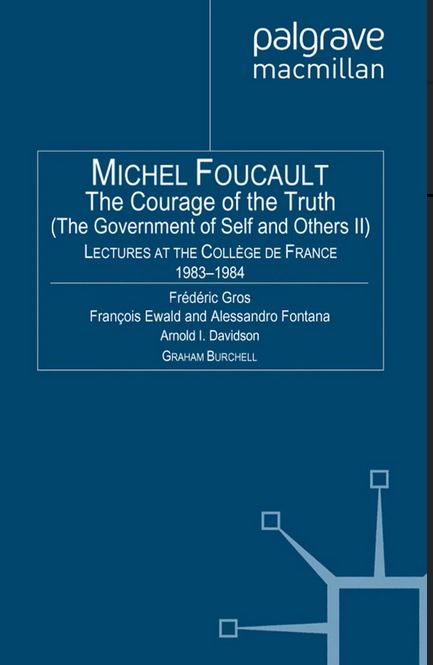
Michel Foucault The Courage of Truth, Series: Michel Foucault: Lectures at the Collège de France, Palgrave Macmillan, 2011

The course given by Michel Foucault from February to March 1984, under the title The Courage of Truth, was his last at the Collège de France. His death shortly after, on June 25th, tempts us to detect a philosophical testament in these lectures, especially in view of the prominence they give to the theme of death, notably through a reinterpretation of Socrates’ last words–’Crito, we owe a cock to Asclepius’– which, with Georges Dumézil, Foucault understands as the expression of a profound gratitude towards philosophy for its cure of the only serious illness: that of false opinions and prejudices. These lectures continue and radicalize the analyses of those of the previous year. Foucault’s 1983 lectures investigated the function of ‘truth telling’ in politics in order to establish courage and conviction as ethical conditions for democracy irreducible to the formal rules of consensus. With the Cynics, this manifestation of the truth no longer appears simply as a risky speaking out, but in the very substance of existence. In fact, Foucault offers an incisive study of ancient Cynicism as practical philosophy, athleticism of the truth, public provocation, and ascetic sovereignty. The scandal of the true life is constructed in opposition to Platonism and its world of transcendent intelligible Forms.

‘There is no establishment of the truth without an essential position of otherness. The truth is never the same. There can be truth only in the form of the other world and the other life.’

Géraldine Brausch, «Un détour par les stratèges de Jullien pour relire les analyses stratégiques de Foucault», Dissensus, N° 4 (avril 2011)

Table des matières
I. Nécessité d’une hétérotopie
II. Contre le modèle du droit, le modèle stratégique
III. La logique disciplinaire ou l’art de faire table rase du réel pour mieux le (re)créer. Retour sur la matrice militaire
IV. Une stratégie sans général, certes, mais pas sans modèle
V. Grippage, ratage, friction : la logique disciplinaire à l’épreuve de l’analyse stratégique
VI. Le dispositif de sécurité : gouverner non pas le réel mais « à partir du réel »57. Vers l’« efficience » chinoise
VII. Conclusion

Michael Power, Foucault and Sociology, Annual Review of Sociology, Volume 37 July 07, 2011
https://doi.org/10.1146/annurev-soc-081309-150133

ABSTRACT
Michel Foucault was a gifted but elusive thinker with a wide and continuing impact across many academic fields. This article positions his work as a historical sociology of knowledge and evaluates its contribution. After reviewing Foucault’s central preoccupations as they emerge in his major works, the argument briefly considers their influence on accounting scholarship as an informative exemplar of a wider Foucault effect. Four key areas for the sociological reception of Foucault are then considered: the nature of discourse and archaeology, his historical method, the problem of agency and action, and his conception of power. Articulating Foucault’s relationship to sociology is inherently problematic, not least because he takes the emergence of the sciences of man as something to be explained rather than augmented. Yet his work remains a rich resource for inquiries of the sociological type, is broadly aligned with a practice turn in social theory, and intersects with several themes in both mainstream and critical sociology.

Michael Power
Department of Accounting, London School of Economics and Political Science, London, WC2A2AE, United Kingdom; email: m.k.power@lse.ac.uk