
Foucault News

News and resources on French thinker Michel Foucault (1926-1984)

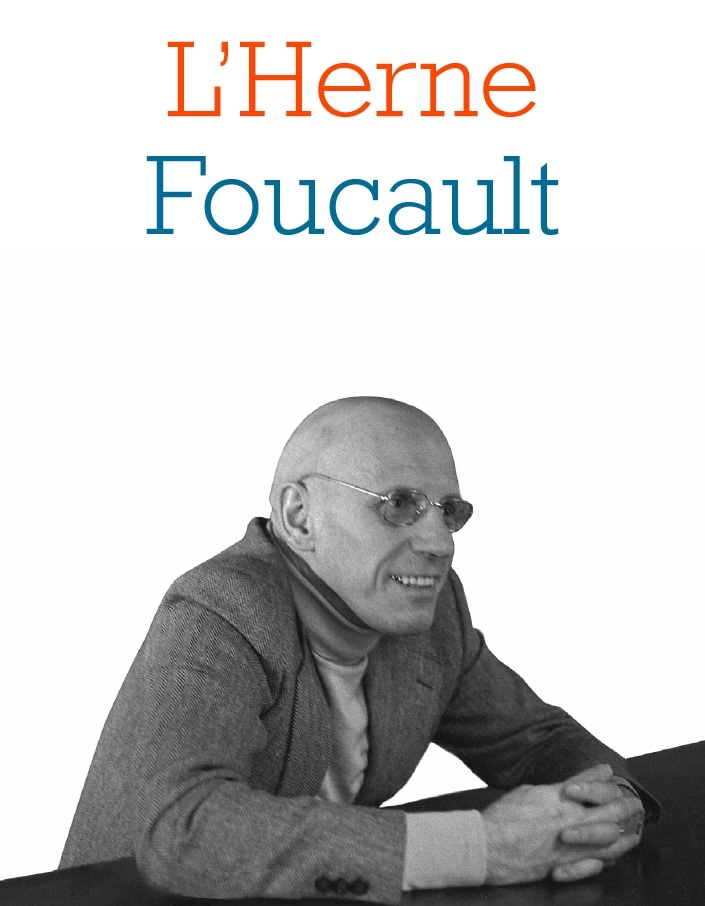
Philippe Artières, Jean-François Bert, Frédéric Gros et Judith Revel, Cahier Foucault, Cahiers de L’Herne, 2011

« Escrimeur plus que sabreur, Foucault est resté un dissident politique, toujours à la riposte plus qu’à la parade, sans jamais laisser s’automatiser ses esquives ou ses bottes ni prêter à imitation facile. »

Toute la variété de l’oeuvre de Michel Foucault est prise en considération dans l’éventail des contributions.

Les ouvrages de Foucault ont tous été ressentis comme des provocations : Histoire de la folie a heurté la bonne conscience des psychiatres, Les mots et les choses ont soulevé la grande polémique du structuralisme au milieu des années 1960, Surveiller et punir a scandalisé les milieux professionnels de la justice, et son Histoire de la sexualité enfin (tomes II et III) a surpris au contraire par son recentrement éthique. Les livres de Foucault ont été en tout relativement rares, mais chacun a représenté un événement théorique et politique. Très tôt la pensée de Foucault a compté en-dehors des cercles académiques, en France et ailleurs : elle a nourri de nombreuses luttes, et est rapidement devenue une référence dans toute l’Europe, mais aussi en Amérique et en Asie. Enfin les interventions esthétiques, politiques, éthiques, philosophiques de Foucault l’ont rendu indispensable dans tous les domaines de la pensée et de la création, sans spécialisation.

Ce Cahier de l’Herne dynamique, transdisciplinaire et créatif recueille des entretiens : ceux d’amis, de proches, qui dressent un portrait plus intime, offrant un visage différent de l’auteur ; des textes inédits de Foucault, sur l’art, la folie, Nietzsche, etc. ; des témoignages qui révèlent l’atmosphère intellectuelle de l’époque et la place controversée mais néanmoins centrale qu’y occupa Foucault.

Une iconographie inédite et abondante vient enrichir ce Cahier.

From Stuart Elden’s blog Progressive Geographies

Prevent and Tame. Protest under (Self)Control

This is available as an ebook
PDF here

The common dualistic approach to social movements tends to see power and resistance as separate and independent antagonists. RLF Manuskripte, Volume 88

The contributors to this book aim to transcend that approach, arguing that to adequately analyze ongoing struggles, it is also critically important to trace the constitutive interconnectedness between social movements and power. This is the aim of the title “Prevent and Tame”: emergent strategies to prevent and tame protest—whether they are undertaken by the state or by factions within the movements themselves—have given rise to new kinds of social relations and regulations that call for a new approach to research on social movements and protest.

Inspired by Foucault and others, this book offers theoretical and empirical investigation into the implications that governmentality studies and subjectivation perspectives may have for a deeper understanding of the dynamics in the relationship between power and movements. The articles reflect on the effects of current neo-liberal or neo-social transformations on social movement practice, including the impact of surveillance, the criminalization and stigmatization of protest, and how these can lead movements to engage in self-taming behavior amongst themselves.

Taken as a whole, this book suggests that to take the struggles of social movements seriously, requires to acknowledge the complexity of the power dynamics in which they are involved. In so doing, the authors’ aim is not to tame protest by over-amplifying its apparent obstacles, but to prevent its energy from being pointlessly wasted or misdirected (i.e. by being spent in the wrong places, in false conflicts, or even in fighting the clouds they cast themselves).

Includes contributions by Stephen Gill, Peter Ullrich, Florian Heßdörfer, Andrej Holm, Anne Roth, Marco Tullney, Michael Shane Boyle, Darcy K. Leach, Sebastian Haunss and Nick Montgomery.

MATERIALI FOUCAULTIANI – CALL FOR PAPERS

italiano
Abbiamo il piacere di annunciare il secondo call for papers per la rivista online « mf / materiali foucaultiani » :
Razze e razzismi: approcci foucaultiani
La rivista online mf/materiali foucaultiani intende dedicare il suo secondo numero all’articolazione di razza e razzismo che emerge dalle opere di Michel Foucault… [Leggi il CFP completo]
Scadenza (abstract di 500 parole circa, in italiano, inglese o francese): 1° marzo 2011
Si prega di diffondere questo annuncio.

English
We are pleased to announce the second call for papers for the online journal « mf / materiali foucaultiani » :
Races and Racisms: Foucaultian Approaches
The online journal mf/materiali foucaultiani dedicates its second special issue to the articulation between race and racism which comes out from Michel Foucault’s thought… [Read the complete CFP]
Deadline (abstract of about 500 words in Italian, English or French): March 1, 2011
Please pass this information on.

français
Nous avons le plaisir d’annoncer le deuxième appel à contribution pour la revue en ligne « mf / materiali foucaultiani » :
Races et racismes : approches foucaldiennes La revue en ligne mf/materiali foucaultiani a décidé de dédier son deuxième numéro à l’articulation de ‘race’ et racisme dans l’œuvre de Michel Foucault… [Lire l’AAC complet]
Date limite (abstract 500 mots environ, en italien, anglais ou français) : 1er mars 2011
Merci de faire circuler cette annonce.

Matthew Bannister, ‘“I’m Set Free…”: The Velvet Underground, 1960s Counterculture, and Michel Foucault’, Popular Music and Society, Volume 33, Issue 2 May 2010 , pages 163 – 178
https://doi.org/10.1080/03007760903142889

Abstract
This article explores concepts of freedom, repression, and sexuality in Western society and popular music, in relation to selected aspects of Michel Foucault’s writing and the work of the Velvet Underground. Both were critically responding to the “repressive hypothesis” implicit in 1960s countercultural discourses of liberation from oppression, by highlighting the role of the gaze in power relations, its role in both disciplining and constructing sexual and other identities, and how possibilities for action or resistance can be enacted only through material and pragmatic interventions within existing power relations, rather than by reference to an imagined Utopia “beyond power.”

Corey McCall, The Art of Life: Foucault’s Reading of Baudelaire’s “The Painter of Modern Life”, The Journal of Speculative Philosophy, Volume 24, Number 2, 2010, pp. 138-157
https://doi.org/10.5325/jspecphil.24.2.0138

In lieu of an abstract, here is a preview of the article.

In his essay “What Is Enlightenment?” Foucault compares the role of modernity in the work of the decadent Parisian poet Charles Baudelaire with that of the austere Prussian philosopher Immanuel Kant. He claims that the relationship between these two strange bedfellows can be found in the value each writer accords to the present in contrast to the past and future. Each writer claims, in his own style, that each individual must render his or her existence meaningful by cultivating what Foucault calls in this essay a philosophical ethos. This conception of the philosophical form of life forms the conceptual basis of Foucault’s later work. I briefly interpret Foucault’s discussion of Kant and Baudelaire in “What Is Enlightenment?” in order to begin to reconsider this idea of a philosophical ethos through a reading of Baudelaire’s seminal essay in art criticism, “The Painter of Modern Life.” From this initial ethical sense of life as self-fashioning, I turn next to the living body as the object of discipline (in Foucault) and custom (in Baudelaire) in the first section, before concluding with a consideration of life in its biological sense in the final section of the essay. I track these three senses of life in both Foucault’s work and Baudelaire’s “The Painter of Modern Life” and compare the philosophical significance of these three conceptions of life in the work of Baudelaire and Foucault. In terms of the title of Baudelaire’s essay, the first section focuses on the figure of the painter, while the second examines the concept of life.

Patrice Maniglier et Dork Zabunyan, Foucault va au cinéma., Montrouge: Editions Bayard, Collection La logique des images, 2011

A workshop on 11 February 2011 and a subsequent cinema program in association with the book took place in Nice. See here for a video of the program.

See also this press release

You can can also listen to a program (podcast) with the authors on France Culture.

Review in Le Monde

Des textes réunis pour la première fois.

Voici réunis pour la première fois les textes de Michel Foucault sur le cinéma grâce à Dork Zabunyan et Patrice Maniglier qui les présentent et les analysent. On peut s’étonner que cette facette de l’œuvre de Michel Foucault n’est jamais fait l’objet d’un livre jusque là tant ses ouvrages sont commentés et débattus aujourd’hui. Une réflexion inédite sur sa relation au cinéma .

Penser autrement le cinéma

Ses travaux sur la prison, l’hôpital, la sexualité répondaient à son désir de « penser autrement » et notamment de faire de l’histoire autrement, en s’attachant à tous ces micro-procédures dont nous ne sommes pas conscients mais qui décident certains des changements les plus profonds. Justement, et c’est ce que démontrent ici les philosophes Dork Zabunyan et Patrice Maniglier, le cinéma est un lieu où ces micro-changements inconscients peuvent être vus. La relation de la pensée de Foucault au cinéma est donc loin d’être marginale, comme l’apport de cet ouvrage à la réception de son œuvre.

Dork Zabunyan est philosophe, maître de conférence à l’université de Lille 3. Il est l’auteur de Gilles Deleuze. Voir, parler, penser au risque du cinéma (Presses de la Sorbonne nouvelle) et collabore à de nombreuses revues (Critique, Art Press, Trafic, Vacarme…)

Patrice Maniglier enseigne la philosophie française du vingtième siècle, à l’université d’Essex en angleterre. Il est notamment l’auteur de La perspective du diable (Actes Sud), Antimanuel d’éducation sexuelle (avec Marcella Iacub, Bréal), La vie énigmatique des signes (Leo Scheer).

Added August 2018
This book was translated into English by Clare O’Farrell and published by Columbia University Press in August 2018. The English edition includes the full versions of all ten of Foucault’s articles and interviews relating to film and appendices compiled by the translator as well as additional referencig. The book in French contains extracts from 9 of Foucault’s articles, not the full versions.

Sabine Audrerie, A l’ami qui m’a sauvé la vie. Compte rendu de Matthieu Lindon Ce qu’aimer veut dire. Paris: P.O.L., 2011, La Croix, 12 janvier 2011

L’écrivain et journaliste Mathieu Lindon fait le très beau récit de son amitié avec Michel Foucault et de ses liens avec son père, Jérôme, fondateur des Éditions de Minuit

Il l’appellera Michel, tout au long de cette très belle confidence. Il fut, durant six années parmi les plus passionnantes de sa vie personnelle et intellectuelle, l’ami de Michel Foucault, rencontré lors d’un entretien pour la revue dont il s’occupait alors. Ils se reverront, au domicile du philosophe, rue de Vaugirard, où passe une foule de gens, et cette amitié deviendra un point central de sa vie. Mathieu Lindon publie aujourd’hui une remémoration personnelle de ces années qui courent jusqu’à la mort de Michel, en 1984. Un récit émouvant, simple et beau, où se conjuguent et s’éclairent histoires filiales et amicales.

See also the review in Le Monde

Megan Warin, ‘Foucault’s progeny: Jamie Oliver and the art of governing obesity’, Social Theory & Health, (1 December 2010)
https://doi.org/10.1057/sth.2010.2

Abstract
Jamie Oliver is an English celebrity chef who has publicly politicised the relationships between class and food in Britain. No longer a simple chef, Oliver is presented as an evangelical saint, salvation of British school dinners, advocate for young disadvantaged kids, and now with his latest series Ministry of Food, a saviour of the British obesity epidemic. In this series, the population of Rotherham is surveilled and targeted as representative of poor eating habits and lifestyles in Britain. In need of urgent intervention, the townsfolk are urged to make themselves anew and ‘fight’ their way out of the obesity epidemic. Moving beyond a mechanistic application of Foucault, this article examines the intersections of different technologies that give rise to specific lifestyle interventions, and the forms of resistance they generate. Through a convergence of the cultural technology of reality TV and technologies of self-governance, this article argues that a novel form of obesity intervention is being re-invented in a health promoting, neoliberal environment.

Eliot Weinberger “‘Damn right,’ I said”, Review of Decision Points by George W. Bush, London Review of Books, Vol. 33 No. 1 · 6 January 2011
pages 3-5.

Read rest of review here

In the late 1960s, George Bush Jr was at Yale, branding the asses of pledges to the Delta Kappa Epsilon fraternity with a hot coathanger. Michel Foucault was at the Societé française de philosophie, considering the question, ‘What is an author?’

The two, needless to say, never met. Foucault may have visited Texas on one of his lecture tours, but Junior, as far as it is known, never took his S&M revelry beyond the Ivy League – novelists will have to invent a chance encounter in a basement club in Austin. Moreover, Junior’s general ignorance of all things, except for professional sports, naturally extended to the nation known as France. On his first trip to Paris in 2002, Junior, now president of the United States, stood beside Jacques Chirac at a press conference and said: ‘He’s always saying that the food here is fantastic and I’m going to give him a chance to show me tonight.’

Foucault found his theories embodied, sometimes unconvincingly, in writers such as Proust or Flaubert. He died in 1984, while Junior was still an ageing frat boy, and didn’t live to see this far more applicable text. For the questions that he, even then, declared hopelessly obsolete are the very ones that should not be asked about Decision Points ‘by’ George W. Bush (or by ‘George W. Bush’): ‘Who really spoke? Is it really he and not someone else? With what authenticity or originality? And what part of his deepest self did he express in his discourse?’

Decision Points holds the same relation to George W. Bush as a line of fashion accessories or a perfume does to the movie star that bears its name; he no doubt served in some advisory capacity. The words themselves have been assembled by Chris Michel (the young speechwriter and devoted acolyte who went to Yale with Bush’s daughter Barbara); a freelance editor, Sean Desmond; the staff at Crown Publishing (who reportedly paid $7 million for the book); a team of a dozen researchers; and scores of ‘trusted friends’. Foucault: ‘What difference does it make who is speaking?’ ‘The mark of the writer is … nothing more than the singularity of his absence.’

From the Portail Michel Foucault

PROGRAMME DU COLLOQUE « USAGES DE FOUCAULT »

1ère Journée (jeudi 3 mars 2011)

Usages (Ouverture)

8h30-9h Accueil des participants

9h-9h45 Mathieu POTTE-BONNEVILLE (Lycée J. Jaurès, Montreuil) : « De l’usage à l’usager »

I/ L’archipel carcéral

9h45-10h30 Karine BOCQUET (Lille 3) : « Foucault et la question carcérale : fécondités théorique et pratique »

10h30-11h15 Philippe ARTIERES (CNRS-EHESS) : « Des usages du GIP (1985-1995- 2005) »

11h15-11h30 Pause café

11h30-12h15 Paolo NAPOLI ( EHESS) : « Repenser la rationalité administrative »

12h15-13h30 Pause déjeuner

II/ Politiques (1) : libéralismes, démocratie

13h30-14h15 Jean TERREL (Bordeaux 3) : « Après Foucault. Les usages modernes du concept de souveraineté »

14h15-15h Christian LAVAL (Paris 10) : « L’entreprise est-elle une vision du monde ? »

15h-15h45 Ferhat TAYLAN ( Bordeaux 3) : « Du vital au social. Généalogie de la notion de milieu dans le cadre de la gouvernementalité libérale »

15h45-16h Pause café

16h-16h45 Bruno KARSENTI (EHESS) : « Dramatique de la vérité et démocratie »

16h45-17h30 Fabienne BRUGERE (Bordeaux 3) : « La participation et ses usages. De Rancière à Foucault »

18h-19h30 Frédéric Keck présente son ouvrage Un monde grippé (Paris, Flammarion, 2010) à la librairie Mollat

20h30 Repas

2ème journée (vendredi 4 mars 2011)

III/ Classe, genre, race

8h45-9h30 Eric MACE (Bordeaux 2) : « Normes de genre et pratiques de la liberté : le mouvement culturel trans »

9h30-10h15 Philippe SABOT (Lille 3) : « Sedgwick, Butler : ‘‘Sexual Politics” d’après Foucault »

10h15-11h Guillaume LE BLANC (Bordeaux 3) : « Les métamorphoses de la question coloniale »

11h-11h15 Pause café

IV/ Spiritualité (1) : la fonction-psy

11h15-12h Shigeru TAGA (Kyoto University) : « Foucault et Guattari au croisement de la théorie du micro-pouvoir et de la psychothérapie institutionnelle »

12h-12h45 Emmanuel GRIPAY ( Bordeaux 3) : « Psychanalyse, exercice spirituel et herméneutique du désir »

15h-15h45 Valéry LAURAND (Bordeaux 3) : « L’usage de l’usage : problèmes et fécondités du renouvellement foucaldien de la notion de parrhésia »

15h45-16h Pause café

16h-16h45 Hervé OULC’HEN (Bordeaux 3) : « Attitude critique et attitude pragmatiste : les dimensions des pratiques de vérité »

16h45-17h30 Michel SENELLART (ENS Lyon) : « Vérité et spiritualité : une autre histoire du christianisme »

17h30-18h15 Jean-Claude MONOD (CNRS) : « Du spirituel en politique ? Herméneutique du sujet, pouvoir pastoral et révoltes de conduites »

20h30 Repas

3ème journée (samedi 5 mars 2011)

VI/ L’extension du pouvoir médical

8h45-9h30 Maria MUHLE (Fakultät Medien, Bauhaus,Universität Weimar) : « Les politiques de la vie »

9h30-10h15 Todd MEYERS (Wayne State University) : « Le patient comme catégorie de la pensée »

10h15-10h30 Pause café

10h30-11h15 Luca PALTRINERI (ENS Lyon) : « Population et contraception : deux émergences »

11h15-12h Frédéric KECK (CNRS) : « La biopolitique aujourd’hui : Foucault et Lévi- Strauss »

12h-13h30 Pause déjeuner

VII/ Politiques (2) : les pouvoirs

13h30-14h15 Frédéric WORMS (Lille 3/ENS Ulm) : « Le pouvoir comme relation, la relation comme pouvoir »

14h15-15h Sandrine RUI ( Bordeaux 2 ) : « Parler, mal dire ou se taire. Pouvoir et espace public »

15h-15h45 Didier LAPEYRONNIE (Paris-Sorbonne ) : « Les relations sociales sont- elles des relations de pouvoir ?

15h45-16h Pause café

16h-16h45 Hélène L’HEUILLET ( Paris-Sorbonne) : « Penser la violence avec et sans Foucault »

16h45-17h30 Grégoire CHAMAYOU (Institut Max Planck ) : « Qui sont les mauvais rois ? Pouvoir pastoral et pouvoir cynégétique »

Clôture

17h30-18h15 François DUBET (Bordeaux 2) : « Y a-t-il une sociologie de Michel Foucault ? »