Foucault News

News and resources on French thinker Michel Foucault (1926-1984)

Bob Robinson, Michel Foucault: Ethics, Internet Encyclopedia of Philosophy

The French philosopher and historian Michel Foucault (1926-1984) does not understand ethics as moral philosophy, the metaphysical and epistemological investigation of ethical concepts (metaethics) and the investigation of the criteria for evaluating actions (normative ethics), as Anglo-American philosophers do. Instead, he defines ethics as a relation of self to itself in terms of its moral agency. More specifically, ethics denotes the intentional work of an individual on itself in order to subject itself to a set of moral recommendations for conduct and, as a result of this self-forming activity or “subjectivation,” constitute its own moral being.

more…

Kim Su Rasmussen, Foucault’s Genealogy of Racism, Theory, Culture & Society September 2011 vol. 28 no. 5 34-51
https://doi.org/10.1177/0263276411410448

Abstract
This paper argues that Foucault’s genealogy of racism deserves appreciation due to the highly original concept of racism as biopolitical government. Modern racism, according to Foucault, is not merely an irrational prejudice, a form of socio-political discrimination, or an ideological motive in a political doctrine; rather, it is a form of government that is designed to manage a population. The paper seeks to advance this argument by reconstructing Foucault’s unfinished project of a genealogy of racism. Initially, the paper situates the genealogy of racism within the context of Foucault’s work. It belongs to a period of transition between the mature and the late part of Foucault’s work, more specifically a period of transition from discipline to governmentality. The paper proceeds by reading closely key passages from the 1976 lectures at Collège de France in which Foucault proposes to rethink racism as a form of biopolitical government. While Foucault’s genealogy of racism remains an incomplete project, lacking for example any substantial treatment of European colonialism, the paper proposes to expand the Foucauldian analysis by linking it to the pan-German discourse between 1890 and 1914. Finally, the paper reflects on some of the implications of the Foucauldian analysis, in particular attempts to understand and counter contemporary forms of racism. Foucault’s genealogy of racism, in short, shows us the constructedness of our racialized world and challenges us to develop new and more effective strategies to change it.

EPTC Incubator Workshop—Philosophy and/as Biopolitics

The Society for Existential and Phenomenological Theory and Culture (EPTC) is looking for submissions for the Second ETPC Incubator. This event will be a collaborative workshop with presentations of work-in-progress as well as paper presentations on this year’s theme: Philosophy and/as Biopolitics.

Some of the most important thinkers from the past century and many of the most innovative philosophers working today have been focused on the rather diffuse question of biopolitics. While the very meaning of this term may remain open to interpretation, it is nevertheless becoming one of the most important philosophical horizons moving into the twenty-first century. What is biopolitics? Looking back on the past century, why is it possible to count so many philosophers as biopolitical thinkers? Which issues and problems can biopolitics address? And what does the turn to biopolitics mean for philosophy as it advances into the next millennium?

Discussion may involve theoretical questions or applied work. Possible figures for consideration include Foucault, Agamben, Arendt, Derrida, Deleuze, Hardt, Negri, Haraway, Nancy, Butler, Schmitt, Rancière, Habermas, Zizek, Grosz, and Nikolas Rose.

This workshop lets presenters bring problems, questions, and concerns about work-in-progress for discussion in a roundtable setting. It is appropriate to bring a project in its nascent stages, specific passages of a work that are causing difficulties or trouble for the author, or work that is at a crossroad and requires more reflection before it can advance. Suitable projects may include journal articles, book chapters, conference papers, lectures, or perhaps doctoral thesis work. Our aim is to incubate and nurture these projects so participants can take them to the next level. The WIP sessions will be bookended by two formal paper presentations to situate and inspire the conversation.

The workshop will be conducted during EPTC’s annual meeting at Canadian Congress of the Humanities and Social Sciences, which will be held May 29 –June 1, 2012 in Waterloo, ON.

We seek two types of work:

i) Work in Progress

– 500-750 word proposal outlining the project you would present at the workshop

– 10-15 minute presentation will be followed by 30-minute roundtable discussion

ii) Conference papers

– 4500 word maximum, plus 150-word abstract

– 30 minute paper will be followed by a brief commentary and 20-minute discussion period

** Please prepare submissions for anonymous review in Word format. On a separate sheet include the title of project, author name, institutional affiliation, and contact information.

Note that the workshop will be open so that all conference delegates can take part. Short précis (approx. 500 words) prepared by participants will be made available on the EPTC/TCEP web site prior to the event. It is preferred that participants discuss their projects extemporaneously so conversation remains colloquial and collegial.

Deadline: January 15, 2012

Submissions and/or questions should be sent to Bronwyn Singleton (bronwynsingleton@gmail.com)

Nielsen, Cynthia R. (2011), Unearthing consonances in Foucault’s accourn of Greco-Roman self-writing and Christian technologies of the self, The Heythrop Journal, pp. 1-15
https://doi.org/10.1111/j.1468-2265.2011.00694.x

Opening paragraphs
Although his critics claim otherwise, Michel Foucault understood his work as consistently focused in one way or another on the genealogy of the subject and the construction of subjectivities.1 In other words, while acknowledging changes, developments, retractions, methodological expansions and the like, Foucault also observed strong lines of continuity unifying his corpus – continuity centered upon and constantly hovering around subject-formation.2 Here perhaps I should say a few words regarding my synonymous employment of the terms ‘subject,’‘subjectivity,’ and ‘self.’ Although some scholars might contest my usage, claiming that it conflates distinct concepts, my riposte is that Foucault himself, or at least the English translators of his work, employ the terms synonymously. For example, in his essay, ‘About the Beginnings of the Hermeneutics of the Self,’3 he describes his work on the institutional practices associated with prisons, hospitals, and asylums as directed towards how ‘subjects became objects of knowledge and at the same time objects of domination.’4 He then describes the next phase of his work – the focus of this essay – as an analysis of ‘those forms of understanding which the subject creates about himself.’5 This attention to an active subject who creates, transforms, or reconstitutes himself, Foucault correlates with what he calls, a ‘technology of the self.’6 Rather than analyze the subject primarily from the perspective of social construction or ‘techniques of domination’– as was the case in Discipline and Punish–, he now examines how subjects constitute themselves via techniques allowing them ‘to effect, by their own means, a certain number of operations on their own bodies, on their own souls, on their own thoughts, on their own conduct, and this in a manner so as to transform themselves, modify themselves.’7 In these passages, as well as others, Foucault uses the terms ‘subject’ and ‘self’ interchangeably, adding qualifiers such as ‘phenomenological’ or ‘transcendental’ to the word ‘subject’ when distinguishing his particular understanding from that of Husserl, Kant, Sartre, or any other philosopher.

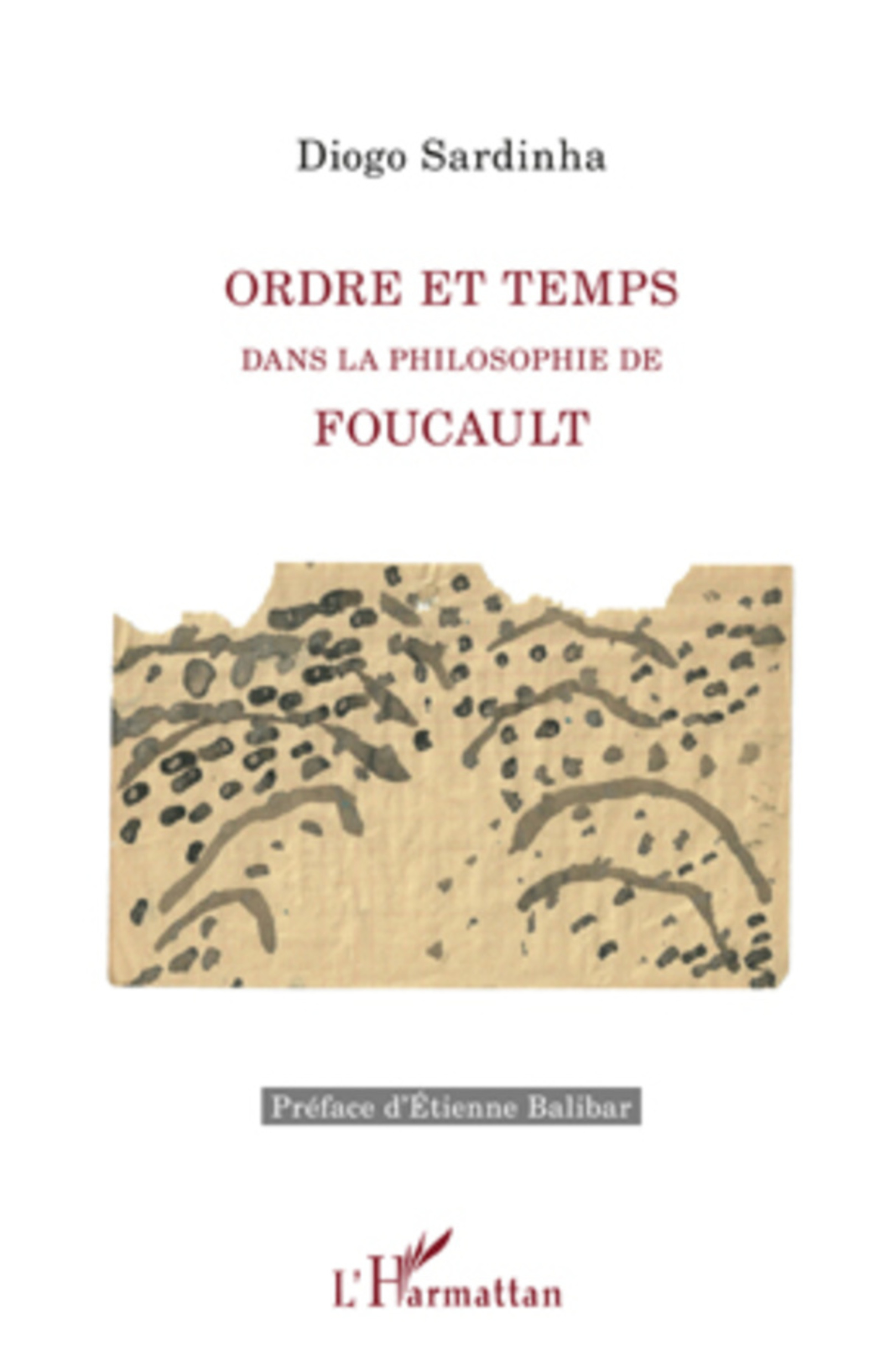
Diogo Sardinha, Ordre et temps dans la philosophie de Foucault, Préface d’Etienne Balibar, L’Harmattan, La philosophie en commun, ISBN : 978-2-296-56327-8 • septembre 2011 • 252 pages. Book available in paperback or ebook

Pdf of further details, cover and table of contents

L’oeuvre de Foucault apparaît comme une succession d’études dispersées, plus que comme un tout cohérent. C’est l’une des raisons pour lesquelles on doute du caractère même d’oeuvre que constitueraient l’ensemble de ses travaux. Ce livre montre, au contraire, que ces travaux sont marqués par une cohérence fondamentale. Celle-ci n’est pas une caractéristique transitoire, mais un trait constant de la recherche de Foucault, à laquelle elle accorde sa valeur proprement philosophique.

Kevin Hetherington, Foucault, the museum and the diagram, The Sociological Review Volume 59, Issue 3, Article first published online: 1 SEP 2011
https://doi.org/10.1111/j.1467-954X.2011.02016.x

Abstract
Foucault’s work on the museum is partial and fragmentary but provides an interesting opportunity through which to explore issues of power, subjectivity and imagination. Following a discussion of Deleuze’s reading of Foucault and his introduction of the issue of diagram as a way of understanding the discursive and visual operation of power, the paper explores some of Foucault’s work from the period around 1967–9 on the non-relation to consider how he engaged with the question of seeing/saying that Deleuze identifies as a key problematic in his work. Through analysis of Foucault’s discussions of the themes of the outside, heterotopia and the work of the painter Manet, in the context of the museum, the paper explores how power operating through the diagram of the museum allows us to understand the space of imagination as one in which subjectivity is constituted.

Key thinkers – Michel Foucault. Interview with Professor Stephen Shapiro, Department of English and Comparative Literary Studies
Update August 2025: This podcast is no longer available. Stephen Shapiro’s webpage can be found here

English Literature student Alexander Freer and PPE student Danny Smith interview Professor Stephen Shapiro on Foucault’s major theories as part of a series looking at the key thinkers for the social sciences.

Summary
This interview provides an introduction to the revolutionary work of Michel Foucault (1926–1984), French historian and social theorist. Professor Stephen Shapiro talks about Foucault’s major ideas about society, power and the individual, giving examples from history, literary studies and gender theory. Foucault’s insights are located in discussions about the army, the classroom and the prison, and he discusses how ideas about marginal groups and practices impact on normal conversations, our bodies and how we live in society.

Professor Stephen Shapiro is Professor of English and Comparative Literary Studies at the University of Warwick. He was educated at Williams College and Yale University. He has published many books on the American novel, and his most recent publications include How to Read Marx’s Capital (London: Pluto, 2008) and, with Anne Schwan, How to Read Foucault’s Discipline and Punish (London: Pluto 2011).

This podcast was produced by Alexander Freer and Danny Smith as part of a series of interviews offering an introduction to the most important theorists used in the humanities and social science disciplines today. Alexander Freer is a third-year undergraduate English student specialising in Romantic Poetry and editor of Reinvention: A Journal of Undergraduate Research. Danny Smith is a third-year undergraduate PPE student specialising in Modern Germen philosophy.

Jörg Spieker, Foucault and Hobbes on Politics, Security, and War, Alternatives: Global, Local, Political August 2011 vol. 36 no. 3 187-199
https://doi.org/10.1177/0304375411418596

Abstract
This article engages and seeks to develop Michel Foucault’s account of the nexus between modern politics, security, and war. Focusing on his 1976 lecture series Society Must Be Defended, the article considers Foucault’s tentative hypothesis about how the logic of war becomes inscribed into modern politics through the principle of security. Contra Foucault, it is suggested that this nexus can already be found in the proto-liberal political philosophy of Thomas Hobbes. In order to make this argument, the article focuses on the ontological dimension of Hobbes’ thought. It suggests that the relationship between the state of war and political order in Hobbes is more complex and more ambiguous than Foucault thought. Rather than being transcended, the Hobbesian state of war is appropriated by the state, and converted into the fundamental antagonism between reason and passion. The latter gives rise to a regime of security through which a relationship of war is inscribed into the Hobbesian commonwealth.

Michael Welch, Counterveillance: How Foucault and the Groupe d’Information sur les Prisons reversed the optics, Theoretical Criminology August 2011 vol. 15 no. 3 301-313
https://doi.org/10.1177/1362480610396651

Abstract
The analysis herein considers the dynamics of panopticism by developing further the concept of counter-surveillance—or counterveillance—whereby prison officials rather than the prisoners become the target of unwanted attention. While maintaining an interest in panoptic as well as synoptic theory, the article describes two counterveillant tactics deployed by Foucault and the Groupe d’Information sur les Prisons (GIP) in France during the 1970s. First, the GIP turned the prison inside out, in a manner of speaking, so as to publicly expose the harsh conditions of confinement. Second, the group set out to watch the watchers in an effort to hold certain prison administrators accountable for their unjust policies and practices. Implications of optical activism aimed at improving transparency in penal operations also are discussed alongside the limits of such protest.

Magritte and Foucault at Moderna Museet until 6 November
Stockholm 1 September 2011 – 6 November 2011

“Moderna Museet Essä” is a new series of essays published by the Modern Museeum of Stockholm and Axl Books. The first essay was written by Lars O Ericsson : Magritte – Foucault. Om orden och tingen (Magritte-Foucault. Worlds and things). This is also the title of the exhibition by Lars O Ericsson presented in the Pontus Hultén Gallry of the Modern museum of Stockholm from September 1 to November 6, 2011.