 Michel Foucault, Du Gouvernement des vivants. Cours au Collège de France (1979-1980)
Date de parution 25/10/2012
Paris: Gallimard Seuil. Collection Hautes Etudes
320 pages – 25 € TTC

Michel Foucault, Du Gouvernement des vivants. Cours au Collège de France (1979-1980)
Date de parution 25/10/2012
Paris: Gallimard Seuil. Collection Hautes Etudes
320 pages – 25 € TTC
Du Gouvernement des vivants est un cours charnière. Prononcé au Collège de France au premier trimestre 1980, Michel Foucault y poursuit cette histoire des « régimes de vérité » qui traverse l’ensemble des cours du Collège de France, en y apportant une inflexion majeure : commencée dans le champ du juridique et du judiciaire, l’exploration s’était poursuivie dans le champ politique ? thématique des rapports pouvoir-savoir, puis de la gouvernementalité. Elle s’investit ici dans le champ des pratiques et des techniques de soi, domaine de l’éthique que Michel Foucault ne quittera plus.
« Comment se fait-il que dans la culture occidentale chrétienne, le gouvernement des hommes demande de la part de ceux qui sont dirigés en plus des actes d’obéissance et de soumission, des “actes de vérité” qui ont ceci de particulier que non seulement le sujet est requis de dire vrai, mais de dire vrai à propos de lui-même, de ses fautes, de ses désirs, de l’état de son âme ? » se demande Michel Foucault. Ce projet le conduit d’une relecture de l’Œdipe-roi de Sophocle à l’analyse des « actes de vérité » propres au christianisme primitif, à travers les pratiques du baptême, de la pénitence et de la direction de conscience. Michel Foucault choisit de s’intéresser aux actes par lesquels le croyant est conduit à manifester la vérité de ce qu’il est lui-même, en tant qu’être indéfiniment faillible. De l’expression publique de sa condition de pécheur, dans le rituel de la pénitence à la verbalisation minutieuse de ses pensées les plus intimes, dans l’examen de conscience, c’est l’organisation d’une économie pastorale centrée sur l’aveu que l’on voit se dessiner.
Du Gouvernement des vivants est la première des enquêtes, inédite, que Michel Foucault va mener dans le champ de l’éthique, autant dans les cours du Collège de France que dans les derniers volumes de l’Histoire de la sexualité.
« Hautes Études » est une collection des Éditions de l’École des hautes études en sciences sociales, des Éditions Gallimard et des Éditions du Seuil.
Paris, 10 September 2012, Art Media Agency (AMA).
From 8 September to 11 November 2012, the Praz-Delavallade Gallery in Paris is displaying “The Petrified Forest”, a new exhibition of artist John Miller.
John Miller’s work is characterised by a multiform aspect: painting, sculpture, photography, and video. With humour, empathy, and perspicacity, his works immerse the spectator into the maelstrom of daily life and sublimate banality. In his previous series, Miller took an interest into the differences between the price and meaning of things, and questioned in depth the notion of worth in our capitalist societies. His most recent projects are dedicated to representations both critical and poetic of the emotional affects, of the relationships to “biopower” (concept elaborated by Michel Foucault) and of its impact on individuals.
In the new series of wooden relief paintings displayed in this exhibition, Miller uses again the subject of individuals crying in reality TV shows, a theme previously tackled in the “Everything Is Said” series. The use of a drab palette of colours, of greys and browns, takes the bad taste inherent in mass media from the images and highlights the paintings’ manufactured aspect. In his “Game Show Paintings” series (1998-2000), John Miller has focused on the coloured settings of TV games, in opposition with the candidates’ apparently interchangeable character. In opposition, the gendre of reality TV shows seems to focus on individuals and on staged or unstaged situations but John Miller chooses to depict the other side of the picture. Crying has indeed become a performative asset: angers, fights and tears represent strong moments in these shows. On the same level as beauty or charisma, the ability to show one’s emotions in front of cameras seems to have become an essential prerogative when participating in these shows. With his work, Miller reminds that every representation of reality necessarily requires a subjective point of view.
This is John Miller’s fourth solo exhibition in the Praz-Delavallade Gallery. Currently, his work is also displayed in group exhibitions at the Rubell Family Collection in Miami and at the Palais de Tokyo in Paris.
Graham, Helen (2012). “Scaling governmentality: Museums, co-production and re-calibrations of the ‘logic of culture'”. Cultural studies, 26 (4), pp. 565-92.
https://doi.org/10.1080/09502386.2012.679285
Abstract
This article explores contemporary uses of museum co-production for public policy through a sustained theoretical engagement with Tony Bennett’s work on museums as an ‘object of government’. The specific focus is a theoretical discussion of the ‘logic of culture’ as it relates to new UK policy uses of participants’ ‘experience’ as the desired site of authenticity at the very same time as the process of expressing this authenticity is located as a site for reform. It is argued that Bennett mobilizes two techniques of scale (fixing the analytic lens of governmentality and drawing on a strong scalar correspondence of power) in order to secure a relatively disciplinary reading of governmentality and to foreclose the resistant possibilities of cultural politics. Drawing on the differences between practices associated in UK museums with ‘access’ (which works through the dis-intensification of the difference between the museum and everyday life) and with ‘social impact’ (which requires a re-intensification of this difference in order to increase the visibility of effect), this article concludes by countering Bennett’s more disciplinary uses of Foucault with the Foucault of ‘The Subject and Power’. It is argued that the ‘logic of culture’ can be calibrated to varying intensities in considering the coming-into-relationship between the museums and those-to-be-involved. It is specifically argued – following Foucault’s spatializaton of ‘thought’ as distance (limit-attitude) and ‘counter-conduct’ as proximity – that the ‘logic of culture’ might be actively re-calibrated to use the spatialized dynamic of distance and proximity to create spaces which might allow the museum and its associated policy – not just those involved – to be affected by the co-production encounter.
Author Keywords:
museums; governmentality; Cultural Studies; cultural policy; co-production; community engagement
Foucault’s 1976 lecture ‘The Mesh of Power’ is available online in English (with a link to the French) at Viewpoint Magazine. This lecture was previously translated by Gerald Moore for the Space, Knowledge and Power: Foucault and Geography collection Jeremy Crampton and I edited. But this version includes the discussion that followed Foucault’s lecture. Thanks to Peter Gratton for the link.
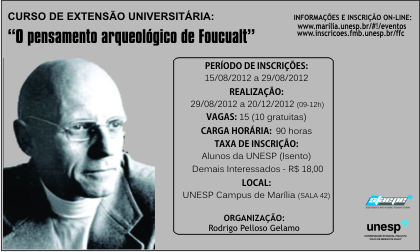
O curso de extensão está ocorrendo na sala 42.
Horário: 09:00h às 12:00h.
Período: todas as quintas, até 20/12/2012.
Carga horária: 90 horas.
Acesso ao Site
Esposito, R. The dispositif of the person, Law, Culture and the Humanities, Volume 8, Issue 1, February 2012, Pages 17-30
https://doi.org/10.1177/1743872111403104
Abstract
In this essay one of Italy’s leading philosophers examines the category of person from legal, historical, and biopolitical perspectives. Reading texts ranging from Roman law to Christian theology to bioethics, Esposito shows how person functions in Foucault’s terms as a dispositif, that is as a way of arranging the relation between the human and animal in contemporary subjectivity. Drawing on the etymology of person from persona or mask, Esposito shows how the term allows a subject to dispose of his or her animal half through the gift of grace in order to become a human person. Reading Saint Augustine, Simone Weil, and others, Esposito shows how the archaic role played by the person in Roman law returns today in liberalism’s objectification of the body as a thing. Esposito concludes by elaborating a counter dispositif of the impersonal as a way of transforming our political lexicon.
Author keywords
Classical sovereignty; Giorgio Agamben; Human rights; Impersonal; Living being; Roman law; Saint Augustine; Simone Weil; Slave as property
Street, A.A , Coleman, S.B. Introduction: Real and imagined spaces, Space and Culture, Volume 15, Issue 1, February 2012, Pages 4-17
https://doi.org/10.1177/1206331211421852
Abstract
The hospital’s ambiguous relationship to everyday social space has long been a central theme of hospital ethnography. Often, hospitals are presented either as isolated “islands” defined by biomedical regulation of space (and time) or as continuations and reflections of everyday social space that are very much a part of the “mainland.” This polarization of the debate overlooks hospitals’ paradoxical capacity to be simultaneously bounded and permeable, both sites of social control and spaces where alternative and transgressive social orders emerge and are contested. We suggest that Foucault’s concept of heterotopia usefully captures the complex relationships between order and disorder, stability and instability that define the hospital as a modernist institution of knowledge, governance, and improvement. We expand Foucault’s focus on the disciplinary, heterotopic qualities of the hospital to explore the heterotopia as a space of multiple orderings. These orderings are not only biomedical. Rather, hospitals are notable for the intensity and heterogeneity of the ongoing spatial ordering processes, both biomedical and other, that produce them. We outline an approach to heterotopias that traces the contingent configuration of hospital space through relationships between the physical environment, technologies, and persons, while simultaneously considering the kinds of spatial imaginings, hopes for the future, and emotional responses that are rendered possible by those configurations. We provide three thematic frameworks through which the heterotopic and contingent qualities of hospital spaces might be explored: boundary work, generating scale, and layered space.
Author keywords
biomedicine; heterotopia; Hospital ethnography; medical anthropology; STS
For an article in response to this article see Comments
Biebricher, Thomas & Frieder Vogelmann, Governmentality and State Theory: Reinventing the Reinvented Wheel?, Theory & Event, Volume 15, Issue 3, 2012
https://muse.jhu.edu/article/484422
Abstract
In this paper we pose the question what constitutes the originality of governmentality as a state analytical framework by confronting it with alternative contemporary approaches in state theory, suggesting that the latter may already contain many of the insights Foucaultians sometimes tend to ascribe to the governmentality perspective exclusively and thus run the risk of reinventing the state theoretical wheel. Still, we argue that there is something unique to the governmentality perspective, namely a particular kind of unwieldy knowledge about the state it aims to produce. Generating such knowledge would no longer be state theory but rather state philosophy in a specifically Foucaultian sense.
Graduate Seminar:
Asceticism, Eroticism, and the Premodern Foucault: Revisiting Foucault’s History of Sexuality through Medieval and Early Modern Sources
The Newberry Centre for Renaissance Studies
Chicago, USA
Friday, January 11, 2013 to Friday, March 15, 2013
2- 5 pm
Room B-91
Led by Eileen Joy, Southern Illinois University Edwardsville, and Anna Klosowska, Miami University (Ohio)
This seminar will focus on re-reading Foucault’s History of Sexuality (both the three published volumes as well as additional published materials intended for a fourth volume) in relation to hagiographic narratives from the Late Antique, Old English, and Middle English traditions (Eileen Joy) and to medieval and early modern literary texts on love in French (in translation) (Anna Klosowska). The central guiding concept is Foucault’s notion of an “improbable manner of being”—a notion that Foucault sketched, somewhat elliptically, in his late lectures and interviews in relation to his thinking on asceticism and techniques of the “care of the self” that he had explored in classical and early Christian texts, but had no time to more fully develop.
Participants will explore medieval and early modern texts to imagine what the inclusion of particular representations in these texts of “improbable” modes and techniques of the self would have contributed to Foucault’s history of sexuality, with an eye toward the consequences Foucault’s readings of these texts might have had upon his study of sexuality in the premodern period. The seminar will also interrogate some of the paradoxes inherent in Foucault’s attempts to provide a linear periodization of the development of the history of sexuality from the classical period to the present time—a periodization, moreover, which much work in current medieval and early modern studies of sexuality have called into question. The time is extremely ripe for such a reexamination of the premodern premises of Foucault’s work on sexuality and the care of the self.
Each of the ten meetings will pair excerpts from Foucault’s works with readings in relevant medieval or early modern texts, as well as in contemporary critical sexuality studies. The seminar dovetails nicely with the recent publication, for the first time in English, of the final volume of Foucault’s last lectures at the Collège de France on the birth of biopolitics, which is a direct outcome of his multivolume history of sexuality project (publication of these last lectures: hardback, April 2011, paperback, 2012).
Learn more about the instructors: Eileen Joy, Southern Illinois University Edwardsville, and Anna Klosowska, Miami University (Ohio).
Faculty and graduate students of Center for Renaissance Studies consortium institutions may be eligible to apply for travel funds to attend CRS programs or to do research at the Newberry. Each member university sets its own policies and deadlines; contact your Representative Council member in advance for details.
Learn more about Center for Renaissance Studies programs for graduate students.
Prerequisites:
Reading knowledge of French, Latin, Italian, Old English, or Middle English is desirable but not required. Original texts and English translations will be made available. Some background in courses in medieval literature, at the undergraduate or graduate level, is desirable.
Eligibility:
Limited enrollment, with priority to students from Center for Renaissance Studies consortium institutions. Students may take this seminar on a not-for-credit basis or arrange to earn credit at their home campuses. When space permits, consortium faculty members are encouraged to audit Newberry seminars, and graduate students from non-consortium schools may also enroll. The course fee is waived for consortium students.
With thanks to Joseph Derosier for this news
Power, Government and Strategy: Foucault’s Reconsideration of Power after 1976
Prof. Paul Patton (University of New South Wales)
Deakin Philosophy Seminar Series
Tuesday, September 18, 3:30pm – 5:00pm
Deakin University C2.05
221 Burwood Highway
Melbourne 3125
Australia
Sponsor:
The Alfred Deakin Research Institute, the Centre for Citizenship and Globalization and the School of Humanities and Social Sciences
Organiser
For further information, please contact Dr Sean Bowden at: sean.bowden@deakin.edu.au
Details
Foucault’s lectures in 1976 open with the statement of an intellectual crisis. They proceed to a series of questions about the nature of power and the ways that he has conceived of it up to this point: what is power? How is it exercised? Is it ultimately a relation of force? Only some of these questions are answered in the course of these lectures. His answer to the overriding question, what is power?, is not forthcoming until after the discovery of governmentality in his 1978 lectures. It is not fully developed until after his lectures on liberal and neoliberal governmentality in 1979. This talk aims to retrace his answers to the questions in the light of the published lectures and to examine the consequences of these answers for his analysis of neoliberal governmentality.
Paul Patton is Professor of Philosophy at the University of New South Wales and Fellow of the Australian Academy of the Humanities. He has published extensively on contemporary European philosophy and political philosophy. He is the author of, among other works, Deleuzian Concepts: Philosophy, Colinization, Politics (Stanford University Press, 2010) and Deleuze and the Political (Routledge, 2000).

 Foucault News