Foucault News

News and resources on French thinker Michel Foucault (1926-1984)

Sayer, A. Power, causality and normativity: A critical realist critique of Foucault, Journal of Political Power, Volume 5, Issue 2, August 2012, Pages 179-194
https://doi.org/10.1080/2158379X.2012.698898

Abstract
A critical realist account is developed of two aspects of the study of power which are normally left implicit: the theory of causation presupposed and the way in which the normative connotations of power are dealt with. These matters are discussed partly by reference to Foucault’s views on power, particularly as set out in Volume 1 of The History of Sexuality. Regarding the conception of power as ubiquitous, it is argued that this is not incompatible with concepts of causation or of power as deriving from the capacities of objects; indeed dispersed power presupposes causality and causal powers. Other concepts such as emergent powers, fields, structures and ecological dominance are also assessed from a critical realist standpoint. In the second part, it is argued that the normative implications of power should not be evaded, and indeed that evaluation of the implications of power for flourishing and suffering are necessary for adequate description and explanation in social science. Positivist and Foucauldian refusals of normativity are critiqued by reference to the untenability of the fact-value and is-ought distinctions and the necessity of thick ethical concepts in social science. It is concluded that students of power should embrace causality and normativity.

Author keywords
causality; critical realism; dispersed power; Foucault; normativity

Jeudi philosophie “Mal faire, dire vrai. Fonction de l’aveu en justice”, rencontre-conversation avec Fabienne Brion et Michel Senellart

Librairie Vrin: 6 place de la Sorbonne,
75005 Paris,
29 Novembre 2012
6:30 pm

Source m/f materiali foucaultiani

At last something I will actually be able to go to. How exciting 🙂

The Foucault Society Reading Group

Michel Foucault “Society Must Be Defended”, Lectures at the Collège de France, 1975-1976

Friday, November 30
7:30-9:30pm

Location:
CUNY Graduate Center
365 Fifth Avenue, New York, NY
Room 5489
(Please note new room.)

We invite you to join us as we continue our in-depth discussion of Foucault’s lectures. The group is multidisciplinary and includes faculty, graduate students and independent scholars.

New participants are welcome! If you are interested in attending the reading group, we encourage you to contact us first.

This will be our last meeting of the fall semester. We will announce meeting dates for Winter/Spring 2013 in early January.

Please join us!
Open to the public.
We recommend that participants have some familiarity with Foucault’s work.

Suggested donation: $10/meeting.
Registration: foucaultsocietyorg@gmail.com

For complete description, see our website.

Questions? Please contact
Kevin Jobe, Reading Group Director, at foucaultsocietyorg@gmail.com.

About the Foucault Society:

The Foucault Society is an independent, nonprofit educational organization offering a variety of programs dedicated to the critical study of the ideas of Michel Foucault (1926-1984).  All of our events are open to the public. We welcome new participants who have an interest in Foucault’s work and its impact on diverse areas of inquiry, including critical social theory, philosophy, politics, history, culture, gender/sexuality studies, and the arts.
Website
Facebook
Twitter:  @foucaultsociety

E-mail: foucaultsocietyorg@gmail.com

Between Deleuze and Foucault
Purdue University, College of Liberal Arts
November 30 – December 1, 2012

An international conference exploring the relations between the work of Gilles Deleuze (1925-1995) and Michel Foucault (1926-1984).

pdf flyer

Plenary Speaker:
William Connolly, Johns Hopkins University

Participants:

Marco Altamirano, Purdue University; Alain Beaulieu, Laurentian University; Thomas Flynn, Emory University; Colin Koopman, University of Oregon; Leonard Lawlor, Penn State University; Nicolae Morar, University of Oregon; Thomas Nail, University of Denver; Roberto Nigro,Université de Paris; Chris Penfield, Purdue University; John Protevi, Louisiana State University; Anne Sauvagnargues, Université Paris Ouest Nanterre; Janae Scholtz, Alvernia University; Daniel W. Smith, Purdue University; Dianna Taylor, John Carroll University; Kevin Thompson, DePaul University

Roundtable Discussion:

Gary Gutting, Notre Dame University
Todd May, Clemson University
Ladelle McWhorter, University of Richmond
Alan Schrift, Grinnell College
Moderated by: Alan Rosenberg, Queens College, CUNY

The conference is free and open to the public.
Location: West Faculty Lounge, Purdue Memorial Union

Organizers: Daniel W. Smith (smith132@purdue.edu), Nicolae Morar (nmorar@uoregon.edu), and Thomas Nail (thomas.nail@du.edu).

The conference is made possible through the generous support of a Global Synergy Grant for Faculty and an Enhancing Research in the Humanities and Arts Grant from the College of Liberal Arts at Purdue University.

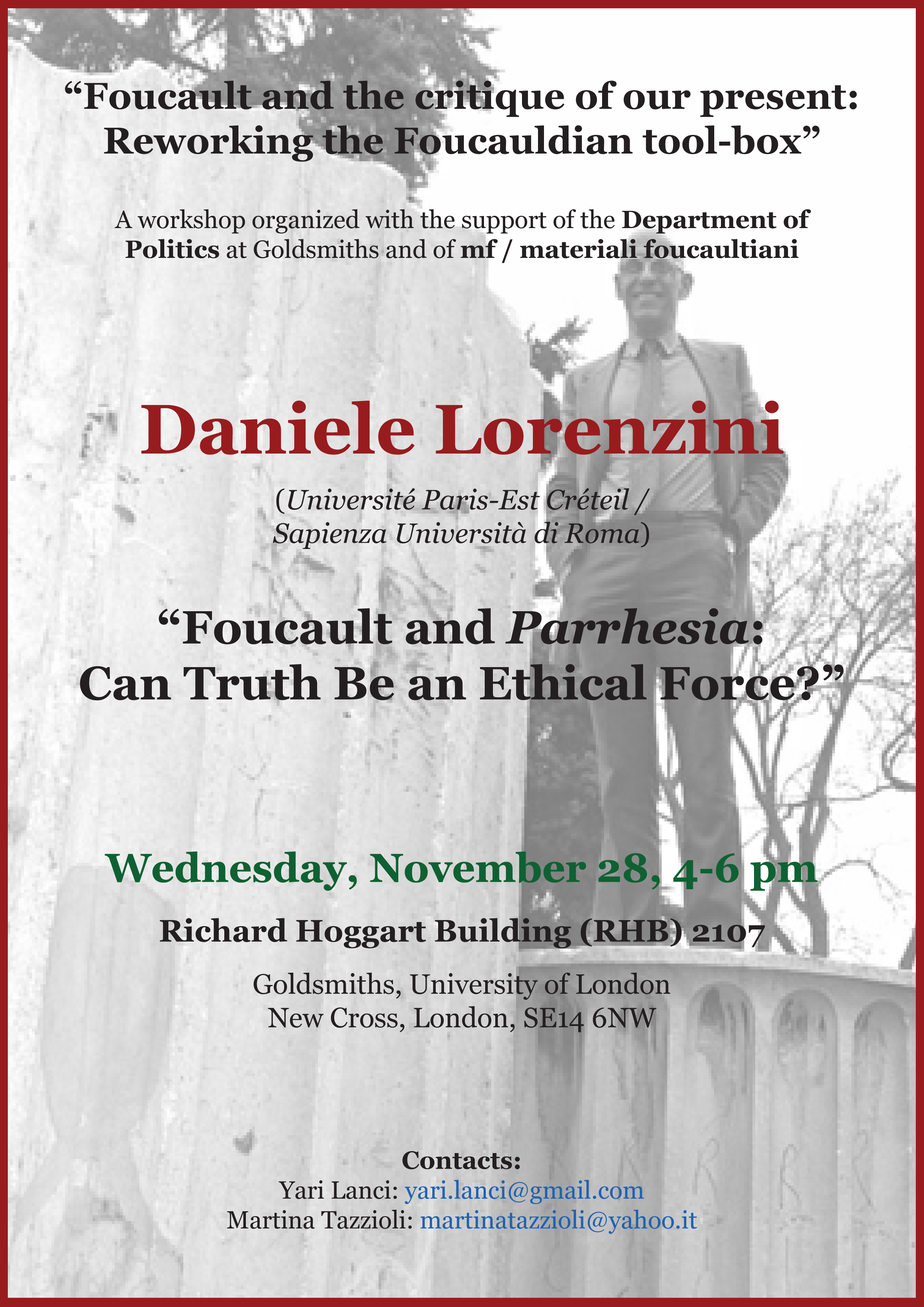
Workshop “Foucault and the critique of our present: Reworking the Foucauldian tool-box” Part 3

organized at Goldsmiths College (London) by Yari Lanci, Amedeo Policante and Martina Tazzioli,
with the support of the Department of Politics and of mf / materiali foucaultiani

Daniele Lorenzini (Université Paris-Est Créteil /Sapienza Università di Roma):
“Foucault and Parrhesia: Can Truth Be an Ethical Force?”

Wednesday, November 28 2012, 4-6 pm

Richard Hoggart Building (RHB) 2107
Goldsmiths, University of London
New Cross, London, SE14 6NW

Contacts:
Yari Lanci: yari.lanci@gmail.com
Martina Tazzioli: martinatazzioli@yahoo.it

Isin, E.F. Citizens without nations, Environment and Planning D: Society and Space, Volume 30, Issue 3, 2012, Pages 450-467
https://doi.org/10.1068/d19210

Abstract
To broach the question of whether citizenship could exist without (or beyond) community, this paper discusses genealogies of citizenship as membership that binds an individual to the com- munity of birth (of the self or a parent). It is birthright as fraternity that blurs the boundary between citizenship and nationality. After briefly discussing recent critical studies on birthright citizenship (whether it is civic or ethnic or blood or soil) by Ayelet Shachar and Jacqueline Stevens, the paper discusses three critical genealogies of the relationship between birthright and citizenship by Max Weber, Hannah Arendt, and Michel Foucault. Although each provides a critical perspective into the question, Weber reduces citizenship to fraternity with nation and Arendt reduces citizenship to fraternity with the state. It is Foucault who illustrates racialization of fraternity as the connection between citizenship and nationality. Yet, since Foucault limits his genealogical investigations to the 18th and 19th centuries, a genealogy of fraternity of what he calls an immense biblical and Greek tradition remains for Derrida to articulate as a question of citizenship.

Author keywords
Arendt; Citizenship; Community; Derrida; Foucault; Fraternity; Weber

Kaden, D.A., Foucault, feminism, and liberationist religion: Discourse, power, and the politics of interpretation in the feminist emancipatory project of Elisabeth Schüssler Fiorenza, Neotestamentica, Volume 46, Issue 1, 2012, Pages 83-104
https://www.jstor.org/stable/43048846

Abstract
The work of Elisabeth Schüssler Fiorenza (ESF) has been celebrated as a significant and ground-breaking contribution to the fields of biblical and religious studies. Her emancipatory paradigm has been used to situate scholarship of biblical studies as an ally of liberationist religion, and conceive of early Christian texts as sites of struggle, the interpretation of which indicates more about the individual interpreter’s ethical-political posture than a particular “truth” inhering in the text itself. The overall project overlaps in many ways with the work of Michel Foucault, yet comes short of critically engaging his theories. This article demonstrates areas of confluence between these two theorists, and raises the question of how ESF’s project would be altered if Foucault were more directly addressed. The article argues that the alterations would be significant. © New Testament Society of South Africa.

Eve, M.P. Whose line is it anyway?: Enlightenment, revolution, and ipseic ethics in the works of Thomas Pynchon, Textual Practice, Volume 26, Issue 5, 1 October 2012, Pages 921-939

Further info

Abstract
This piece effects a critical revision of the interactions between late Foucault and the works of Thomas Pynchon through the theme of Enlightenment, a relationship far more nuanced than granted by current appraisals. Examining resistance, revolution, and the critical attitude alongside a focus on the Foucauldian sphere of ethics, this work posits Pynchon’s negative and positive utopianism as a regulative idea. Reading both Pynchon’s fiction and his essays, particularly Nearer My Couch to Thee, alongside Foucault’s two pieces on Kant’s Was ist Aufklrung?, it emerges that the divide between Pynchon and Foucault hinges more upon what we can know about ourselves and not necessarily, as has always been supposed, on who, or how, we can dominate. Pynchon’s stance on revolution and resistance runs broadly in line with late Foucault’s remarks on incrementalism; any change that can come about will, and should, be incremental while remaining pessimistic towards Meliorism. The narrowing of the sphere of ethics to ipseity that Foucault introduces to effectively counter the problems of agency that this entails, however, are not shared by Pynchon. For Pynchon, work upon the self is intrinsically contaminated and cannot be clearly delineated from the wider, impinging systems. With apologies to the author himself, it seems fair to say that when reading Pynchon in the Foucauldian Enlightenment tradition: we do know what’s going on (to some, perhaps ingrained and inescapably limited, extent), and we let it go on, only ever imagining, in sorrow, how it could (never) be otherwise.

Author keywords

ethics; literature; Michel Foucault; Thomas Pynchon

Quel réel ? (4/4) : Foucault et la réalité de la fiction
podcast@radiofrance.com
durée : 00:59:44 – LES NOUVEAUX CHEMINS DE LA CONNAISSANCE – Par Adèle Van Reeth Réalisation : Mydia Portis-Guérin Lectures : Jean-Louis Jacopin

Update August 2025. No updated link for this.

Ouverture de la salle de lecture Foucault au CCFEF, l’Université de Varsovie (25 octobre 2012)

M. Pierre Buhler, Ambassadeur de France en Pologne, a participé le 25 octobre, dans le nouveau bâtiment de l’Université de Varsovie abritant la faculté de Néophilologie et l’Institut de Linguistique appliquée, à l’ouverture inaugurale de la salle de lecture Michel Foucault au Centre de civilisation française et d’études francophones. Michel Foucault, le philosophe français bien connu, a été le premier directeur du CCFEF. Cette inauguration est aussi l’occasion de célébrer le nouveau bâtiment, de conception très moderne, dans son entier.

L’Ambassadeur, dans son discours, a rendu hommage à la ténacité et au soutien des autorités de l’Université de Varsovie pour faire aboutir la construction. Il a félicité Mme Chalasinska-Macukow, ancienne rectrice de l’Université de Varsovie, ainsi que M. Palys, l’actuel recteur, pour avoir veillé à préserver le lien particulier qui unit la France et la Pologne, et à donner à la salle de lecture Michel Foucault une place éminente.

Grâce à ces efforts, le Centre de civilisation française et d’études francophones est devenue une composante de plein droit de l’Université de Varsovie. Une réforme profonde de ses statuts, va lui permettre de mener sa double mission, développer la recherche en sciences sociales, et promouvoir un débat d’idées de haute tenue.