See earlier post for details as well as this additional lecture on biopolitics and sovereignty.
With thanks to Dirk Felleman for this link

See earlier post for details as well as this additional lecture on biopolitics and sovereignty.
With thanks to Dirk Felleman for this link
Bronwyn Davies, Jane Speedy, Who was Pierre Rivière? Introduction to the special issue, Emotion, Space and Society, Available online 22 April 2012
https://doi.org/10.1016/j.emospa.2012.03.005
Table of contents for special issue
Abstract
Foucault’s (1975) edited book, I, Pierre Rivière, having slaughtered my mother, my sister and my brother… A case of parricide in the 19th century, includes the court documents and newspaper reports from the 1835 trial of Pierre Rivière, Pierre Rivière’s memoir written while in prison, and the “analytic notes” written by Foucault and his colleagues. Whereas the court focused on the question of whether Pierre Rivière was of sane mind or not, Foucault and his colleagues sought to avoid the closure that such categorical thinking invites the reader into. This paper introduces the story of Pierre Rivière, and opens up some of the questions to be addressed in this special issue. The papers examine the memoir, the accompanying documents, and Foucault’s and his colleagues’ take on them, and reopen discussion of the Pierre Rivière case and its contemporary twenty-first century relevance, using a combination of both philosophical ethnography and arts-based enquiry. These contemporary papers are based upon a series of interdisciplinary workshops and seminars that took place at the University of Bristol during 2010. In this introductory paper we ask what was the emotional geography of this young man who engaged in such an unthinkable act? And how did that geography intersect with the emotional geography of his village in France in 1835, and what does it still have to tell us about our own contemporary society?
Keywords
Pierre Rivière; Foucault, Parricide, Madness; Arts-based social science; Narrative enquiry
Lectureship in French Philosophy, King’s College London
The Department of French and the Department of Philosophy of King’s College London wish to make the joint appointment of a Lecturer in French Philosophy, starting in September 2013. We are seeking an outstanding philosopher with research expertise and teaching experience in French philosophy, broadly conceived, but with preference for specialism in the area of 20th-century French phenomenology and existentialism. Candidates working in all areas of French philosophy from the early modern period onward will be fully considered.
The successful applicant will be able to teach undergraduate and postgraduate modules in both the French and the Philosophy departments. S/he will have native or near-native fluency in French. S/he will be expected to contribute to the College’s 2014 REF submission, will make an active contribution to the research culture of the two Departments, and will attract PhD students.
The closing date for receipt of applications is 3 February 2013.
For an informal discussion of the post please contact the Head of the Department of French, Professor Patrick ffrench via patrick.ffrench@kcl.ac.uk, or the Head of the Department of Philosophy, Maria-Rosa Antognazza, via maria.rosa.antognazza@kcl.ac.uk.
Korvela, P.-E. Sources of governmentality: Two notes on Foucault’s lecture, History of the Human Sciences, Volume 25, Issue 4, October 2012, Pages 73-89
https://doi.org/10.1177/0952695112454370
Abstract
The article scrutinizes Michel Foucault’s interpretation of Machiavelli in his famous lecture on governmentality. Foucault is slightly misguided in his search for the origins of governmentality, the article asserts. Foucault gives credit for the development of what he calls a new art of government to anti-Machiavellian treatises, but also follows those treatises in their distorted interpretation of Machiavelli. Consequently, Foucault’s analysis gets confused and regards as novel those arguments and developments that were essentially of ancient pedigree compared with Machiavelli’s ideas. The article discusses especially two points in Foucault’s interpretation of Machiavelli: Foucault’s insistence on the singularity of the prince in Machiavelli and the importance of territory to Machiavelli. In both of these points Foucault is beside the mark. Foucault’s interpretation inverts the development of an art of government and regards as new those ideas that were fundamentally reactionary vis-à-vis Machiavelli’s ideas. The article suggests that a more viable lead in searching for an art of government might be found from Machiavelli’s writings and the republican experience of the late medieval Italian city-states rather than from the birth of administrative monarchies of the 16th and 17th centuries. Therefore, the article concludes that Foucault is somewhat misled in contextualizing the birth of governmentality, a view which also has some wider implications for the whole framework of governmentality Foucault is trying to develop.
Author keywords
art of government; governmentality; Michel Foucault; Niccolò Machiavelli; territory
Call for Stream Proposals
London Conference in Critical Thought
Royal Holloway, University of London
June 6th and 7th, 2013
Building on the success of the inaugural conference, the 2013 London Conference in Critical Thought (LCCT) will offer a space for an interdisciplinary exchange of ideas for scholars who work with critical traditions and concerns. It aims to provide opportunities for those who frequently find themselves at the margins of their department or discipline to engage with other scholars who share theoretical approaches and interests. Central to this vision is an inter-institutional, non-hierarchal, and accessible event which makes a particular effort to embrace emergent thought and the participation of emerging academics, fostering new avenues for critically orientated scholarship and collaboration. Coordinated by colleagues from across the University of London, this year’s conference is to be held at Royal Holloway on the 6th and 7th June, 2013.
We now welcome proposals for thematic streams for the 2013 conference. Last year’s conference included streams as diverse as ‘Critical Human Rights’, ‘Radical Political Rhetoric’, ‘Spatial Text’, ‘The Object: between Time and Temporality’, and ‘Deleuzian Theory in Practice’. [Plus stream titled ‘New Foucauldian approaches’] It brought into conversation scholars working in the fields of philosophy, fine art, geography, politics, law, musicology, literature, and many others.
The deadline for stream proposals is the 20th of January, 2013. Stream proposals should include abstracts or descriptions that seek to stimulate a range of cross-disciplinary responses. A later call for papers (in early February) will seek proposals for presentations suited to the accepted conference streams, as well as paper proposals for inclusion in a general stream. Given the collaborative nature of the conference, stream convenors will have input into and take a hand in the coordination of the conference.
Please send stream proposals tolondoncriticalconference@gmail.com. Details of last year’s conference (including previous streams and papers) can be found on the LCCT website.
http://londonconferenceincriticalthought.wordpress.com/
Email: londoncriticalconference@gmail.com Twitter: @LondonCritical
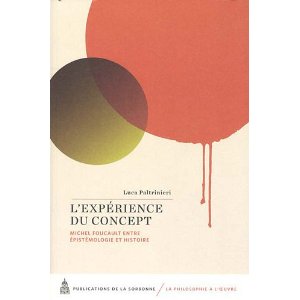 Luca Paltrinieri, L’expérience du concept : Michel Foucault, entre épistémologie et histoire, Publications de la Sorbonne, Collection : La philosophie à l’oeuvre, 2012
ISBN-10: 2859447067
ISBN-13: 978-2859447069
pdf flyer
Présentation de l’éditeur
Ce livre ne s’intéresse – en aucune manière – à ce que Foucault a dit. Et son auteur n’essaie ni de déceler la vérité de l’oeuvre, ni d’en reconstruire la systématicité secrète. Il aborde les ouvrages foucaldiens comme des objets fabriqués selon des règles, poursuivant des fins : il veut montrer ce que Foucault a fait de la philosophie, de l’histoire, de la science. En partant du fil conducteur du rapport non exclusif entre vie et concept, rapport que l’on retrouve chez Canguilhem, il s’agit ainsi de revenir aux sources de la pratique foucaldienne de pensée. Quelle forme d’expérience traduit la naissance, l’émergence et la propagation d’un nouveau concept ? Quel est le rapport entre des expériences historiques de pensée et leur conceptualisation par la science, la philosophie, la littérature ? Pourquoi, au cours de ces opérations discursives, avons-nous besoin de vérité ? En reconstruisant le geste de pensée foucaldien à travers l’exemple privilégié de l’histoire des statistiques, on tente moins de faire oeuvre de commentaire que de dessiner les traits opératoires d’une machine de pensée qui pourrait nous être utile aujourd’hui, pour étudier le besoin de vérité lié aux pratiques contemporaines de gouvernement. Car la source de la fascination durable que l’oeuvre foucaldienne continue d’exercer pourrait bien être précisément ceci : elle n’autorise aucune interprétation qui n’en soit pas une appropriation et une actualisation.
Biographie de l’auteur
Luca Paltrinieri est docteur en philosophie de l’Ecole normale supérieure de Lyon et de l’université de Pise. Il est chargé de recherche au Centre d’innovation et de recherche en pédagogie de Paris (CCIP), chercheur rattaché au CIEPFC (ENS-Ulm) et membre de l’Association pour le Centre Michel Foucault.
See also earlier post of a video of a lecture by Catherine Malabou which includes biographical and other relevant details.
With thanks to Dirk Felleman for this link
For details of this 3 day conference in Madrid, Spain from 17-19 December 2012 see pdf flyer
Binkley, S. The Government of Intimacy: Satiation, Intensification, and the Space of Emotional Reciprocity, Rethinking Marxism, Volume 24, Issue 4, October 2012, Pages 556-573
https://doi.org/10.1080/08935696.2012.711062
Abstract
Considering a series of transformations in the fields of marriage and couples counseling, family therapy, and so on in the United States from the turn of the century to the present, this article undertakes a Foucaultian analysis of the government of intimacy that seeks to broaden contemporary understandings of governmentality, biopower, and discipline. It traces a series of shifts and transformations in the government of intimacy, understood as a dynamic trajectory of sometimes dissonant and unstable assemblages centered on the maximization of mutuality, trust, and empathy within the bond of intimate life. The overall pattern of change is one of an intensification of forms of power that increasingly satiates subjectivity and intimacy itself with each successive form. Suggestions are offered for scholarship on governmentality and other Foucaultian and post-Foucaultian themes.
Author keywords
Biopower; Governmentality; Intimacy; Marriage Counseling; Michel Foucault
Table ronde: «Travailler à partir des cours de Michel Foucault»
avec Philippe Artières, Frédéric Gros, Philippe Chevallier et Luca Paltrinieri
Une rencontre autour de Michel Foucault à l’occasion de la parution de Du gouvernement des vivants Cours au Collège de France 1979-1980 (EHESS/Gallimard/Le Seuil, 2012)
le jeudi 20 décembre 2012 à 18h00
IMEC – 174, rue de Rivoli, 75001 Paris
Métro Palais-Royal Musée du Louvre Codes porche et cour – 9614 ; 8512
Table ronde: «Travailler à partir des cours de Michel Foucault»
avec Philippe Artières, Frédéric Gros, Philippe Chevallier et Luca Paltrinieri
Réservation indispensable auprès de Laure Papin
Tél. 01.53.34.23.21
reservations-rivoli@imec-archives.com
 Foucault News