Foucault News

News and resources on French thinker Michel Foucault (1926-1984)

Warren Montag, Althusser and His Contemporaries: Philosophy’s Perpetual War, Duke University Press, 2013

Description
Althusser and His Contemporaries alters and expands understanding of Louis Althusser and French philosophy of the 1960s and 1970s. Thousands of pages of previously unpublished work from different periods of Althusser’s career have been made available in French since his death in 1990. Based on meticulous study of the philosopher’s posthumous publications, as well as his unpublished manuscripts, lecture notes, letters, and marginalia, Warren Montag provides a thoroughgoing reevaluation of Althusser’s philosophical project. Montag shows that the theorist was intensely engaged with the work of his contemporaries, particularly Foucault, Derrida, Deleuze, and Lacan. Examining Althusser’s philosophy as a series of encounters with their thought, Montag contends that Althusser’s major philosophical confrontations revolved around three themes: structure, subject, and beginnings and ends. Reading Althusser reading his contemporaries, Montag sheds new light on structuralism, poststructuralism, and the extraordinary moment of French thought in the 1960s and 1970s.

Warren Montag is the Brown Family Professor in Literature, English and Comparative Literary Studies at Occidental College in Los Angeles. He is the author of Louis Althusser; Bodies, Masses, Power: Spinoza and His Contemporaries; and The Unthinkable Swift. He is editor of Décalages: A Journal of Althusser Studies.


Teresa Macias, ‘Tortured bodies’: The biopolitics of torture and truth in Chile (2013) International Journal of Human Rights, 17 (1), pp. 113-132.
https://doi.org/10.1080/13642987.2012.701912

Abstract
In the same way that torture has become a common and privileged instrument of war and political repression, and a regular occurrence of our time, so, too, has the question of how to speak and account for torture and its legacies become a concern and an unavoidable issue for nations either transitioning from periods of torture or invested in separating themselves from regimes of torture. In Chile, the democratic transition that ended the authoritarian regime in 1990 gave way to demands for the recognition of torture and other human rights violations. In 2003, Chile instituted the Torture Commission, its second truth and reconciliation commission. This article uses the Foucaultian concept of biopower to analyse the strategies and practices used by the Torture Commission to produce a national truth about torture by critically looking at the implications and challenges of organising national processes of accounting for practices such as torture.

Author Keywords
Agamben; Biopolitics; Chile; Foucault; Torture; Truth and reconciliation commissions

DOI: 10.1080/13642987.2012.701912

Burke A. Hendrix, Where should we expect social change in non-ideal theory? (2013) Political Theory, 41 (1), pp. 116-143.
https://doi.org/10.1177/0090591712463201

Abstract
This essay considers the relationship between ideal theory and non-ideal theory. It begins with Rawls’s conception of ideal theory and A. John Simmons’s articulation of non-ideal theory. Both defend the priority of ideal theory over non-ideal theory. The essay then considers three different conceptions of the social barriers standing in the way of an ideal society, taken broadly from Mill, Marx, and Foucault. Each conception of power suggests a divergent strategy for pursuing non-ideal theory. The Foucauldian conception also suggests reasons to mistrust our own political and moral judgments. The essay advocates a more limited view of the relationship between ideal and non-ideal theory than is commonly described, in which ideal theory retains its logical priority but not its temporal priority. In other words, the essay argues that we will fare best when we focus first on reducing specific injustices while setting aside further speculation about the character of an ideal society. © 2013 SAGE Publications.

Author Keywords
Foucault; Ideal theory; Marx; Mill; Power

DOI: 10.1177/0090591712463201

Eva Vakirtzi, Phil Bayliss, Towards a Foucauldian Methodology in the Study of Autism: Issues of Archaeology, Genealogy, and Subjectification (2013) Journal of Philosophy of Education Volume 47, Issue 3, pages 364–378.
https://doi.org/10.1111/1467-9752.12004

Abstract
The remarkable increase in diagnoses of autism has paralleled an increase in scientific research and turned the syndrome into a kind of a new ‘trend’ within psychiatric and developmental conditions of childhood. At the same time, discursive technologies, such as DSM-IV, autobiographies, movies, fiction, etc., together with ‘educational’ interventions, such as TEACCH, PECS, Makaton, etc., seem to anticipate a form of an apparatus built around the condition named autism. Starting from this premise, the article proposes a new approach within autism studies, which treats the condition in Foucauldian terms and focuses on the emergence of the autistic subjectivity following Foucault’s methodology of archaeology, genealogy, and modes of subjectification.

DOI: 10.1111/1467-9752.12004

Centre for Research in Philosophy, Literature and The Arts, Warwick University

On the afternoon of 29 January 2013 we hosted a special public lecture by French philosopher Bernard Stiegler. The one-hour lecture was entitled ‘General Organology, Digital Studies and the Neurosciences’ and offered a succinct account of some of the major preoccupations of Stiegler’s groundbreaking recent work at the theoretical forefront of the digital humanities. A video of Stiegler’s lecture can be viewed [on this site].
[…]
Read more

With thanks to Dirk Felleman for this link

carceralgeography's avatarProf Dominique Moran

‘Carceral Spaces: Mobility and Agency in Imprisonment and Migrant Detention‘ (Ashgate, 2013) edited by Dominique Moran, Nick Gill and Deirdre Conlon.moran_gen 55 cover.QXD_mobility and agency

This book draws together the work of a new community of scholars with a growing interest in carceral geography: the geographical study of practices of imprisonment and detention. It combines work by geographers in ‘mainstream’ penal establishments that incarcerate people convicted of a crime by the prevailing legal system, with geographers’ recent work on migrant detention centres, in which refused asylum seekers, irregular migrants and some others are detained, ostensibly pending decisions on admittance or repatriation. In each of these contexts, contributions investigate the geographical location and spatialities of institutions, the nature of spaces of incarceration and detention and experiences inside them, governmentality and prisoner agency, cultural geographies of penal spaces, and mobility in the carceral context. In dialogue with emergent and topical agendas in geography…

View original post 508 more words

Alissa Overend, Candida, food discipline and the dietary taming of uncertainty (2013) Food, Culture and Society, 16 (1), pp. 145-160.
https://doi.org/10.2752/175174413X13500468045560

Abstract
Discourses of nutritional health are strongly associated with illness, and have recently been linked to the prevalence and management of chronic undefined disorders. Using the case of Candida-a yeast-related disorder of vague symptomatology-I explore the role of food in the narratives of twenty-four people living with Candida. As Candida remains a speculative illness within the boundaries of biomedical science, it is relevant to critically explore the often-focal role of food in the management of this condition, and to consider the range of personal, social and cultural motivations at work in its dietary regulation. Taking up Foucault’s theory of docility, I trace the ways in which dietary practices can be understood as normalizing the Candidad-body by helping to create a sense of certainty and control in the persistent face of illness ambiguity. In drawing on Foucault’s later work, I move beyond illness dieting as solely a disciplinary regime and explore the ways in which dietary regime can also be conceptualized as a practice in the care of the self, fostering a heightened, often-changing sense of self. While Candida dieting practices will never fully operate separate from the pervasive discourses of nutritional science, they can offer productive possibilities in the regulation and maintenance of an illness not fully recognized by biomedical science.

Author Keywords

Candida; Care of the self; Food discipline; Illness dieting; Undefined illness

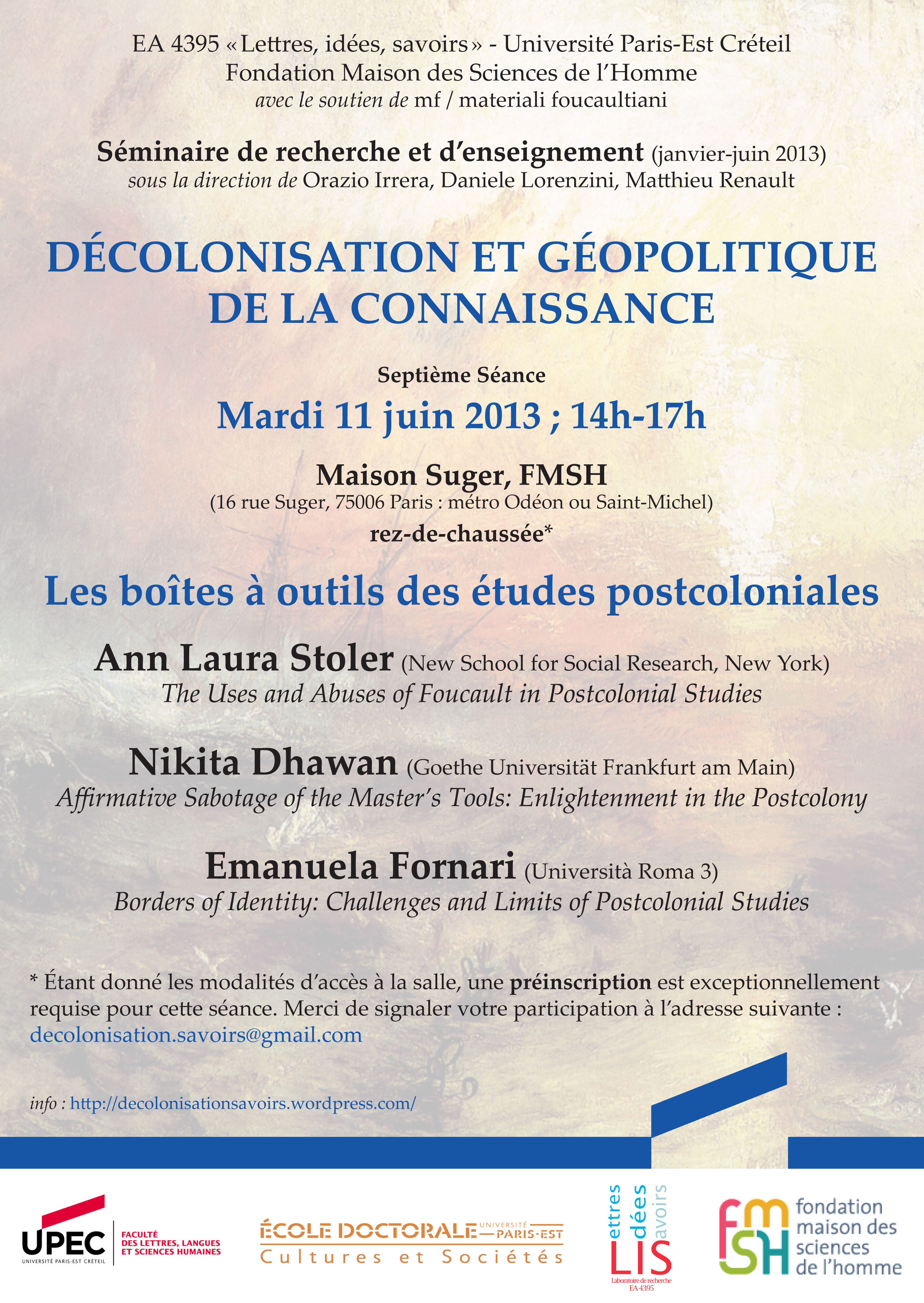
Affiche DGC (S7)

Décolonisation et géopolitique de la connaissance
Séminaire de recherche et d’enseignement (janvier-juin 2013)

Sous la direction de Orazio Irrera, Daniele Lorenzini, Matthieu Renault

7ème séance
Mardi 11 juin 2013, 14h-17h
Maison Suger (FMSH), 16-18 rue Suger, 75006 Paris rez-de-chaussée)

Les boîtes à outils des études postcoloniales

Ann Laura Stoler (New School for Social Research, New York) – The Uses and Abuses of Foucault in Postcolonial Studies

Nikita Dhawan (Goethe Universität Frankfurt am Main) – Affirmative Sabotage of the Master’s Tools: Enlightenment in the Postcolony

Emanuela Fornari (Università Roma 3) – Borders of Identity: Challenges and Limits of Postcolonial Studies

Étant donné les modalités d’accès à la salle, une préinscription est exceptionnellement requise pour cette séance. Merci de signaler votre participation à : decolonisation.savoirs@gmail.com

Dominik Bartmanski, How to become an iconic social thinker: The intellectual pursuits of Malinowski and Foucault, European Journal of Social Theory, Volume 15, Issue 4, November 2012, Pages 427-453
https://doi.org/10.1177/1368431011423577

Abstract
The present article develops a new approach to intellectual history and sociology of knowledge. Its point of departure is to investigate the conditions under which social thinkers assume the iconic reputation. What does it take to become ‘a founding father’ of a humanistic discipline? How do social thinkers achieve the status of a trans-disciplinary star? Why some intellectuals attract tremendous attention and ‘go down in history’ despite personal and professional failures, while others enjoy only limited recognition or simply sink into oblivion, even if they have met all the standards of their day? Quite a few sociologists have tackled this elusive issue. Pierre Bourdieu, Michele Lamont and Randall Collins are among those who fleshed out strong explanatory frameworks. This project adds to this body of knowledge by emphasizing cultural factors that these authors downplayed in their seminal accounts, despite being aware of their significance. By showing why these underdeveloped aspects of their works need to be incorporated into the debate and how this can be achieved, this article introduces a new theorization of the iconic, lasting intellectual reputation substantiated by evidence from the lifeworks of Bronisław Malinowski and Michel Foucault. As such, it aims, minimally, to make sociology of knowledge decisively ‘cultural’. Maximally, it seeks to demonstrate that the iconic success of intellectual intervention in social theory depends on carefully performed and contingently mediated engagement with the binary systems of symbolic classification.

Ten Weeks on Foucault Course: Powerful Ideas and Practical Applications

Course by Kerry Sanders
6 Aug 2013 – 8 Oct 2013

University of Sydney, Centre for Continuing Education.
Training and development courses open to anyone

Introduction
It will be argued that Foucault gives an analysis of political power and its institutions, which are crucial to understanding the world we now live in. Foucault shows that control over knowledge, that is what we know or believe, makes us what we are. One of the most important mechanisms of making modern individuals is the process of ‘normalisation’ in which divisions are established between groups such as ‘sane and insane’; criminal and law abiding; diseased and healthy. We will then apply ideas such as: ‘bio-power’; ‘technologies of the self’; ‘surveillance’ to some contemporary situations and see if Foucault’s ideas illuminate our social understanding.

Course Content

  • Introduction to Foucault: The construction of the subject through power and knowledge
  • Bio-Power: How do political and cultural institutions use the human body, with its capacities and limitations, to its own ends?
  • Discipline and Punish
  • Those who have the power to say what constitutes the truth, have the power to construct subjecthood.
  • The History of Sexuality, Vol. l
  • Technologies of Self Construction: These are the self-chosen practices of the subject, in which self-discipline and self-analysis seem to be freely chosen.
  • “The Subject and Power”
  • Technologies of the Self. What is Foucault’s (limited) ‘solution’ to the problems of oppressive power?
  • Technologies of Space. The body is actively produced with its constraints and capacities through the spaces in which it operates. E.g. The shifts in workplace architecture in the different stages of industrialism, produces different kinds of workers: agricultural workers developed different body capacities than someone confined to the space of an assembly line, where the body is maximised to do repetitive tasked for long periods.
  • Apply ideas such as: ‘bio-power’; ‘technologies of the self’; ‘surveillance’ to some contemporary situations and see if Foucault’s ideas illuminate our social understanding.