Foucault News

News and resources on French thinker Michel Foucault (1926-1984)

Krylova, A.
Foucault, Post-structuralism, and the Fixed “Openness of History”
(2024) Modern Intellectual History

DOI: 10.1017/S1479244324000088

Abstract
Today, it seems impossible to discuss historians’ encounter with post-structuralist theory, the ensuing triumphant surge of the cultural turn, and the establishment of what scholars have recently called the postcultural historiography without the help of such paramount concepts of post-structuralist analysis as contingency, variability, instability, open-endedness, and so on. Having defined the last forty years of theoretical and methodological developments in history, these nowadays conventional tools of critique and interpretation have grown to become synonymous with the post-structuralist conceptual promise and outcome.

This article questions this standard and exceptionally generous account. What if, the article asks, we start our account not with the resolute assertion of the radical contingency and variability of the post-structuralist view of history, but with something more fundamental to it – its own fixed and totalizing presuppositions? To show how an intellectual agenda opposed to fixed and totalizing reasoning can end up operating with fixed and totalizing logics of its own, the essay turns to Michel Foucault and his momentous career, to be traced from the 1960s to the 1980s. Copyright © The Author(s), 2024. Published by Cambridge University Press.

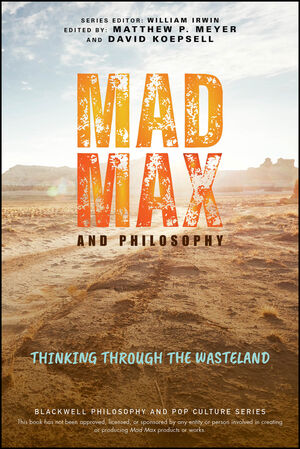
Mad Max and Philosophy: Thinking Through the Wasteland
David Koepsell (Editor), Matthew P. Meyer (Editor), William Irwin (Series Editor)

Description
Explore the philosophy at the core of the apocalyptic future of Mad Max

Beneath the stylized violence and thrilling car crashes, the Mad Max films consider universal questions about the nature of human life, order and anarchy, justice and moral responsibility, society and technology, and ultimately, human redemption. In Mad Max and Philosophy, a diverse team of political scientists, historians, and philosophers investigates the underlying themes of the blockbuster movie franchise, following Max as he attempts to rebuild himself and the world around him.

Requiring no background in philosophy, this engaging and highly readable book guides you through the barren wastelands of a post-apocalyptic future as you explore ethics and politics in The Wasteland, the importance of costumes and music, humankind’s relationship with nature, commerce, gender, religion, madness, and much more.

  • Covers all of George Miller’s Mad Max films, including Mad Max: Fury Road
  • Discusses connections between Mad Max and Nietzsche, Malthus, Mill, Foucault, Sartre, and other major philosophers
  • Follows Max’s journey from policeman and family man to lost soul in search of redemption
  • Examines the future of technology and possible impacts on society, the environment, and access to natural resources
  • Delves into feminist themes of Mad Max, such as the reversal of heroic gender roles in Fury Road and relationships between power and procreation

Part of the bestselling Blackwell Philosophy and Pop Culture series, Mad Max and Philosophy: Thinking Through the Wasteland is a must-read for anyone wanting to philosophically engage with Max, Furiosa, and their dystopian world.

Loriane Lafont-Grave, The Mystical Quality of Foucault’s Confessions of the Flesh: An Inquiry from Within, The Journal of Religion 2024 104:2, 145-170

Abstract
This article offers an investigation of Foucault’s Confessions of the Flesh—published in 2018, thirty-four years after the death of the author—through a literary approach. It argues that “The Laborious Baptism,” the second section of the first chapter of the book, “The Formation of a New Experience,” has an immersive quality of writing that signals a way of writing “from within,” to take up an expression coined by Emerson.

By putting Foucault in conversation with James Bernauer, Willemien Otten, Philippe Büttgen, and Pierre Macherey, among others, this article aims to show that Foucault’s Confessions of the Flesh may best be seen, in a final analysis, as a confessio fidei in the flesh. It owns, at some point, a mystical quality so that the book truly offers a peculiar experience to its readership. In the first part of the article, we make some metaliterary comments about the potential pitfalls of dealing with a posthumous book, helped by T. S. Eliot and Nietzsche. In the second part, we delve into “The Laborious Baptism” by making a close reading of it. In concluding remarks, we reflect on how Confessions of the Flesh may display a form of Christian parrhesia under the sign of risk-taking in keeping with Foucault’s ultima verba as a professor in his very last lecture at the Collège de France.

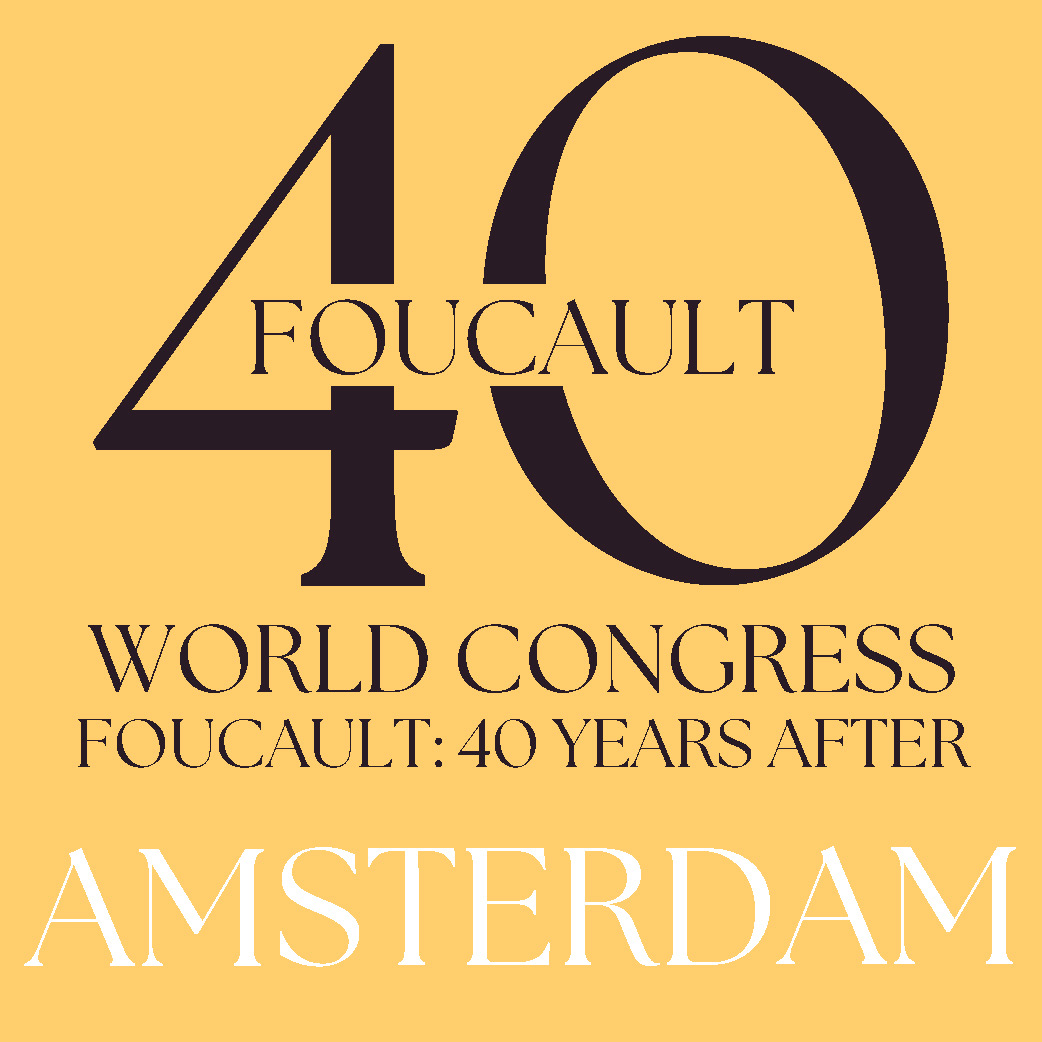
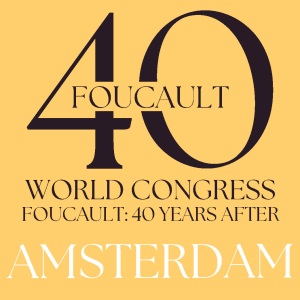
Echoes of Foucault, forty years after

The Foucault Circle NL/BE is organizing a conference about interdisciplinary uses of Foucault’s work, with a focus on themes which Foucault did not think much about himself, but we do. Among other topics, colonialism and decolonization, gender, ecology.

University of Amsterdam: Amsterdam Roeterseilandcampus
25-06-2024
Few philosophers have been such fertile and suggestive thinkers as Michel Foucault. His general theme of practices concerning ‘the subject’ led him to explore a wide range of different topics. His investigation into the subject took him from analyses of the human sciences, to dividing practices that categorize subjects as normal or abnormal, to analyses of neoliberalism, and eventually to the modes in which we change ourselves into subjects. Foucault’s work always supported emancipation of marginalized groups. Yet, many commentators have argued that, despite the wide range of his work, Foucault has left some surprising lacunae in his analyses. For example, in his work, he appears to have had little attention for feminist movements, decolonization, and climate change. The Echoes of Foucault conference aims to critically celebrate Foucault’s thought forty years after his death, by focussing on these lacunae. How is his work helpful for researchers today, across different disciplines? We will ask whether and how it might be possible to think with Foucault about these kinds of topics. With a wink, we say: Woke Foucault!

We are very happy to announce that professor Jeannette Pols will provide the keynote address.
Jeannette Pols is Professor Anthropology of Everyday Ethics in Healthcare at the department of Anthropology, Faculty of Behavioral & Social Sciences, and the department of Ethics, Law & Humanities of the Amsterdam Medical Center, University of Amsterdam. Her most recent book, Reinventing the Good Life: an empirical contribution to the philosophy of care (2023), provides fascinating insights into Foucault’s reading of the Cynics, and how to employ his concepts in our contemporary world.

The conference will be mostly in-person only. However, we will have a session with online presenters only, which will be possible to join online. The keynote address will also be live streamed. The links for the streams will be provided in due course.

Participation is free, but we kindly ask you to register through this Google Form by June 23nd:
https://forms.gle/4kwosCSZc2UpQkRy8

Conference Programme

09:30 – 10:00 Walk-in & coffee (A2.11)
10:00 – 10:45 Day opening by Guilel Treiber (A2.11)
11:00 – 13:00 Resistance and Foucault (B2.05)
Moderator: Steven Dorrestijn

Bolan Zhang Foucault’s dominant resistance, his self-critique, and a reflection of China’s resisting movements

Plami Dimova, The biopolitical manifestations of hetero-nationalism in post-Soviet countries

Goran Kusic, Ambiguity, Aesthetics, and Animosity: How P-Valley’s Uncle Clifford Resists Categorization Through an Ethics of the Self

Samu/elle Striewski, Regimes of (De)Recognition: Butler and Preciado as Foucauldian recognition theorists Rereading Foucault (C1.08)
Moderator: Michiel Leezenberg

Berend van Wijk, Between politics and friendship: avowal and the art of living

Casper Verstegen, Missing links: towards a genealogy of homo economicus

Maria Jankowska, Suicide in the Age of Biopower

Anastasiia Maslova, Digital information through the lenses of power-knowledge theory

13:00 – 14:00 Lunch (A2.11 or Waterside picnic)
14:00 – 16:00 Digital Discourse (B3.04)
(online session)
Moderator: Guilel Treiber

Giorgi Vachnadze, The Silence of Savoir: Foucault and Wittgenstein in the Classroom

Adriano Habed, Not against but with Foucault. Queer and feminist discontents with Foucault’s critique and a proposal to move forward

Jade Gonçalves Roque, The notion of punishment in Foucault before Surveiller et Punir: a new tool for Brazil’s case?

Charles Piecyk, After the ‘end of man’: a Foucauldian analysis of Transhumanism and Posthumanism as contemporary discourses on the surpassing of the human Foucault in the Field (C1.08)
Moderator: Steven Dorrestijn

Liza Steultjens, Foucault and the politics of agropastoralism: analyzing the securitization of Sahelian agri-spaces through a governmentality lens

Abigail Cunningham, Conforming to belong: a dialogic exploration of Scottish Pakistanis’ experiences of self and belonging

Dirk Lafaut, Beyond biopolitics: the importance of the later work of Foucault to understand care practices of healthcare workers caring for undocumented migrants

Kimberley Vandenhole, Eco-shaming

16:30 – 18:00 Keynote: Jeannette Pols (A2.11)
Reinventing the good life, an empirical contribution to the philosophy of care


Thought does exist, both beyond and underneath systems and edifices of discourse. It is something that is often hidden but always drives everyday behaviors. There is always a little thought occurring even in the most stupid institutions; there is always thought even in silent habits.

Criticism consists in uncovering that thought and trying to change it: showing that things are not as obvious as people believe, making it so that what is taken for granted is no longer taken for granted. To practice criticism is to make harder those acts which are now too easy… [A]s soon as people begin to no longer be able to think things the way they have been thinking them, transformation becomes at the same time very urgent, very difficult and entirely possible. (trans. mod)

Michel Foucault, (1981) [2000] “So is it important to think?” in In J. Faubion, ed., Power Translated by Robert Hurley, New York: New Press, 2000, pp. 456-7.

Thomas Nail, The Philosophy of Movement. An Introduction, University of Minnesota Press, 2024
Foreword by Daniel W. Smith

Why are city dwellers worldwide walking on average ten percent faster than they were a decade ago? Why are newcomer immigrant groups so often maligned when migration has always constituted civilization? To analyze and understand the depth of the reasons, Thomas Nail suggests that it serves us well to turn to a philosophy of movement. Synthesizing and extending many years of his influential work, The Philosophy of Movement is a comprehensive argument for how motion is the primary force in human and natural history.

Nail critiques the bias toward stasis at the core of Western thought, asking what a philosophy that began with the primacy of movement would look like. Interrogating the consequences of movement throughout history and in daily life in the twenty-first century, he draws connections and traces patterns between scales of reality, periods of history, and fields of knowledge. In our age of rapid movements shaped by accelerating climate change and ensuing mass global migration, as well as ubiquitous digital media, Nail provides a contemporary philosophy that helps us understand how we got here and how to grapple with these interlocking challenges.

With a foreword by philosopher Daniel W. Smith, The Philosophy of Movement: An Introduction is a must-read for scholars and students not only of philosophy but also history, anthropology, science and technology studies, mobility studies, and other fields across the humanities and social sciences.

Thomas Nail is distinguished scholar and professor of philosophy at the University of Denver. He is author of Matter and Motion: A Brief History of Kinetic Materialism; Lucretius III: A History of Motion; Theory of the Object; and Being and Motion.

Daniel W. Smith is professor of philosophy at Purdue University. He has translated, from French, books by Gilles Deleuze, Pierre Klossowski, Isabelle Stengers, and Michel Serres.

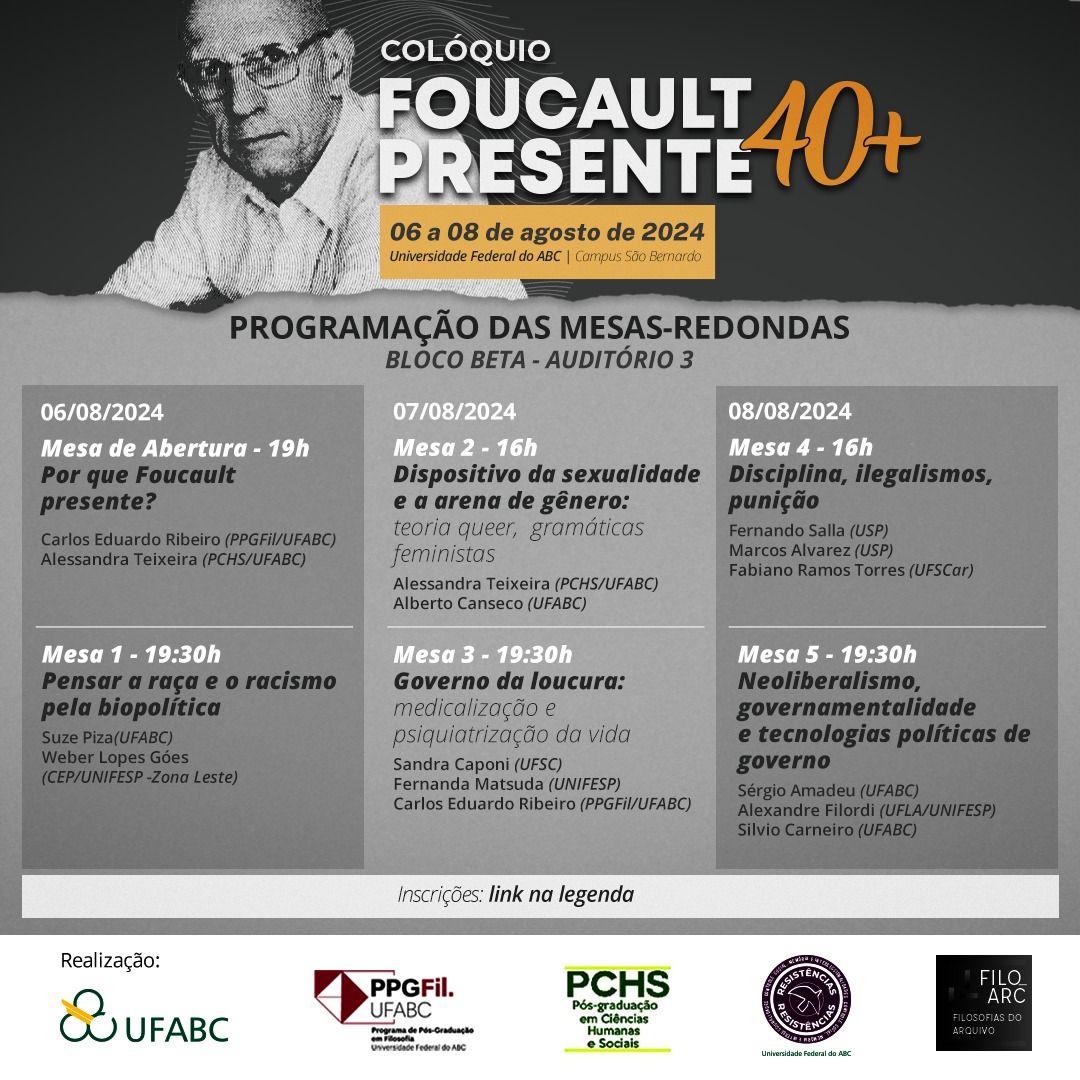
O Colóquio Foucault Presente 40+ acontecerá para celebrar a vida e a obra de um dos maiores intelectuais do Séc. XX. Na perspectiva de como a filosofia foucaultiana demanda uma análise do presente, o Colóquio tem por objetivo refletir e debater as possibilidades e os sentidos de seu legado, segundo alguns usos conceituais e metodológicos que seu pensamento emplacou séculos XX e XXI adentro. O colóquio está organizado sob a forma de mesas-redondas e 5 Grupos de Trabalhos Temáticos cujos resumos serão selecionados.

Instagram link

Qualquer dúvida encaminhar e-mail:
foucault40mais@gmail.com

Gjerde, Lars Erik Løvaas. “Biopolitical Leviathan: Understanding State Power in the Era of COVID-19 through the Weberian-Foucauldian Theory of the State”, Theoria 71, 178 (2024): 48-74,
https://doi.org/10.3167/th.2024.7117803

Abstract
The coronavirus pandemic made the biopolitics of infection control the core object of states around the world. Globally, states governed spheres usually free of state control, implementing various restrictions, closing down society in the process. This is possible due to the state’s capacities to act through and over society, grounded in the state’s powers. I argue that while the pandemic has led to useful and interesting state-centric Foucauldian literature on the politics of COVID-19, this literature has not fully taken the theoretical lessons of the pandemic into account. Explicating these lessons, I discuss how the pandemic invites us to reconsider the Foucauldian approach to the state. The purpose of this article is to combine the Foucauldian theory of power with a Weberian state theory based on Michael Mann’s work on the state and the sources of power, so to lay the foundations for a Weberian-Foucauldian theory of the state.

Keywords:
autonomous power; biopolitics; coronavirus; Foucault; lockdown; Mann

Bannikov, K.V., Radina, N.K.
Biopolitical media discourse in France in the COVID-19 pandemics
(2023) RUDN Journal of Studies in Literature and Journalism, 28 (3), pp. 553-565.

DOI: 10.22363/2312-9220-2023-28-3-553-565

Abstract
The publication activities of the French media during the COVID-19 pandemic in a biopolitical way are analyzed. The theoretical frame of the study is set by Michel Foucault’s concept of biopolitics, as well as the propaganda model of Edward Herman and Noam Chomsky. To collect and analyze empirical data, the methods of computational linguistics and the method of identifying contextual ideologemes were applied. The research materials were the texts of independent media (Le Figaro, Le Monde, Le Parisien), identified using the keywords “pandemic” and “COVID-19” during the four waves of the pandemic (from January 2020 to March 2022). A total of 29,584 Le Figaro articles, 22,446 Le Monde articles, and 6,402 Le Parisien articles were used in the research. The purpose of the research is to analyze the strategies for including the French media in the biopolitical practices of propaganda and public education on the example of the COVID-19 pandemic.

As a result of the research, it turned out that the studied media during the pandemic were integrated both into general information campaigns and into biopolitical education and propaganda campaigns. Two scenarios for organizing media discourse during the pandemic of COVID-19 were identified, determined by target groups and media tasks. The first scenario actively involves educational and propaganda tools to promote state biopolitical goals. The second scenario integrates informing readers about the COVID-19 pandemic and the measures used by the authorities for biopolitical control, with the presentation of the hierarchies of responsible persons/ institutions (within the state biopolitics). It is concluded that the participation of French independent media in the active promotion of biopolitical programs indicates their close connection with the actors and subjects of biopolitics – the state or business representatives. Copyright by the Author(s), 2023.

Author Keywords
biopolitics; ideologeme; Le Figaro; Le Monde; Le Parisien; propaganda

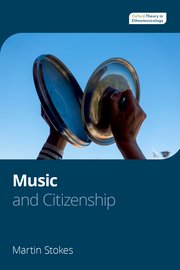
Martin Stokes, Music and Citizenship, Oxford University Press, 2023

Critical citizenship practices and the language of today’s populism have never been more sharply opposed. Today’s insistent efforts to anchor citizenship narratives in national belonging now confront a variety of ‘flexible’ or ‘differentiated’ citizenships – plural, performative, and decentered practices of rights claiming mutually defining ‘the political’, its subjects, and its others on a variety of scales. They confront, too, critiques of citizenship in totalitarian or neoliberal governmentality that derive from Foucault, Agamben, and Arendt and have become pressing today in proliferating states of emergency and exception and the growing ranks of non-citizens. How should these debates be configured now? And what place does music have in them?

In Music and Citizenship, author Martin Stokes argues that music has for a long time been entangled with debates about citizenship and citizenly identities, though for various reasons this entanglement has been insufficiently recognized. Citizenship and citizenly identity debates, for their part, have important implications for the way we think about music in relation to politics, identity, and scholarly practice. Stokes’s particular claim is that ethnomusicology has for too long configured relationships between music, society, and reflective and critical practice in terms of identity paradigms. The rejection of these identity paradigms in recent years has taken the form of a post- or anti-humanism that is equally problematic. This book challenges the conventional understanding of citizenship in terms of nationalism and national identity though the examination of case studies from across Latin America, Africa, Asia, and Europe.

In this way, this volume departs from an earlier ethnomusicology preoccupied with belonging and cultural participation in the nation-state. Citizenship-the fantasy, according to some definitions, of political community without outsiders-suggests, in this book, a different space in which one might configure such relations, one more satisfactorily, and energetically, oriented to questions about musical ecology, sustainability, democracy, and inclusivity.

  • Offers the first comprehensive review of the relationship between citizenship and ethnomusicology
  • Presents a new understanding of music and politics in the context of today’s debates about political belonging in an age of authoritarianism, failed states, and climate emergency
  • Features case studies based on new research of music and political crises in Egypt, Turkey, and United Kingdom