Foucault News

News and resources on French thinker Michel Foucault (1926-1984)

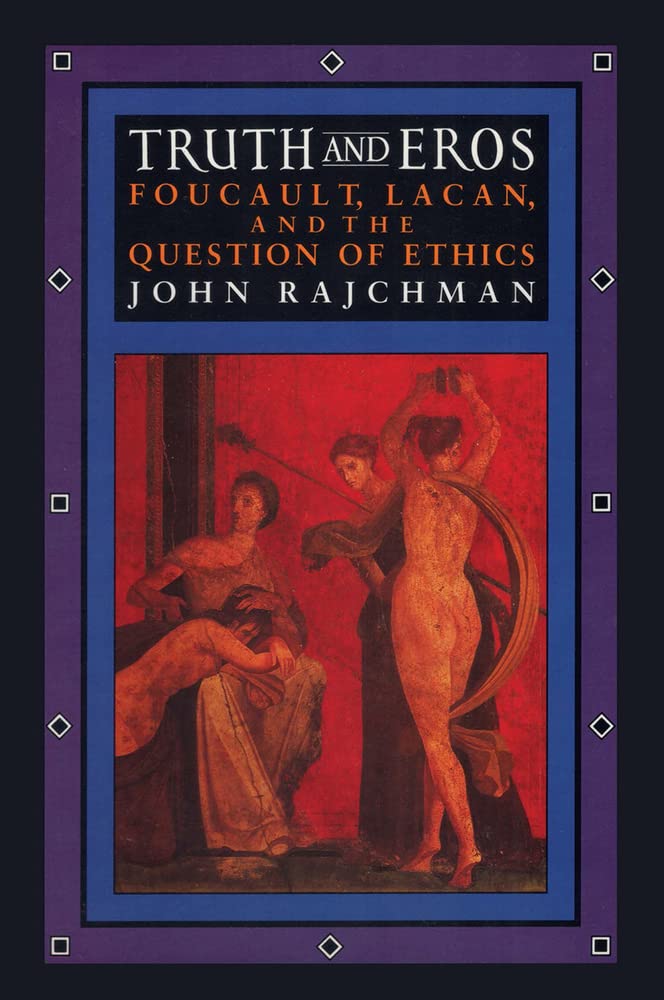
John Rajchman, Truth and Eros Foucault, Lacan and the question of ethics. Routledge, 1991. Reissued 2013

In this reissused work, first published in 1991, John Rajchman isolates the question of ethics in the work of Foucault and Lacan and explores its ramifications and implications for the present day. He demonstrates that the question of ethics was at once the most difficult and the most intimate question for these two authors, offering a complex point of intersection between them. As such, he argues that it belongs to the great tradition that is concerned with the passion or eros of philosophy and of its “will to truth”.

Truth and Eros suggests a way of reading Foucault and Lacan as philosophers who re-eroticised the activity of thought in our time, opening new and different spaces for thought and action – new types of subjectivity.

Foucault-Origine-Couv

Michel Foucault, L’origine de l’herméneutique de soi. Conférences prononcées à Dartmouth College, 1980, Paris, Vrin, coll. « Philosophie du présent / Foucault inédit », 2013 (168 pages, ISBN 978-2-7116-2509-3, 14€).

Édition établie par Henri-Paul Fruchaud et Daniele Lorenzini.
Introduction et apparat critique par L. Cremonesi, A.I. Davidson, O. Irrera, D. Lorenzini, M. Tazzioli.

En novembre 1980, Michel Foucault prononce en anglais, à Dartmouth College, deux conférences intitulées Truth and Subjectivity et Christianity and Confession. Dans ces conférences, à travers l’étude des techniques de soi, et notamment de l’examen de conscience et de l’aveu, dans l’Antiquité gréco-romaine et le christianisme primitif, Foucault retrace la généalogie du sujet moderne et de l’herméneutique de soi qui nous caractérise encore aujourd’hui.

Cette édition présente pour la première fois la traduction française des conférences de Dartmouth College, avec les variantes de la version prononcée par Foucault le mois précédent à l’Université de Californie à Berkeley. Elle présente également deux interventions inédites, contemporaines de ces conférences : un débat public qui s’est tenu à Berkeley et une interview, où Foucault répond à des questions sur ses recherches et est amené à préciser quelles sont les valeurs qui guident son travail.

L’origine de l’herméneutique de soi est le premier d’une série de volumes qui seront publiés chez Vrin dans la nouvelle collection « Philosophie du présent », dirigée par Jean-François Braunstein, Arnold I. Davidson et Daniele Lorenzini, et qui recueilleront des textes, des conférences, des débats publics et des entretiens de Michel Foucault encore inédits en français, mais aussi parfois inédits au sens propre.

Summary in English
In November 1980, at Dartmouth College, Michel Foucault pronounces two lectures in English: Truth and Subjectivity and Christianity and Confession. In these lectures, through the study of some techniques of the self, namely examination of conscience and avowal (aveu), in Greco-Roman Antiquity and Early Christianity, Foucault retraces the genealogy of the modern subject and of the hermeneutics of the self that still characterizes our contemporary Western societies.

This edition offers for the first time the French translation of the Dartmouth College lectures, together with the variants of the version of these same lectures pronounced by Foucault the previous month at the University of California, Berkeley. In addition, it offers also two unpublished interventions, contemporary with these lectures: a public debate held in Berkeley and an interview, where Foucault answers to some questions about his researches and is pushed to clarify the values that govern his work.

L’origine de l’herméneutique de soi is the first of a series of books with still unpublished texts, conferences, public debates and interviews by Michel Foucault that are going to be published by Vrin in the new collection « Philosophie du présent » (edited by Jean-François Braunstein, Arnold I. Davidson and Daniele Lorenzini).

Communiqué de presse
Collège International de Philosophie
1, rue Descartes F – 75005 Paris

Diogo Sardinha
élu Président de l’Assemblée collégiale du Collège International de Philosophie

Le Collège International de Philosophie a élu à la fin du mois de septembre le nouveau président de son Assemblée collégiale pour un mandat de 3 ans : Diogo Sardinha, 42 ans, de nationalité portugaise, devient le premier philosophe étranger à accéder à cette charge depuis la fondation du Collège en 1983.

Reçu au Collège en 2010 pour une période de six ans, Diogo Sardinha y mène un programme sur « Violence et politique : l’émeute comme forme de mouvement sauvage ». Il part de l’actualité des émeutes urbaines depuis 2005, pour réfléchir philosophiquement aux discours et catégorisations que suscitent ces événements.

La philosophe suisse Marie-Claire Caloz-Tschopp, professeure émérite de l’Université de Genève, occupe le poste de vice-présidente. Avec une large expérience des relations internationales et une œuvre particulièrement attentive aux thèmes de l’exil et de la citoyenneté, elle renforce l’ouverture au monde qui marque cette nouvelle étape de la vie de l’institution.

Également directrice de programme depuis 2010, Marie-Claire Caloz-Tschopp travaille sur « Exil, création philosophique et politique : repenser l’exil dans la citoyenneté contemporaine ». Ses recherches se situent sur le terrain de la migration, en coopération étroite avec des professionnels de la santé, du social, du droit et du service public, mais aussi avec des migrants exilés et des exilés du monde du travail et de l’appartenance politique au sens large.

La confiance manifestée en ce « tandem » par les membres de l’Assemblée collégiale, avec 63% des voix dès le premier tour, est l’illustration la plus récente de l’ouverture grandissante du Collège à l’international, qu’on constate depuis plusieurs années par l’augmentation du nombre des directeurs et directrices de programme formés (aussi) dans d’autres pays. Actuellement, 30% des membres du Collège, soit quinze sur cinquante, dirigent des programmes hors de France, établissant ou renforçant des liens privilégiés avec leurs pays de résidence ou de vie (Allemagne , Brésil , Canada, Chine, États-Unis, Italie, Japon, Portugal, Royaume-Uni et Suisse).

À eux s’ajoutent des directeurs de programme qui, basés en France, travaillent sur d’autres parties du globe, du Maghreb et du pourtour méditerranéen à l’Amérique Latine. Le Collège tirera parti de cette richesse pour renforcer son rayonnement, montrant que la philosophie française n’est plus seulement faite à partir des structures de formation, de recherche et d’enseignement traditionnelles, mais elle comprend désormais une myriade de penseurs qui,- n’étant pas nés en France, ont adopté le français comme langue de travail. Simultanément, cette réalité s’oppose au prétendu déclin de la langue française en philosophie.

Actuellement chercheur invité à l’Université de Columbia à New York, Diogo Sardinha a été formé dans les Universités de Lisbonne et de Paris et a mené, pendant les dernières années, des travaux notamment en Allemagne et au Brésil , pays avec lesquels il entretient des liens étroits. Il succède à Mathieu Potte-Bonneville, président de 2010 à 2013. Fondé par François Châtelet, Jacques Derrida , Jean-Pierre Faye et Dominique Lecourt, le Collège a fêté son trentième anniversaire en juin dernier.

Information in English
[Editor: Updated 16 April 2026 to page archived on the Wayback Machine]

Diogo Sardinha

Diogo Sardinha (ICLS Visiting Scholar July-December 2013) is the Chair of the Collège International de Philosophie in Paris where he also heads the research program “Violence and Politics” (2010-2016). He studied philosophy at Lisbon (B.A. 1997) and at Paris-Nanterre (M.A. 1999, Ph.D 2005) before continuing his research in São Paulo and Berlin. He is a full member of the Center for Philosophy of Science of the University of Lisbon. His main books are Order and Time in Foucault’s Philosophy (in French, 2011), and The Emancipation from Kant to Deleuze (in French, 2013). His research project at the ICLS is entitled “Anthropology After The ‘End of Man’: Kant, Foucault, and the contemporary renewal of the reflection on human being”.

Nicolas Thirion, Des rapports entre droit et vérité selon Foucault : une illustration des interactions entre les pratiques juridiques et leur environnement, Revue interdisciplinaire d’études juridiques, 2013/1 (Volume 70), 180-88.

Further info and PDF for download

Abstract
La contribution est consacrée à la présentation synthétique de deux ouvrages récemment parus transcrivant la parole délivrée par Michel Foucault dans le cadre d’un cours au Collège de France, d’une part , et d’une chaire Francqui au titre international à l’Université Catholique de Louvain, d’autre part , qui sont l’occasion de reprendre, sous un angle différent, un problème que le philosophe français avait déjà abordé plus tôt dans les années 1970 : celui des rapports entre les modes de production de la vérité et le droit.

Gabriel Hürlimann, Hobbes, Foucault et la peur de la révolte, Rue Descartes 2013/1 (n° 77), 52-68

Further info and full article

Sommaire
Traduit de l’allemand par Ariane Kiatibian
Dans cet article, une lecture foucaldienne du Léviathan de Hobbes nous permettra de soutenir la thèse selon laquelle un examen attentif de l’argument contractualiste de Hobbes en faveur de la souveraineté absolue permettrait de mettre au jour dans sa pensée une peur de la révolte : il ne s’agira pas ici de rendre impossible la survenue de guerres réelles mais d’éliminer toute possibilité de révolte au sein des systèmes étatiques. Dans un premier temps, Grotius nous guidera dans le débat sur la question, soulevée à l’époque moderne, de savoir si des rapports pacifiés sont possibles au sein des systèmes étatiques, ce qui nous conduira dans un second temps à analyser la réponse donnée par Hobbes en mobilisant la lecture foucaldienne du Léviathan pour thématiser cette thèse.

Christopher Chitty, Foucault’s Addendum, The New Inquiry, 3 September 2013

Finally published, Foucault’s lecture notes from 1970–71, his first year teaching at the Collège de France, demolish the caricatures of his thought.

On the first page of the lecture notes of January 27, 1971, Michel Foucault scrawled “incomplete” in his notoriously undisciplined hand. This bit of marginalia from the first year of his public lectures at the Collège de France (one of the last sets to be collected and published in English) hangs like an augury of the end of Foucault’s career, cut short by AIDS. If it’s hard not to hear artful references to his impending death in some of the final lectures at the Collège in 1984, it’s harder not to feel a deeper sense of loss with these lectures, of which there are no recordings, only notes.

In these first lectures at the Collège, the most prestigious teaching appointment in the French Academy, Foucault invited his audience to begin where he would eventually end in 1984: in sixth and fifth century Athens. The starting point will come as a shock to Foucault’s exegetes, who have been operating under the assumption that Ancient Greece was a “late” preoccupation of his. On this and many other points, the publication of Lectures on the Will to Know Lectures at the College de France, 1970-1971 requires a sweeping revision of prevailing receptions of his work.

Read more

Source:  Progressive Geographies

Mark Muhannad Ayyash, The paradox of political violence (2013) European Journal of Social Theory, 16 (3), pp. 342-356.
https://doi.org/10.1177/1368431013476567

Abstract
This article explores the paradoxical relationship between politics and violence in the concept of political violence. By examining the works of prominent theorists, such as Hannah Arendt and Frantz Fanon, the article highlights both the difficulty of separating politics and violence, and the improbability of formulating a harmonious relationship between them. Engaging with some of Michel Foucault’s work on power and violence, the article begins to formulate a theoretical approach that conceptualizes political violence in its inherently paradoxical condition.

Author Keywords
Foucault; political violence; power

Verena Erlenbusch, The place of sovereignty: Mapping power with Agamben, Butler, and Foucault (2013) Critical Horizons, 14 (1), pp. 44-69.
https://doi.org/10.1179/15685160X13A.0000000003

Abstract
This article addresses the relationship between sovereignty, biopolitics and governmentality in the work of Giorgio Agamben, Judith Butler, and Michel Foucault. By unpacking Foucault’s genealogy of modern governmentality, it responds to a criticism leveled against Foucauldian accounts of power for their alleged abandonment of the traditional model of power in juridico-institutional terms in favor of an understanding of power as purely productive. This claim has most significantly been developed by Agamben in “Homo Sacer: Sovereign Power and Bare Life”. I argue that Judith Butler’s analysis of power, in particular in her essay “Indefinite Detention”, presents a more differentiated account of power that registers the significance of practices of sovereignty and resonates with Foucault’s lectures on “Security, Territory, Population”. © W. S. Maney & Son Ltd 2013.

Author Keywords
Agamben; Biopolitics; Butler; Foucault; Governmentality; Sovereignty

DOI: 10.1179/15685160X13A.0000000003

Lorenzini, Daniele. “What is a ‘Regime of Truth’?” Le foucaldien 1, no. 1 (2015): 1–5. DOI: https://doi.org/10.16995/lefou.2 [Note: In 2022, Le foucaldien relaunched as Genealogy+Critique.]

Originally published online 28 October 2013
Open access

Abstract
In this paper, I offer an overview of the ways in which Foucault defines and uses the concept of ‘regime of truth’ in his works between 1975 and 1980, focusing especially on his lectures at the Collège de France On the Government of the Living. There, I argue, a substantial shift takes place, which corresponds to the emergence of the dimension of subjectivity at the heart of the concept of regime of truth itself. This shift bears witness to Foucault’s elaboration of a new critical project, namely that of a genealogy of our contemporary regime of truth ‘indexed to subjectivity’.

Keywords: critique, government, regime, subjectivation, truth, Foucault

From the Critical Theory blog

Eugene Wolters, Listen to Foucault Lecture in English: The Culture of the Self, 27 September 2013

In the following audio recording, Michel Foucault lectures at UC Berkeley in 1983, a year before his death, on the subject “The Culture of the Self.”

Foucault starts with a story written by Greek satirist Lucian. In the story, Hermotimus, a Greek philosopher, walks mumbling in the street. A friend sees Hermotimus, approaches him, and asks him what he is mumbling about. “I’m trying to remember what I have to tell my master,” Hermotimus tells his friend.

Foucault explains that we learn that Hermotimus, to the point of financial ruin, has been paying for lessons with his master for 20 years. Hermotimus explains that he needs another 20 years of lessons before he can arrive at the end of his training. The point of these lessons, we learn, is for Hermotimus to learn how to best take care of himself.

“I am sure none of you is a modern Hermotimus,” Foucault continues, “but I hold a bet that most of you have met at least one of those guys who now-a-days regularly visit a kind of master who takes their money from them in order to teach them how to take care of themselves.” The crowd laughs. The name of these modern masters, Foucault continues, were called “philosophers” in antiquity.