Foucault News

News and resources on French thinker Michel Foucault (1926-1984)

Patrick Gamez, Ricoeur and Foucault: Between Ontology and Critique, Etudes Ricoeuriennes/ Ricoeur Studies (ERSS), Vol 4, No 2 (2013)

doi: 10.5195/errs.2013.160 Link to full PDF

Abstract
In this paper, I trace some of Ricoeur’s criticisms of Foucault in his major works on historiography, and evaluate them. I find that Ricoeur’s criticisms of Foucault’s archaeological project in Time and Narrative are not particularly worrisome, and that Foucault’s “critical” project actually provides alternatives for enriching and expanding on some of Ricoeur’s later insights in Memory, History, Forgetting and – in particular – for troubling the distinction made between critique and ontology.

Keywords
Foucault, critique, ontology, history, historiography

Semester 2 tutoring vacancy for Habermas/Foucault-based subject at Swinburne

A tutor is needed at Swinburne for a two-hour Friday afternoon Social and Political Philosophy tutorial centred around Habermasian deliberative democracy and Foucauldian power relations, for twelve weeks  starting  8 August next.  Please email a CV and expression of interest, preferably by Monday next, 14 July, to Dr Paul Healy, Convenor, Philosophy and Cultural Inquiry, Swinburne University of Technology; email phealy@swin.edu.au

http://www.swinburne.edu.au/health-arts-design/staff-profiles/view.php?who=phealy


Several items for sale here – framed prints, t-shirts, baby clothes, prints, tank tops, hoodies…

Oh No! A Shirt About A Game About Foucault by Kunzelman

Related to this earlier post on Foucault news

Foucault, Governmentality, Context: Contextualised analysis power (27 – 29 October 2014)
PhD School
PhD School in Organisation and Management Studies

Update October 2025: Link above is to the archived page on the Internet Archive Wayback Machine.

Location
Copenhagen Business School
Porcelænshaven
2000 Frederiksberg
Denmark

Enroll no later than
Monday, 15 september, 2014 – 23:45

Faculty 

Mitchell Dean, Professor of Public Governance, CBS/University of Newcastle, Australia,

Michael Behrent, Assistant Professor, Department of History, Appalachian State University

Kaspar Villadsen, Associate Professor, Department of Management, Politics & Philosophy, CBS, Denmark.

Marius Gudmand-Høyer, Post.Doc. Scholar, Department of Management, Politics & Philosophy, CBS, Denmark.

Mads Peter Karlsen, Post.Doc., Institute of Theology, Copenhagen University.

Course coordinator
Kaspar Villadsen & Mitchell Dean
Prerequisites

Only PhD students can participate in the course.

A precondition for receiving the course diploma is that the student attends the whole course.

Aim 

The course will provide the participants with:

a) An updated introduction to key analytical concepts in the Governmentality literature, and the potentials and weaknesses of these concepts will be discussed.

b) Possibilities for supplementing the governmentality approach with other analytical sources will be discussed.

c) Furthermore, a detailed consideration of the current status of governmentality studies and post-Foucauldian studies will be given, in particular in light of recent claims for a crisis of critique.

d) Finally, suggestions will be presented on how to elaborate or move beyond the framework of governmentality by activating concepts of bio-power and sovereignty, reconsidering the social and notions of society, and focusing on international dimensions of governmentality.

In brief, the course aims to provide participants with a thorough understanding of the governmentality framework, that is, its analytical possibilities, its current status, and its possible directions of development.

Description

Over the last 20 years, post-Foucauldian “governmentality studies” have come to growing prominence. These studies have been effective in critically analysing new types of liberal government, in particular by demonstrating ‘the active side of laissez faire’. They describe how the motto of ‘pulling back the state’ has been accompanied by a series of governmental strategies and technologies aimed at shaping institutions and subjects in particular ways. Perhaps most noticeably, they have presented a diagnosis of a proliferation of regimes of enterprise and accounting in new and surprising places. But a wide range of other domains have been subjected to governmentality analysis spanning from genetic screening and risk calculation, new crime prevention strategies, to health promotion by self-responsibilisation. To be sure, the concepts in governmentality studies continue to constitute effective tools for critical social analysis.

Nevertheless, in recent years critical objections have been raised against the governmentality approach. It has been noted by some observers that the Foucauldian and post-structuralist language, originally used for critical academic purposes, seems to be increasingly appropriated by ‘the powers’ that were the object of such critique. Most notably, this point has been voiced (although in different versions) by Zizek, Boltanski, and Hardt & Negri. These thinkers suggest that a post-structural ’politics of difference’ increasingly seems to be an integral part of the ways, in which institutions and companies organise themselves. If modern liberal government has begun to speak for the dissolution of binary essentials, the destabilisation of rigid power structures, the creation of space for the subject’s self-transforming work upon itself, and so on. In light of this development, we need to think of ways to revitalise the Foucauldian concepts of critique/criticism or to push a critical perspective beyond Foucault. A central theme of the PhD course is the search for effective analytical strategies for critique of power (some perhaps less noticed) in the works of Foucault and other writers within and outside the governmentality tradition.

The course gives importance to the need for contextualizing both the concepts that we use for making analysis, both in terms of being aware of how concepts emerge in a particular historical-political context that shape them. We shall hence discuss how to do intellectual history on recent thinkers, including Foucault himself. Foucault’s most intensive reflection on political questions was in the 1970s.  Given that the key source of his reflections here are lectures and interviews, we should attend to this reflection less as elaborated theory and more as a kind of performance in a definite context with specific interlocutors. A Foucault very different from his Anglo-American decontextualized reception as a theorist of omnipresent micropowers emerges if we do so. There are of contemporary events and political currents: European terrorism, state socialism, French Maoism, the Iranian Revolution, the prospects of a Socialist government in France, etc. But there are specific interlocutors including his assistants (Kreigel, Ewald), seminar participants (Pasquino, Procacci, Rosanvallon), colleagues (Donzelot, Castel, Deleuze), auditors, political fractions such as the Second Left and Italian autonomist Marxists.  If statements should be read in terms of what they do as much as what they mean, then the diverse trajectories of these thinkers are also relevant to reading Foucault’s political thought.

The course requires the submission of a paper that deals with conceptual problems or analytical designs in relation to Foucauldian inspired/governmentality studies. Furthermore, papers that apply Foucauldian concepts to empirical problems in a variety of domains are welcomed. It is also possible to participate on the basis of an abstract stating the theme of the PhD project. An abstract should be approximately 1 page, whereas a paper should be approx. 5 pages. In both cases, the PhD student should state his main analytical challenge/concern at his/her current stage in the project.

Papers/abstracts must be in English. Deadline for submission is 17 October 2014.

Teaching style 

The course will use lectures given by specialists in the field, roundtable discussions, and presentation of papers from PhD students.

Participation in the course requires a paper with an outline of PhD project or parts of the project. See more details above.

Lecture plan

Monday 27 October
10:00-12:30: Kaspar Villadsen: Analytical approaches in governmentality studies

12:30-13:30: Lunch

13:30-16:00: Mitchell Dean: Concepts and signatures of power in Foucualt

16:00-17:00: Kaspar Villadsen & Mitchell Dean: Papers from PhD scholars

Tuesday 28 October
10.00-12.30: Michael Behrent: Foucault and the context for his thought on power.

12:30-13:30: Lunch

13.30-15.00: Kaspar Villadsen: Technologies and organisations in Foucault

15.00-17.00: Kaspar Villadsen, Michael Behrent & Mitchell Dean: Papers from PhD scholars

Wednesday 29 October 
10:00-11:30: Mads P. Karlsen: Foucault’s Maoist militancy

11:00-12:30: Mitchell Dean: Foucault and neoliberalism

12.30-13.30: Lunch

13:30-15:00: Marius Gudmand-Høyer: Dispositive analysis: the key concept in Foucault?

15.00-16.00: Kaspar Villadsen, Mitchell Dean, Michael Behrent: Papers from PhD scholars

16:00-17:00: Kaspar Villadsen & Mitchell Dean: Concluding discussion and evaluation

Course literature 

Behrent, M. (2009) “Liberalism Without Humanism: Foucault and the Free Market Creed”, Modern Intellectual History, 6: 539-568.

Behrent, M. (2010) “Accidents happens: François Ewald, the ‘antirevolutionary Foucault”, and the intellectual politics of the French welfare state”, Journal of Modern History 82 (3): 585-624.

Dean, M. (2013) The Signature of Power: sovereignty, governmentality and biopolitics. Sage: London, chapters 2.3.4.

Dean, M. (2014) “Rethinking neoliberalism”, Journal of Sociology 50 (2): 150-163.

Dean, M. (2010) Governmentality: Power and Rule in Modern Societies (2nd edition). London: Sage (especially Introduction to Second Edition and chapter 1).

Foucault, M. (2007) Security, Territory, Population. New York: Palgrave Macmillan (especially lecture 1 & 5).

Foucault, M. (2008) The Birth of Biopolitics. New York: Palgrave Macmillan (especially lecture 12).

Deleuze, G. (1990) “Postscript on Control Societies”, in: G. Deleuze: Negotiations 1972-1990. New York: Columbia University Press

Karlsen, M.P. & Villadsen, K. & (2008) “Who Should Do the Talking? The proliferation of dialogue as governmental technology”, Culture & Organization, 14(4).

Karlsen, M.P. & Villadsen, K. (2014) “Investigate ‘The Intolerable’: Foucault’s Maoist inspirations”, New Political Science (forthcoming).

Mirowski, P. (2012) Never Let a Serious Crisis Go to Waste: how neoliberalism survived the financial meltdown. London: Verso, chs 2, 3.

Raffnsøe, S. & Gudmand-Høyer, M. The Dispositive, Unpublished article.

Villadsen, K. (2011) “Modern Welfare and ‘Good Old’ Philanthropy”, Public Management Review, 13(8): 1057–1075.

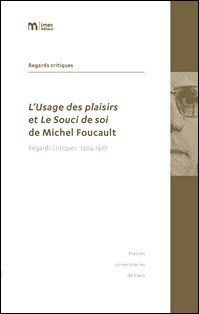
MF_HSL’Usage des plaisirs et Le Souci de soi de Michel Foucault. Regards critiques 1984-1987
coédition PUC – IMEC, Juillet 2014
Dossier coordonné par Luca Paltrinieri.

Textes choisis et présentés par Philippe Artières, Jean-François Bert, Sandra Boehringer, Philippe Chevallier, Frédéric Gros, Luca Paltrinieri, Judith Revel.

Collection Regards critiques.

Avec L’Usage des plaisirs et Le Souci de soi, Michel Foucault reprend, après huit ans de silence, le fil interrompu d’une histoire de la sexualité. Entre-temps, toutefois, le projet a changé profondément : il ne s’agit plus seulement d’étudier les concepts et les normes qui règlent la sexualité, mais aussi les formes et les modalités du rapport à soi par lesquelles les individus se constituent et se reconnaissent comme sujets. La première réception des deux ouvrages témoigne ainsi d’un double étonnement : la découverte d’un nouveau registre de la pensée foucaldienne qui se tisse autour de la subjectivation et l’inexistence, dans les sociétés anciennes, d’une « sexualité » comme ensemble de pratiques humaines définissant l’identité homosexuelle ou hétérosexuelle.

powerlifting-judging-squatKyle Keough, Powerlifting and Philosophy III: What Michel Foucault Can Tell Us about Enforcing Rules in Powerlifting, Lift: Stronger is Better site

Editorial comment: One of the things I most enjoy about running this blog is the sheer diversity of applications (even tenuous ones) in relation to Foucault’s work.

It has been a great many months since I’ve attempted to pen the third addition to a “Powerlifting and Philosophy” I started once upon a time. The premise of this series, originally, was to adopt different philosophical perspectives; these perspectives, I wagered, might shed new light on some of the most regularly debated (and admittedly tired!) subjects in powerlifting: meet preparation, the raw-versus-gear debate, and now, in this third addition, enforcing standards.
….
Concluding paragraph
My point, in writing this article, is to make the argument, through Foucault’s concept of self-discipline, that not only is a certain element of self-discipline necessary for the sport of powerlifting, but that self-discipline must be balanced by the non-discipline, deferrals to authority, and non-committal stances that other lifters associate themselves with. Together, these groups give powerlifting’s discursive community a healthy balance. While the sport is not perfect, this balanced discursive community makes the sport better. Regardless of what side you find yourself on, try to see the value in the existence of your adversaries.

Read more

Philippe Fournier, Foucault and International Relations, E-International Relations, May 12 2014

Extract

Michel Foucault’s name will be familiar to most IR scholars and his influence on the discipline appears to be beyond doubt. The work that Foucault inspired in International Relations is invariably associated with the post-structuralist approach and includes theoretical interventions as much as detailed genealogies. This is not to say that tracing Foucault’s influence on IR is an easy task. Indeed, the fact that he had very little to say about international politics in his own work, that many IR scholars refer to him only parsimoniously, and that his thought is ever-dynamic, elusive, and occasionally frustrating presents some challenges. Nonetheless, it can be traced in the different phases of poststructuralist inquiry in International Relations. First, Foucault’s influence can be found in the early critiques of reigning paradigms in IR theory; second, in discourse analysis; and third, in global governmentality studies. In this short piece, I revisit some of Foucault’s philosophical inclinations, methods, and concepts, and relate them to a series of significant currents and authors in the discipline. Needless to say, the scholars mentioned here do not constitute an exhaustive selection.

Read more

Dotan Leshem, Embedding Agamben’s Critique of Foucault: The Theological and Pastoral Origins of Governmentality, Theory, Culture & Society, June 30, 2014

doi: 10.1177/0263276414537315

Abstract

This article tackles Giorgio Agamben’s critique of Michel Foucault’s genealogy of governmentality in two ways: first, by presenting an alternative model of the relations between pastoral and theological economy and, second, by conducting a genealogy of the former as revealed in the state of exception, when canon law is suspended. Following the author’s genealogy of oikonomia in the state of exception, he argues that politics and economy are distinct from one another by virtue of the fact that the primary relation of the latter is one of inclusion while that of the former is one of exclusion. Finally, the author traces three of oikonomia’s prolific qualities in the operation of governmentality in civil society and of market economy: (i) its inclusiveness; (ii) the constant representation of the irreconcilability of law and authority; and (iii) its operation by accommodating to the ways of the governed.

Michel Foucault, La société punitive: an editorial curiosity

by Graham Burchell, 2014

Graham Burchell is the translator into English of the lectures Foucault delivered at the Collège de France. With thanks to Graham Burchell for sending this note to Foucault News.

Translating Foucault’s Collège de France lectures, La société punitive, I have come across the following curiosity, which, unless I am mistaken, no one has commented on before now. In the “Résumé du cours”, p. 261, discussing the model of talion (lex talionis, an eye for an eye), Foucault remarks that this model was never proposed in a detailed way, but that it did enable different types of punishment to be defined. He then gives, apparently, two examples from Beccaria’s Dei delitti e delle pene. The first is: “Les attentats contre les personnes doivent être punis de peines corporelles (the penalty for violence against persons should be corporal punishment)”. This corresponds, more or less, to the reference to Becccaria given by the editors of Dits et Écrits in footnote 10, p. 261. The second example, however, is rather confusing: “les injures personnelles contre l’honneur doivent être pécuniaires (personal injuries to honor should be pecuniary)”. This is confusing for two obvious reasons. First, the phrase just does not make sense as it is. Second, if we supply the missing words “punis de peines” to give “doivent être punis de peines pécuniaires (should be punished by pecuniary penalties)”, then the example does not in any way support Foucault’s point that the talion model was used to define different types of punishment: a pecuniary punishment for an injury to honor is not an example of talion.

The solution is found in the references given by the Dits et Écrits editors (and reproduced in the previous English translation by Robert Hurley), and in the lecture of 24th January 1973, p. 70 and p. 82 notes 34, 35, and 36. Here we find not two, but three examples:

– violence against persons; corporal punishment

– injury to honor; penalty of infamy

– robbery without violence; pecuniary punishment.

All three of which do support Foucault’s argument. What seems to have happened is that the second and third examples have been merged, with suppression of the second’s punishment and the third’s offense.

The most likely explanation for this is a simple transcription error, a line skipped perhaps, either by Foucault himself or by his editors. The garbled example appears in the earlier publication of the Résumé des cours. 1970-1982, by Julliard in 1989, but this did not contain any notes or references that might have directed a reader to the source of the examples. However, what does seem strange to me is that, again, unless I am mistaken, this has not been picked up before, not even by the Dits et Écrits editors who supplied the references to Beccaria that allow us to restore the correct examples. It is, of course, a minor curiosity, and absolutely nothing of importance hangs on it, but maybe it contains a lesson for all of us who have read these old lines without ever noticing anything odd.

Graham Burchell

Wendy Grace — We Nietzscheans: Foucault and Deleuze, Difference, and the Battle to Think Philosophically Otherwise.

France occupies a singular position in debates about Nietzsche, and Foucault and Deleuze are invariably singled out as French Nietzscheans par excellence. But what does this label “Nietzschean” really mean? Is it useful or misleading for understanding the respective trajectories of Foucault and Deleuze, not to mention the nebulous umbrella term “post-structuralism”? Many commentators have assumed that Foucault and Deleuze were propelled by the same Nietzsche, a man who lived during the 1870s and 1880s as a “philosopher.” I argue that this locks Nietzsche into the history of philosophy, overlooking his role inaugurating a history of Western culture, otherwise known in Foucauldian terms as the history of systems of thought. As Foucault argued during the Colloque de Royaumont in July 1964, “The history of philosophy should not be confused with an archaeology of thought.”

Moreover, the philosophical understanding more readily suits Deleuze’s appropriation of Nietzsche as philosophe maudit – even granting the difficulty of pinning down a Nietzschean system in the first place. But while Deleuze reads Nietzsche as a “counter philosopher”, Foucault admires and emulates Nietzsche in a role I would call “ethnographer of the present.”

Of all concepts associated with post-structuralism, “difference” has curiously evaded critical scrutiny. But difference has opposite if not contradictory meanings in Deleuze and Foucault. Essentially for Deleuze, difference is internal to the individual, immediate (non-representational), and elucidated through a strictly philosophical method. For Foucault, on the other hand, difference is external, dependent on representational truth regimes for its effects, and made manifest through various interpretative strategies broadly ethnographic and comparative.

Note from Wendy Grace to Foucault News

For those interested, this abstract refers to a draft of a paper that I subsequently developed for the Special Issue of Foucault Studies (April 2014) on the topic of Foucault and Deleuze, edited by Morar, Nail & Smith. My paper “Making a Difference with Nietzsche” is one of seven included in the issue.

Needless to say, this paper too only scratches the surface of a fascinating history of the concepts of force, will and power, Nietzsche’s take up of them, and the subsequent readings by Deleuze and Foucault. I’d like to say: “watch this space” but progress is glacial at this stage – climate change will probably get there faster.

Wendy Grace holds an Honorary Research position at both the University of Western Australia and the University of Queensland. She completed her doctorate at UWA in 2010, with the thesis Michel Foucault’s Power: A History of Sexuality Beyond the Desires of French Psychoanalysis. She has published an article on Foucault and Deleuze in Critical Inquiry (2009), a chapter on “Foucault and the Freudians” in the Blackwell Companion to Foucault (2013), and is the author, with Alec McHoul of A Foucault Primer (1992). Wendy has taught on Foucault and 20th century French intellectual history at UWA, as well as the history of anthropological ideas at Murdoch University. Her research interests include 18th and 19th century French and German intellectual history. Her current research relates to Foucault’s account of the Malthusian Couple within the history of heterosexuality, with particular focus on the scientific uncoupling of pleasure and procreation in the 19th century.