Foucault News

News and resources on French thinker Michel Foucault (1926-1984)

Resisting Force and Discourse

Host: California State University, San Marcos

Date: Friday, September 26, 2014

Location: University Student Union, Ballroom

Keynote Speaker: TBA

Conference Website

The conference theme brings into critical light the way that bodies are marked and regulated by discursive practices and spaces, and institutional procedures. This operational force can take the form of juridical and normative practices.

Examples of juridical practices include but are not limited to current police protocols, immigration requirements, and sexuality-managing legislation. In their operation, these forces betray their impingement upon raced, gendered, and classed bodies. As such, the conference solicits papers that challenge neutral and objective neoliberal practices that ultimately regulate, disqualify, torque, and punish bodies at the margins of classification.

The conference theme further recognizes that the regulation of marginal bodies is not limited to institutional codes. Social norms are an essential disciplinary mechanism in the reproduction of the dominant order. Indeed, conformity to, or deviation from, norms designates which subjects are the proper recipients of accusation, disavowal, and injury. Denial of normative power can occur on multiple grounds including: sex work, living with HIV, body size, sexual orientation, and being gender-nonconforming. As such, the conference also invites papers that engage with the regulatory effects of normative power.

We highly encourage submissions from graduate students and advanced undergraduates for fifteen minute presentations. Academic disciplines and methodologies across the humanities and social sciences may be used. Research questions may include, but are not limited to:

  • How is the policing and norming of marginalized bodies represented in literature and film? Or, newer cultural mediums, such as MMORGs and internet spaces?
  • How do state regimes of punishment similarly besiege parolees and racial minorities?
  • Does the U.S immigration system constitute a branch of biopolitical administration?
  • What are the modern norms of surveillance that may be going unnoticed?
  • How is the human body a political site (i.e., hunger strikes, self-branding, gender bending, trans politics)?
  • What is the function of the citizen “Other”?
  • Do social norms challenge the viability of HIV+ persons as subjects proper, leaving only a dangerous corporality?
  • Which social norms are challenged through the undocuqueer identity marker and movement?
  • Do all white subjects possess normative power?
  • How do queer subjects challenge dominant procedures and norms through queer world-making practices? How is this portrayed in popular media, activism, etc.?
  • Where do we find alternative networks, spaces, and autonomous zones? How are they constituted (i.e., spaces of reprieve and crisis heterotopias)?
  • How do juridical and normative systems produce catastrophic violence that no one seems responsible for?
  • Finally, critical theory and psychoanalytic approaches to the conference theme are welcome.

 Submissions: Please submit a 250 word abstract to foucault.madness@gmail.com by August 15, 2014. In the email body include your name, institutional affiliation, and email address.

For any questions about the conference, or our bi-monthly reading group, please contact us at foucault.madness@gmail.com.

rsjeffrey's avatarRobin Jeffrey

“In every generation a slayer is born. One girl in all the world, the Chosen One. She alone will stand against the vampires, the demons and the forces of darkness. She is the Slayer” (Buffy).  For more than seven seasons, fans of the television show Buffy the Vampire Slayer tuned in weekly and heard this prophecy of the Slayer. The knowledge of being the Slayer and the power that comes with that title changed the entire course of Buffy’s life, shaping her and those around her, including her younger sister, Dawn.

Buffy (top right) and Dawn (bottom left) Buffy (top right) and Dawn (bottom left)

In the final season of the show, the audience learns that there are hundreds of girls, scattered across the globe that are all potential slayers. Anyone of these girls could be the next Slayer, not yet imbued with the same level of power as Buffy, but still possessing instincts…

View original post 989 more words

stuartelden's avatarProgressive Geographies

Foucault’s major works – his sole-authored books, plus some articles – will appear in a two-volume collection in 2015 as a prestigious Pléiade edition. Thanks to Colin Gordon for alerting me to the news. Frédéric Gros is interviewed about this here (in French). Among other things the interview says that the final Collège de France course, Théories et institutions pénales (1971-1972), is due out in 2015, and that, in common with other volumes, the Pléiade volumes will be a critical edition.

View original post

Hear Michel Foucault’s Lecture “The Culture of the Self,” Presented in English at UC Berkeley (1983), Open Culture, August 6th, 2014

Michel Foucault’s time in the United States in the last years of his life, particularly his time as a lecturer at UC Berkeley, proved to be extraordinarily productive in the development of his theoretical understanding of what he saw as the central question facing the contemporary West: the question of the self. In his 1983 Berkeley lectures in English on “The Culture of the Self,” Foucault stated and restated the question in a variety of ways—“What are we in our actuality?,” “What are we today?”—and his investigations amount to “an alternative to the traditional philosophical questions: What is the world? What is man? What is truth? What is knowledge? How can we know something? And so on.” So write the editors of the posthumously published 1988 essay collection Technologies of the Self, titled after a lecture Foucault delivered at the University of Vermont in 1982.

Read more

Jacobs, F., Claringbould, I., Knoppers, A.
Becoming a ‘good coach’
(2014) Sport, Education and Society, . Article in Press.

Abstract
The purpose of this paper was to gain insight into how coaches problematized their coaching practices and the process in which they engaged to become what they perceived to be better coaches using a course based on critical reflective practice. We assumed that constant critical self-reflection would enable coaches to move closer to their individual idea of a ‘good coach.’ Scholars and coaches collaborated to develop course content. The course was built on principles of rational-emotive education. We drew on Foucault’s conceptualization of self-constitution or modes of subjectivation and confessional practice and Knaus’ approach to teaching for our analytical framework. Thirty-five coaches participated in this study. The data consisted of semistructured interviews, field notes, open-ended questionnaires and focus group. The results are presented per mode of change or transformation. We explored how coaches wanted to transform their coaching practice (ethical substance), how they defined a good coach (mode of subjection), how they worked on change (ethical work) and how they transformed themselves (telos). To gain further insight into this process, we also examined narratives of three coaches as they described why and how they changed. The practice of critical reflection seemed to meet the needs of the coaches involved in the study. They used it to continually examine their behavior and their normalized taken-for-granted beliefs and to transform themselves in the direction of their idea of a ‘good coach.’ Ontological reflection was seen as a tool and a process that requires continual practice.

Author Keywords
Coach education; Evaluation; Good coach; Reflection; Transformation

DOI: 10.1080/13573322.2014.927756

Chloë Taylor, Birth of the Suicidal Subject: Nelly Arcan, Michel Foucault, and Voluntary Death, Culture, Theory and Critique, Published online: 23 Jul 2014
https://doi.org/10.1080/14735784.2014.937820

Abstract
Michel Foucault argues that it is not sex but death that is the true taboo in the modern, biopolitical era. The result is that regular death has been privatised and institutionalised, wars are waged in the name of life, capital punishment has become a scandal, and suicide has become a problem for sociological and psychiatric analysis rather than law. In contrast to the dominant view, Foucault portrays suicide not as a mark of pathology but as a form of resistance (tragic or pleasurable) to disciplinary power, and argues for an aestheticisation of voluntary death as part of a beautiful life. Through a reading of the writings of Québecoise author Nelly Arcan, this essay presents but also critiques and expands upon Foucault’s accounts of suicide, exploring the thesis that the pathological model of suicide produces the subjects that it intends to treat.

Michelle Murphy, The economization of life, parts 1 and 2 (2014)
Conversation recorded with Michelle Murphy in Toronto on June 21, 2014

Link to audio and further info

Update October 2025: The link above is to the archived page on the Internet Archive Wayback Machine

This conversation with Michelle Murphy is divided into two parts:

BIOPOLITICAL FEMINISM: The first part introduces Foucault’s concept of biopolitics and applies it to forms of economization of life particularly in relation to female bodies. Paraphrasing Foucault, Michelle affirms that governmental capitalism needs for “some must not to be born so that future others will live more consumptibly, productively in the logic of macro-economy .” She thus unfolds the political history of regulation and ‘marketing’ of reproduction and contraception that organizes such an economization of life at a scale of a population. Further, we discuss of Michelle’s concept, “The Girl” as the problematic current vessel of financial investment in the context of imperial humanitarianism.

CHEMICAL INFRASTRUCTURES: The second part considers the body as topological, blurring the limits between inside and outside and, following Peter Sloterdijk think of it as a “being-in-the-breathable.” Michelle has been working on the elaboration of the concept of “chemical infrastructures” to think of our era as the Anthropocene: a time when all atmospheres are fundamentally manufactured (deliberately or not) by human activity. Following Spinoza and his approach of the Genesis’s apple, we talk of our ignorance, as humans, of what ecologies really are, and how we can start thinking of them as ethical systems rather than moralistic ones.

Michelle Murphy is a Professor in the History Department and Women and Gender Studies Institute at the University of Toronto, with graduate appointments in Science and Technology Studies at York University and the Institute for the History and Philosophy of Science and Technology at U of T. She is an organizer of the Toronto Technoscience Salon. I am also coordinator of the Technoscience Research Unit. She is the author of Seizing the Means of Reproduction: Entanglements of Feminism, Health, and Technoscience (Duke UP, 2012) and Sick Building Syndrome and the Problem of Uncertainty: Environmental Politics, Technoscience, and Women Workers (Duke UP, 2006), as well as the co-editor of Landscapes of Exposure: Knowledge and Exposure in Modern Environments, Osiris v. 19 (University of Chicago Press, 2004).

Foucault’s freedom, Johanna Oksala interviewed by Richard Marshall, 3:AM Magazine, Friday, August 1st, 2014.

Update October 2025: Link above to archived page on the Internet archive Wayback Machine

Oksala_talk2

Johanna Oksala is a political philosopher who broods on Foucault, thinks that it’s time people stopped thinking in terms of continental vs analytic, thinks about Foucault and freedom, on Foucault, politics and violence, on Chantal Mouffe’s compelling ideas,on state violence, on why neoliberal rationality must be resisted, and on political spirituality. She’s out there making windows where there were once walls…

3:AM: What made you become a philosopher?

Johanna Oksala: I initially started to study philosophy because it seemed like an easy subject that wouldn’t consume too much of my precious time – I was young so my primary interest at the time was to study life! I was involved in various forms of anarchist politics such as squatting and organizing illegal parties and events in different European cities. While that was exciting and eye opening in many ways, it also taught me that genuine political change requires that people fundamentally alter the way they think. I believe that good philosophy can sometimes do that: it can make possible completely new ways of seeing the world around us. (I have also discovered since that philosophy is not easy at all and nowadays it consumes practically all my time!)

read more

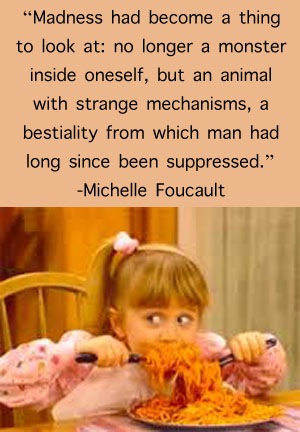
Michelle Foucault: Full House child star by day, French philosopher by night

tumblr blog created by artist Buzz Slutzky.

A sample…
tumblr_blog-michelle-foucault

Courtney Szto & Sarah Gray
Forgive me Father for I have Thinned: surveilling the bio-citizen through Twitter
(2014) Qualitiative Research in Sport, Exercise and Health, . Article in Press.

https://doi.org/10.1080/2159676X.2014.938245

Abstract
The Biggest Loser (TBL) is a reality weight-loss television show that aims to address the notion of an ‘obesity epidemic’ by instructing viewers about how to be responsible for their own health. The popular American show, produced by the National Broadcasting Company, has become a televised confessional for contestants, whereby participants are asked to reflect on their health struggles and express general disgust, disappointment and/or hope about their changing physical state. This study observes that many viewers take their cue from the contestants and use social media to confess their own health sins and ask for redemption. The goal of this study was to provide insight into how viewers of TBL make sense of and interact with the information (re)produced by the television show by analysing viewer engagement through Twitter. Drawing on the work of Michel Foucault, the authors argue that Twitter facilitates the ability to create a public record of personal transgressions, obedience and transformation, which are necessary confessional processes for the production of ‘good’ bio-citizens. Viewers of TBL were observed to facilitate their own captivity and regulation in the Obesity Clinic, an invisible structure that invites individuals to adhere to normative concepts of behaviour. This analysis concludes by arguing for the cancellation of TBL due to the dangerous precedent it creates for both its contestants and viewers.

Author Keywords
Biggest Loser; confession; obesity; surveillance; Twitter