Foucault News

News and resources on French thinker Michel Foucault (1926-1984)

Columbia Center for Contemporary Critical Thought Launches

New Center Will Be Directed By Critical Thought Professor Bernard E. Harcourt, Who Has Challenged Conventional Wisdom on Practices including Mass Incarceration, Free Market Economics, Broken Windows Policing, and Racial Profiling

Media Contact: Public Affairs, 212-854-2650 or publicaffairs@law.columbia.edu

New York, October 7, 2014—The roots of critical thought go back at least to French Renaissance writer Michel de Montaigne, but a new Columbia Law School and Faculty of Arts and Sciences initiative will apply the age-old interdisciplinary approach to a host of modern issues, including the use of surveillance as a mode of government power in the age of Big Data.

The initiative, launched this fall by Columbia Law School Professor Bernard E. Harcourt, is called the Columbia Center for Contemporary Critical Thought and will bring together scholars and students who are engaged in developing novel ways of understanding how legal and scientific knowledge is produced and organized.

Embraced by philosophers ranging from Nietzsche, Freud, and Marx to Michel Foucault, critical thought takes place at the intersection of law, social sciences, and the humanities.

Harcourt, Isidor and Seville Sulzbacher Professor of Law joined the Columbia Law School faculty in July. He describes critical thought as a “logic of suspicion” that attempts to dismantle commonly held beliefs by demonstrating how they have been constructed over time. In his own work, Harcourt has used critical thought and empirical data to argue against racial profiling, broken windows policing, and mass incarceration, to question free market economics, to reexamine asylums and institutionalization in this country and abroad, and to explore the idea of political disobedience. His latest work, including a book forthcoming in 2015, critically examines government and corporate surveillance in the context of social networking sites such as Facebook and Twitter—or what he calls “digital security” and its effects on governing, exchanging, and policing.

“The mission of the Columbia Center for Contemporary Critical Thought is to nourish, explore, encourage, and support critical reexamination of the received wisdom of our time,” Harcourt said. “The task of contemporary critical thought is to question and challenge the authority of established truths and falsehoods, to challenge their empirical foundations, and to engage in forms of practice that test the limits of knowledge.”

Under Harcourt’s direction, the center will provide opportunities for students to analyze how critical thought can be applied to real-world scenarios. Next semester, Harcourt and University of Chicago Professor W.J.T. Mitchell will co-teach Spectacle and Surveillance, a seminar that will examine surveillance in a time of near-total information storage and retrieval. The course is partially funded by a grant from the Mellon Centre for Disciplinary Innovation.

The center also will host short-term seminars with renowned contemporary theorists, sponsor lectures and workshops, organize book events and colloquia, and create a reading group for faculty members and graduate students across Columbia University. The first one-week seminar will take place in November with François Robert Ewald, the recently retired chair of insurance studies at the Conservatoire National des Arts et Métiers (Paris) and Foucault’s primary assistant from 1976 to 1984. A spring seminar will feature Renata Salecl, a philosopher whose recent work has focused on the anxiety produced by choice.

Another dimension of the center will allow students to participate actively in litigation and policy initiatives addressing such criminal justice practices as capital punishment and prison terms of life imprisonment without parole, with the goal of tying practice to critical thought.

“Critical thought bridges philosophy, political theory, sociology and social theory, anthropology, classics, law, art criticism, and cultural studies,” Harcourt said. “It represents an epistemological approach that is reflected in a wide range of disciplines and approaches.”

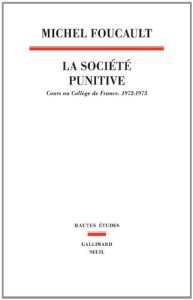
Harcourt is the author of several books, including Occupy: Three Inquiries in Disobedience with Michael Taussig and W.J.T. Mitchell (University of Chicago Press 2013) and The Illusion of Free Markets: Punishment and the Myth of Natural Order (Harvard University Press 2011). He is also the editor of Foucault’s 1973 Collège de France lectures, La Société punitive (Gallimard 2013) and co-editor of Foucault’s 1981 Louvain lectures, Wrong-Doing, Truth-Telling (University of Chicago Press 2014). His scholarship has examined the sociology of punishment and penal law and procedure, including through pioneering empirical research on asylums and prisons. In addition to his work as a scholar, Harcourt represents death row inmates pro bono and has served on human rights missions in South Africa and Guatemala.

Before joining Columbia Law School, Harcourt served as the Julius Kreeger Professor of Law and Political Science at The University of Chicago, where he was the chairman of the political science department. He also holds a chair at the École des Hautes Études en Sciences Sociales in Paris.

# # #

Columbia Law School, founded in 1858, stands at the forefront of legal education and of the law in a global society. Columbia Law School combines traditional strengths in corporate law and financial regulation, international and comparative law, property, contracts, constitutional law, and administrative law with pioneering work in intellectual property, digital technology, tax law and policy, national security, human rights, sexuality and gender, and environmental law.

Join us on Facebook
Follow us on Twitter: www.twitter.com/columbialaw

Performing Sexual Liberation: The Body and the Medical Authority of Pornography

A critical counter point to the current academic trend for analysing pornography as sexually liberating for women

Further info

Date 24 October 2014
Duration One day
Venue College Court
Fee £7
Contact Dr Heather Brunskell-Evans        hbe1@le.ac.uk
Book now only 50 places available

Keynote Speakers

Dr Gail Dines, Wheelock College, Boston, USA:
Neo-liberalism, Pornography and the De-fanging of Feminism

Dr Stephen Maddison,
the University of East London, UK:
Make Love Not Porn? Pornography and the Entrepreneurial Voyeur

Dr Meagan Tyler, Victoria University, Melbourne, Australia:
Spectacular Sex: The Collision of Sexology and Pornography
Outline

Description
The 21st century has witnessed a growth in academic interest in what has come to be understood as the pornographication of culture.

The purpose of this conference is to gather a group of scholars together whose approach provides a critical counter point to the current academic trend to analyse pornography as sexually liberating for women (and men).

The conference addresses whether pornography, as an emblem of sexual freedom in a democratic society, needs rethinking. It aims to do so through analysing the complex inter-relation of pornography with branches of medicine (for example, sexology and psycho-therapy, and the pharmaceutical industry that helps support these latter) which afford pornography considerable legitimacy and even authority with regard to sexuality. The conference provides the opportunity to explore the relationship between pornography and medicine within the context of larger social structures and neo-liberal government.

The papers presented critically examine the increasing medical authority of pornography in the light firstly of feminist ideas, and secondly, of the rapidly changing conditions of neo-liberalism, global capitalism and digital-technologies.

Selected presentations include:

  • ’Squirting’ and the pathologisation of female sexuality as uncontrollable.
  • The disciplinary production of the pornographic body.
  • Dark desires versus natural sex: medicine, pornography and the history of women’s sexuality.
  • The confessional health practices of male porn performers.
  • Pornographic assistance in bio-political times.

Schedule

09:30-10:00 Registration

10:00-10:15 Welcome and Opening Remarks
Dr Heather Brunskell-Evans, Centre for Medical Humanities, University of Leicester

10:15-10:50 Key Note: Neo-liberalism, Pornography and the De-fanging of Feminism
Dr Gail Dines, Wheelock College, Boston, USA

10:50-11:10 Coffee

11:15-11:50 Key Note: Make Love Not Porn? Pornography and the Entrepreneurial Voyeur
Dr Stephen Maddison, University of East London, UK

11:50-12:25 Key Note: Prescribing Porn: Sexology, sex therapy and the construction of ideal sex
Dr Meagan Tyler, Victoria University, Melbourne, Australia

12:30-13-30 Lunch

13:30-15:00 Theme 1: The Disciplined Body

13:30-13:45 The Violable Body: cosmetic practices and the pornographic (de)construction of women’s bodies
Dr Julia Long, Anglia Ruskin University, UK

13:45-14:00 Dark Desires versus “Natural” Sex: medicine, pornography and the history of women’s sexuality
Dr Tracy Penny Light and Dr Diana Parry, University of Waterloo, Canada

14-00-14:15 The Performance and Consumption of the Erotic Body
James Kay, University of Warwick, UK

14:15-14:30 Pornography and the Enfreakment of Disability
Dr Helen Pringle, University of New South Wales, Sydney, Australia

14:30-15:00 Questions and discussion to the Panel

15:00-15:30 Tea

15:30-17:00 Theme 2: The Performing Body

15:30-15:45 Squirting: one in the eye for feminism!
Rebecca Inez Saunders, King’s College, UK

15:45-16:00 Focusing Foucault’s ‘Lens’ on Adult Film Performer’s Sexual Health Within the Sexual Health Setting
Gregory King, University of Greenwich, UK

16:00-16:15 Pornography, sexualising sexism, and sexual consent: exploring how young people talk about gender in pornography and about sexual consent
Dr Maddy Coy, London Metropolitan University, UK

16:15-16:45 Questions and discussion to the Panel

16:45-17:00 Comfort break

17:00-17:45 Plenary

17:45-18:00 Final Remarks – ways forward: Heather Brunskell-Evans

18:00-19:00 Wine reception

Andrew Zimmerman,
Foucault in Berkeley and Magnitogorsk: Totalitarianism and the limits of liberal critique
(2014) Contemporary European History, 23 (2), pp. 225-236.

https://doi.org/10.1017/S0960777314000101

Abstract
Returning to Stephen Kotkin’s Magnetic Mountain: Stalinism as a Civilization almost two decades after its publication allows us to take stock, from a slight temporal distance, of the reception in our discipline of the work of Michel Foucault. Magnetic Mountain is the one of the books that came out of a project that Kotkin and a number of other students began under Foucault’s direction at the University of California, Berkeley in 1983 (p. xviii). Foucault’s work in California occurred during a particular turn in his political thinking, a moment when he experimented with liberal alternatives to the left theories of the first decades of his career. Kotkin’s book is not simply an application of a general Foucauldianism, but rather of a specific California Foucault.

Colin Gordon, Plato in Weimar. Weber revisited via Foucault: two lectures on legitimation and vocation, Economy and Society, Volume 43, Issue 3, 2014

DOI: 10.1080/03085147.2014.956464

The text that follows brings together two papers about resonances between late lectures: Weber’s lectures of 1918 on science and politics as vocations, and Foucault’s final courses (1980–84) on subjectivity, truth and the political. The title alludes to Foucault’s 1983 discussion of Plato’s political experiences in Sicily, as narrated in his Seventh Letter, juxtaposed to Weber’s public interventions in Germany at the time of the foundation of the Weimar Republic. Linked to this is an exploration of the centrality in the work of both Weber and Foucault of an historical ethnography and ethology of the political, and of the forms of connectivity in our cultures between ethics, truth and government.

pscyhiatricPower and the Psychiatric Apparatus: Repression, Transformation and Assistance, Edited by Dave Holmes, University of Ottawa, Canada, Jean Daniel Jacob, University of Ottawa, Canada and Amélie Perron University of Ottawa, Canada
Ashgate, 2014

Further info

Drawing on a broad range of approaches in the fields of sociology, anthropology, political science, history, philosophy, medicine and nursing, Power and the Psychiatric Apparatus exposes psychiatric practices that are mobilized along the continuum of repression, transformation and assistance. It critically examines taken for granted psychiatric practices both past and current, shedding light on the often political nature of psychiatry and reconceptualizing its central and sensitive issues through the radical theory of figures such as Foucault, Deleuze and Guattari, Goffman, and Szasz. As such, this ground-breaking collection embraces a broad understanding of psychiatric practices and engages the reader in a critical understanding of their effects, challenging the discipline’s altruistic rhetoric of therapy and problematizing the ways in which this is operationalized in practice.

A comprehensive exploration of contested psychiatric practices in healthcare settings, this interdisciplinary volume brings together recent scholarship from the US, Canada, the UK, Europe and Australia, to provide a rich array of theoretical tools with which to engage with questions related to psychiatric power, discipline and control, while theorizing their workings in creative and imaginative ways.

Meenal Tula & Rekha Pande
Re-inscribing the Indian courtesan: A genealogical approach
(2014) Journal of International Women’s Studies, 15 (1), pp. 67-82.

https://vc.bridgew.edu/jiws/vol15/iss1/5/

Full PDF

Abstract
Women historiography has been one of the major concerns of the feminist movement particularly since 1960s. Looking at the figure of the courtesan in India-its histories, representations, repression and re-emergence, the paper seeks to problematize discourses of both Universalist and minority history writing that have been built around these women. In the context of Post-Colonial theory, and in the light of the dynamic nature of the categories of Truth, Power, Knowledge, and Discourse, the paper seeks to salvage Foucault’s methodology of writing a genealogical history as opening new avenues within the history of the courtesan in India in particular and women’s history writing in general.

Author Keywords
Courtesans; History writing; Indian women; Women on the margins; Women’s history

katherinelbryant's avatarevoneuro

Some background: A few weeks ago on Twitter I floated around the idea of writing a semi-regular blog post on my experiences reading Foucault for the first time as a neuroscience grad student/MRI researcher.  There was some interest, so here’s my first write-up on my experiences and reactions to reading Michel Foucault’s History of Madness, as part of Professor Lynne Huffer’s course (WGS 475) here at Emory.

In this first chapter, Foucault is retracing/uncovering/attempting to uncover the basis of Western ideas related to insanity and institutionalization. We learn about the role of the leper, leprosy, and the leper colony in the European middle ages, where infected individuals were isolated and contained outside city walls, providing a sort of delineation between society and these outcasts. How is this related to insanity or madness? Well, Foucault is building a case for the replacement of the leper, as the infection began to…

View original post 555 more words

Paul Hanna
Foucauldian Discourse Analysis in Psychology: Reflecting on a Hybrid Reading of Foucault When Researching “Ethical Subjects”
(2014) Qualitative Research in Psychology, 11 (2), pp. 142-159.

https://doi.org/10.1080/14780887.2013.853853

Abstract
This article attempts to address a novel dilemma the author recently faced when undertaking qualitative psychological research into sustainable tourism. The article embraces notions of reflexivity to highlight how the research process was far removed from the sanitised version often presented in research methods textbooks. The article provides a reflexive account of the struggles of analysing Internet and interview data in relation to sustainable tourism via the dominant version of Foucauldian Discourse Analysis familiar to many qualitative/critical psychologists. Turning to an account of Foucault’s later work on ethics, this article presents an alternative approach to Foucauldian Discourse Analysis that adopts a hybrid reading of Foucault’s work on power, knowledge, and ethics. Drawing on Foucault’s four precepts helps us explore the ways individuals “cultivate the self as an ethical subject,” and interview data are presented to highlight the ways such an approach can enrich analysis. It is concluded that while presenting issues surrounding understandings of structure and agency, such an approach did offer a pragmatic solution to an ethical question and may indeed be useful in a range of other areas.

Author Keywords
ethics; Foucauldian Discourse Analysis; knowledge; power; reflexivity

stuartelden's avatarProgressive Geographies

318prs0sjdlMy substantial (c. 8,000 words) essay on Foucault’s La société punitive is forthcoming in Historical Materialism.

Thanks to Sebastian Budgen for his invitation to write this, and Alberto Toscano for taking it through two rounds of review.

My shorter review of this important lecture course appeared in Berfrois earlier this year. You can also hear me lecturing on the course in Melbourne here.

View original post

Ian Hunter, History of Theory workshop

When: October 8th, 12pm-5.30pm

Where: C2.05, Burwood campus, Deakin University, Melbourne, Australia

12pm. Prof. Ian Hunter (UQ): History of Theory: a précis

1pm. Dr Matthew Sharpe (Deakin): Idols of the Den in the Personae of the Theorist

2pm. A/Prof. Adrian Jones (LTU): “Theory” as coming out of Being or as an Ascesis: Implications of New Notions of Mind

3pm. Dr Richard Sebold (LTU): Truth, History, and the Persona of the Theorist

4pm. Prof. Jack Reynolds (Deakin): University metaphysics today: the analytic-continental divide and the fate of transcendental phenomenology in the light of Hunter

5pm. Prof. Ian Hunter (UQ): rejoinders, discussion

5.30 conclude

The workshop is hosted by the European Philosophy and the History of Ideas Research Group (EPHI), Deakin University.

For further information, please contact Jack Reynolds