See also artist’s site
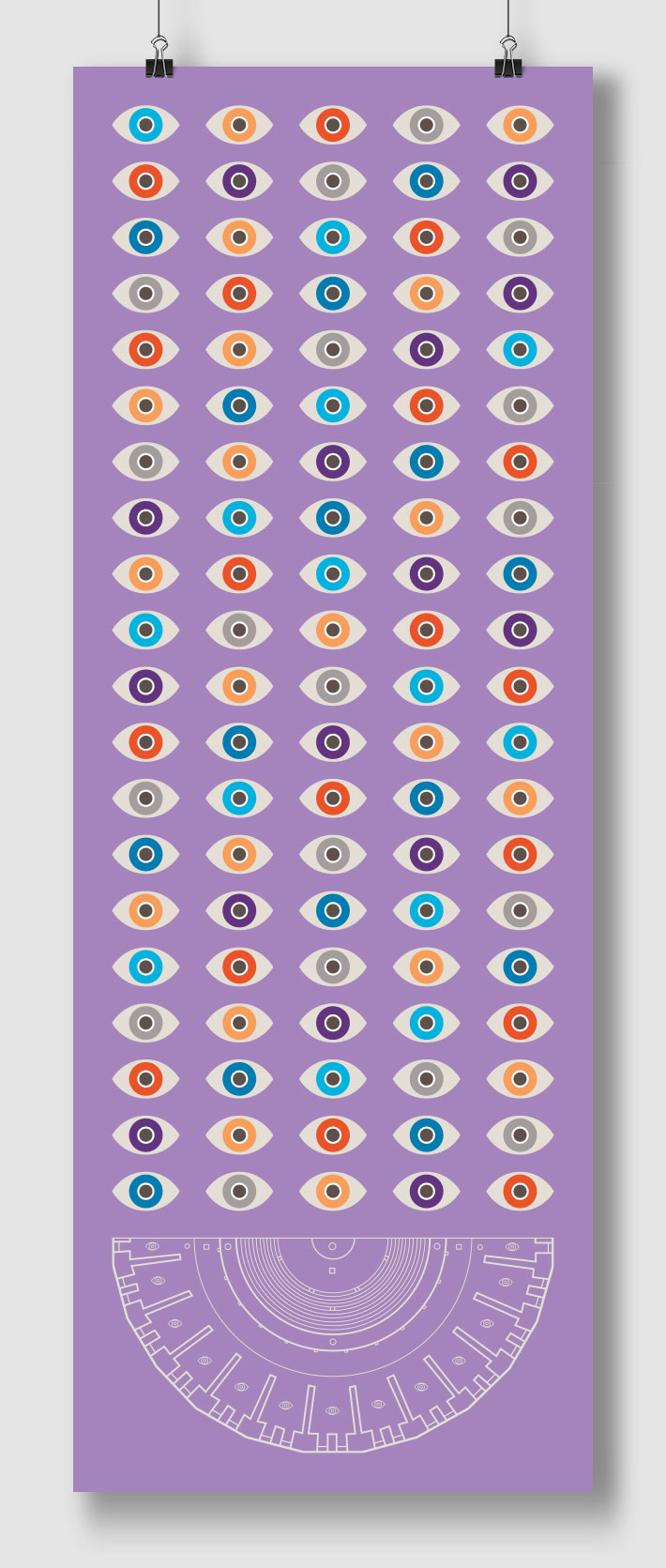
360 Foucault, 2014
Andy Bennett
01:00 projected video loop
Dimensions vary with installation
*Preferred viewing: 1080p

See also artist’s site
360 Foucault, 2014
Andy Bennett
01:00 projected video loop
Dimensions vary with installation
*Preferred viewing: 1080p

To Be King – Christine Dixie
To Be King by Christine Dixie is an animated video installation informed by the first chapter in Michel Foucault’s book ‘The Order of Things’ (1966), entitled Las Meninas.
Opening Reception: 26th February 2015 from 6pm, Preview from 4pm with the artist
Exhibition: 26th February – 7th March 2015 (Sulger-Buel Lovell Cape Town)
Talk by James Sey: 28th February 11am (limited space available, please book, free of charge, RSVP to info@sulger-buel-lovell.com)
To be King is informed by the essay ‘Las Meninas’ which Michel Foucault published in 1966 as the first chapter to his book The Order of Things. Foucault in his description of the painting by Velàsquez suggests (amongst other things) that it is through language, the taxonomy of the day, that things are ordered. This order, particular yet tenuous, is dependent on who is in control of the gaze, who is ‘king’.
To be King situates itself as a destabilizing narrative in which the king is ‘dethroned’. Positioning characters and spaces from the periphery in the place from which the dominant gaze originates points to the possibility of a different order of things and highlights the fragility of the established and dominant order.
The sculptural component, the Black Infanta embodies everything the Spanish King, Philip IV is not. Her pose imitates that of the seventeenth century portrait paintings of royal children. She is placed on an enlarged headrest, an object associated with sleeping, dreaming and the unconscious and holds instead of a sceptre, orb or sword, a stick made of Port Jackson willow.
The Black Infanta’s placement in front of the ‘painting’ places her in the role reserved for the king for whom Las Meninas was originally made and who also stands outside the frame of the painting. Completing the circuit of gazes is the museum guard who role is witness to the viewer looking at the ‘painting’. In addition she functions as an ironic indicator of status, an embodiment of the value placed by the cultural centre on a ‘masterpiece’.
You can find a large number of open access books and articles on Foucault at Open Editions. Items are mainly in French and Spanish with a few in English.
You can also find open access academic articles through the search engine FreeFullPdf and JURN (with thanks to David Haden for the JURN link).
Lectures de Michel Foucault
3 volumes originally published by ENS editions, now available in their entirety as open access at Open Edition books
Les interventions et discussions réunies dans les trois volumes des Lectures de Michel Foucault sont issues de trois rencontres. La première, organisée à l’initiative de l’association Autrement dit, de l’association pour le centre Michel-Foucault et du Centre de recherches en rhétorique, philosophie et histoire des idées (CERPHI – ENS Fontenay / Saint-Cloud) eut lieu à Chauvigny les 31 mai, 1er et 2 juin 1996. La seconde était organisée à Fontenay-aux-Roses par le Centre de recherche sur la pensée politique italienne (CERPPI – ENS Fontenay / Saint-Cloud) le 14 décembre 1996, à l’occasion de la parution du cours de 1976 au Collège de France « Il faut défendre la société ». Enfin la troisième rencontre, consacrée aux Dits et écrits, était organisée conjointement par le CERPHI et le Centre de synthèse. Elle s’est déroulée à Paris le 23 octobre 1997.
Lectures de Michel Foucault, 1
À propos de « Il faut défendre la société »
Textes réunis par Jean-Claude Zancarini
2001 – ISBN 2-9021126-80-8 – 118 pages
Lectures de Michel Foucault, 2
Foucault et la philosophie
Textes réunis par Emmanuel da Silva
2003 – ISBN 2-84788-017-8 – 138 pages
Lectures de Michel Foucault. Volume 3
Sur les Dits et écrits
Pierre-François Moreau (dir.)
Michael Bibby, Foucault’s Lectures on ‘Psychiatric Power’ at the Collège de France (1973-74)
Notes on selections
Here is a selection I have made from Foucault’s lectures at the Collège de France between 1973-4, translated by Graham Burchell, and published by Macmillan in 2006 with the title Psychiatric Power.
The first thing I think that should be said about these lectures, given their title, is that they should be viewed as less about the ‘power of psychiatry’ and more about the ‘psychiatric character of power’ (although as soon as I invoke the word ‘power’ I feel the need to place that loaded word in quotation marks, to bracket it off, so that its meaning is no longer self-evident, and it is allowed to wander in the uncertainty of its meaning. Perhaps a better word here would be ‘discipline’, with which it is more or less synonymous).
In these lectures Foucault’s takes up again some of the themes which he first took up in Histoire de la folie. In some respects, it could be seen as a follow up to that earlier work which took up so much of his energies and represented the culmination of his first efforts (chronologically it begins roughly where that book left off, and, after all, he did say that Histoire de la folie was going to be the first volume of a much larger work), but it can also be seen as preparatory work for his Discipline and Punish (which was published the following year). Here is a link to a selection from the chapter ‘The Birth of the Asylum’ from Histoire de la folie.
My selection represents an attempt to distill the contents of these lectures so that they can be allowed to express themselves more forcibly (of course, it can in no way be said to replace the Macmillan publication, and I can satisfy my conscience for the crime of violating intellectual property laws– even though the size of my selection falls under 10% of the text– with the knowledge that, if anything, my dissemination of its contents will only lead to more interest in that publication). I have also added some supplementary material to further augment the text.
Here is the link to a selection I have made from Tuke’s Description of the Retreat, and see here for a selection from Pinel’s Treatise on Insanity.
Thomas Zummer. Foucault, the apparatus and the sublime. 2014
http://www.egs.edu/ Thomas Zummer, artist and independent scholar, giving a talk on the apparatus in Foucault and Agamben, the phantasma and the sublime. In the final section of the clip, Leslie Thornton’s film “A philosopher’s walk on the sublime” is shown. Theorists discussed include Foucault, Nietzsche, Agamben, Heidegger, Sophocles, Jean-Luc Nancy and others. The talk essentially presents a complex meditation on the philosophical concepts of dispositif/apparatus, withdrawal, violence, the sublime, the phantasm and the aporias of communication. Public open lecture for the students and faculty of the European Graduate School EGS Media and Communication Studies department program Saas-Fee Switzerland Europe 2014 Thomas Zummer and Leslie Thornton.
Thomas Zummer is an artist and lecturer at the Tyler School of Art and a visiting professor in critical studies in the Transmedia Programme at the Hogeschool Sint Lukas, Brussels, as well as visiting professor at the European Graduate School in Saas-Fee. Thomas Zummer is an internationally aclaimed independent scholar and writer, as well as being an artist and curator. As an artist he has exhibited internationally since 1976, including at Exit Art, Thread Waxing Space, and The Dia Foundation in New York City as well as at the CAPC in Bordeaux and Wigmore Hall in London. With his wife, they have had a long collaboration as well with The Wooster Group, acting in many of their performances. Most recently, Zummer was artist in residence at the haudenschildGarage in La Jolla, California. In 1995 Thomas Zummer won 5th Prize in the ACA/CODA Architectural Design Competition for the City of Atlanta for the 1996 Olympics.
Education has played an essential role in the development of Thomas Zummer as both an artist and writer. His academic career began in Michigan where his undergraduate studies at Delta College and University of Michigan. Zummer’s undergraduate studies focused on paleozoology, philosophy and cinema. In 1974 Thomas moved to Hartford, Connecticut. Thomas Zummer obtained his BFA in 1976, focusing on Aesthetics and Cinema Studies at the Hartford Art School / University of Hartford. Thomas Zummer participated as a panelist and attended seminars at the Center for 20th Century Studies at the University of Wisconsin in Milwaukee room 1979-82. From 1980-81 Thomas was at the New School for Social Research where he was a graduate faculty and studied philosophy. In 1982 Thomas Zummer began his studies with Paul de Man and Jacques Derrida at Yale University in the Comparative Literature department. Thomas Zummer then worked as a research assistant to Michel Foucault. at the University of California, Berkeley. From 1981-86 Zummer studied with Michel Foucault, Jacques Derrida, Umbert Eco, Paul Ricoeur and John Searle at the University of Toronto, Institute for Semiotics and Structural Studies. From 1991-92 Zummer studied Arabic Languages at The New School for Social Research.
CFP: Conference: Discipline and Punish – Today
November, 5th to 7th
Bremen, Germany
Update October 2025. Link above is to the archived page on the Internet Archive Wayback Machine.
This conference is about how we can use and develop Foucault’s analysis from Discipline and Punish now, 40 years after its publication. We invite you to submit abstracts no longer than 500 words until April 31st 2015.
You may of course give your talk in English, but a passive understanding of German is needed to follow the discussions and to read the full CFP:
Frieder Vogelmann/Jörg Bernardy/Martin Nonhoff
Überwachen und Strafen heute
Bremen, 5.-7. November 2015
Vor genau 40 Jahren veröffentlichte Michel Foucault Überwachen und Strafen, ein Buch, das Schockwellen in ganz verschiedene Disziplinen schickte und mit seiner genealogischen Analyse der disziplinären Machttechniken ein theoretisches Werkzeug anbot, das seither für vielfältige Zwecke verwendet wird. Daher soll nicht die Rezeption seines Buches, sondern die Fortführung von dessen Analyse im Zentrum der Tagung stehen: Wie überwachen und strafen wir heute? Gibt es entscheidende Brüche, Mutationen und evolutionäre Weiterentwicklungen der Disziplinarmacht? Wie müssen wir Disziplin heute konzeptualisieren, um beispielsweise den reformierten Sozialstaat oder das Finanzregime der Europäischen Union zu analysieren? Oder müssen wir neue Machttypen ausfindig machen?
Überwachen heute
Dass die flächendeckende Überwachung von Bürger_innen fast aller Nationalstaaten heute gang und gäbe ist, scheint ein Faktum geworden zu sein, mit dem wir uns arrangiert haben. Im Namen von Terroristenbekämpfung, allgemeiner Gefahrenabwehr oder Kriminalprävention an Überwachung gewöhnt, konnte nicht einmal die NSA-Abhöraffäre zu einem echten Skandal werden. Doch wie analysieren wir die Machttechniken der Überwachungsdispositive und ihre Effekte auf die Subjekte? Reicht das Diagramm des Panoptikums immer noch, um die heutigen Überwachungsfantasien zu erfassen? Und wie steht unser ungeheures Verlangen nach Transparenz zu diesen alltäglich gewordenen Überwachungstechniken? Vor welche neuen politischen, pädagogischen und gesellschaftlichen Herausforderungen stellt uns der digitale Wandel, durch den die Frage nach Transparenz und Privatsphäre auf einer radikal neuen Ebene gestellt werden muss?
Strafen heute
Unsere Strafprozeduren haben sich in den letzten 40 Jahren gewandelt. Nicht nur sind Todes- und Schamstrafen (besonders in den USA) wieder populär geworden, auch ist die Bereitschaft angewachsen, mehr und härter zu strafen. Angesichts des immer dominanteren Präventionsparadigmas in der Kriminalpolitik scheint zudem der zentrale Bezug auf die »Seelen« der Täter_innen, den Foucault in Überwachen und Strafen herausarbeitet, in den Hintergrund zu treten: Nicht länger das Individuum mit seiner psychischen und sozialen Biografie, sondern die Figur des statistischen Knotenpunkts, des Individuums als Risikofaktorenbündel, bildet den Fokus einer auf Prävention umgestellten Strafkultur. Welche Machttechniken werden also heute in den Präventions- und Strafpraktiken geboren, erprobt und verfeinert – und wohin schwärmen sie aus? Müssen wir beispielsweise die Sozialpolitik mit Loïc Wacquant mittlerweile als Ergänzung der Kriminalpolitik denken, so dass aus welfare der Zweiklang workfare und prisonfare wird?
Disziplinarmacht heute
Damit stellt sich die zeitdiagnostische Frage nach den gegenwärtig dominanten Machttechniken. Denn obwohl die Gouvernementalitätsforschung in den letzten zwei Jahrzehnten gezeigt hat, dass die von der Disziplin beherrschte »Kerkergesellschaft« nicht Foucaults letztes Wort war, ist die Disziplin nicht verschwunden und ihr Verhältnis zu den regulativen Machtbeziehungen nicht abschließend geklärt. Wie hat sich die Disziplinarmacht entwickelt und welchen Status hat sie heute?
Zwei Entgrenzungen von Foucaults Analyse scheinen hier hilfreich: Einerseits rückt der Wandel des Sozialstaats, der lange Zeit als klassisches Beispiel der Disziplinarmacht galt, die Frage in den Vordergrund, welche Machtverhältnisse sozialstaatliche Institutionen heute prägend und welche Rolle der Disziplin dabei (noch) zukommt. Zwar wurde häufig die Zunahme Anreize-setzender, regulierender Machtbeziehungen beschrieben, die eher dem Sicherheitsdispositiv zuzurechnen sind, aber ohne sanktionsbewährtes Fordern scheint dieses Fördern dennoch nicht auszukommen.
Andererseits hilft es, Foucaults Blick vom französischen Staat auf die Europäische Union zu erweitern. Insbesondere in der Finanzkrise hat sich gezeigt, dass Sanktionen und politische Disziplinarmechanismen auf dem internationalen Parkett zum unverzichtbaren Repertoire gehören. Kann man hierbei von einer neuen Disziplinarmacht sprechen? Und ist sie vielleicht sogar wesentlich und entscheidend für die Funktionsweise und Verfassung der postnationalen europäischen Demokratie? Oder ist die Europäische Union der Inkubator einer ganz anderen Machttechnik jenseits von Disziplin und Sicherheit? Wie also steht es um die Entwicklung der Disziplinarmacht mit Blick auf den Sozialstaat und auf transnationale Räume?
Fragen
Die drei Fragekomplexe deuten an, dass ein produktives Anknüpfen an Foucaults Überwachen und Strafen nicht allein in der Fortschreibung seiner Machtanalyse bestehen kann, sondern auch seine für die Analyse genutzten Begriffen kritisch prüfen und an der veränderten Gegenwart erproben muss. Wir suchen daher nach Beiträgen (ungeachtet ihrer disziplinären Herkunft), die sich mit der Möglichkeit einer Aktualisierung sowohl der materialen Diagnose als auch der methodischen Begrifflichkeiten versuchen, um so auch Foucaults Verdienst einer interdisziplinären Transferleistung Rechnung zu tragen.
Format
Die Tagung findet vom 5.–7. November 2015 in Bremen statt. Die anvisierten 15–17 Vorträge werden ungefähr zur Hälfte mit eingeladenen Sprecher_innen und zur anderen Hälfte über diesen Call for Papers (PDF) besetzt. Bisher zugesagt haben Friedrich Balke, Thomas Biebricher, Petra Gehring, Susanne Krasmann, Katrin Meyer, Maria Muhle und Martin Saar.
Für jeden Vortrag ist mit Diskussion eine volle Stunde Zeit vorgesehen; Vorträge sollten also nicht länger als 30 Minuten dauern und können auf Deutsch und Englisch gehalten werden. Wir streben eine Publikation der ausgearbeiteten Vorträge im Rahmen eines Schwerpunkts in der Zeitschrift Foucault Studies an.
Wir laden ein, Abstracts von einer Länge bis zu 500 Worten bis zum 31. April 2015 an ueberwachenundstrafenheute [at] openmailbox [dot] org zu schicken; Benachrichtigungen werden wir spätestens am 1. Juni verschicken. Reise- und Übernachtungskosten werden (unter dem Vorbehalt der Finanzierung) übernommen.
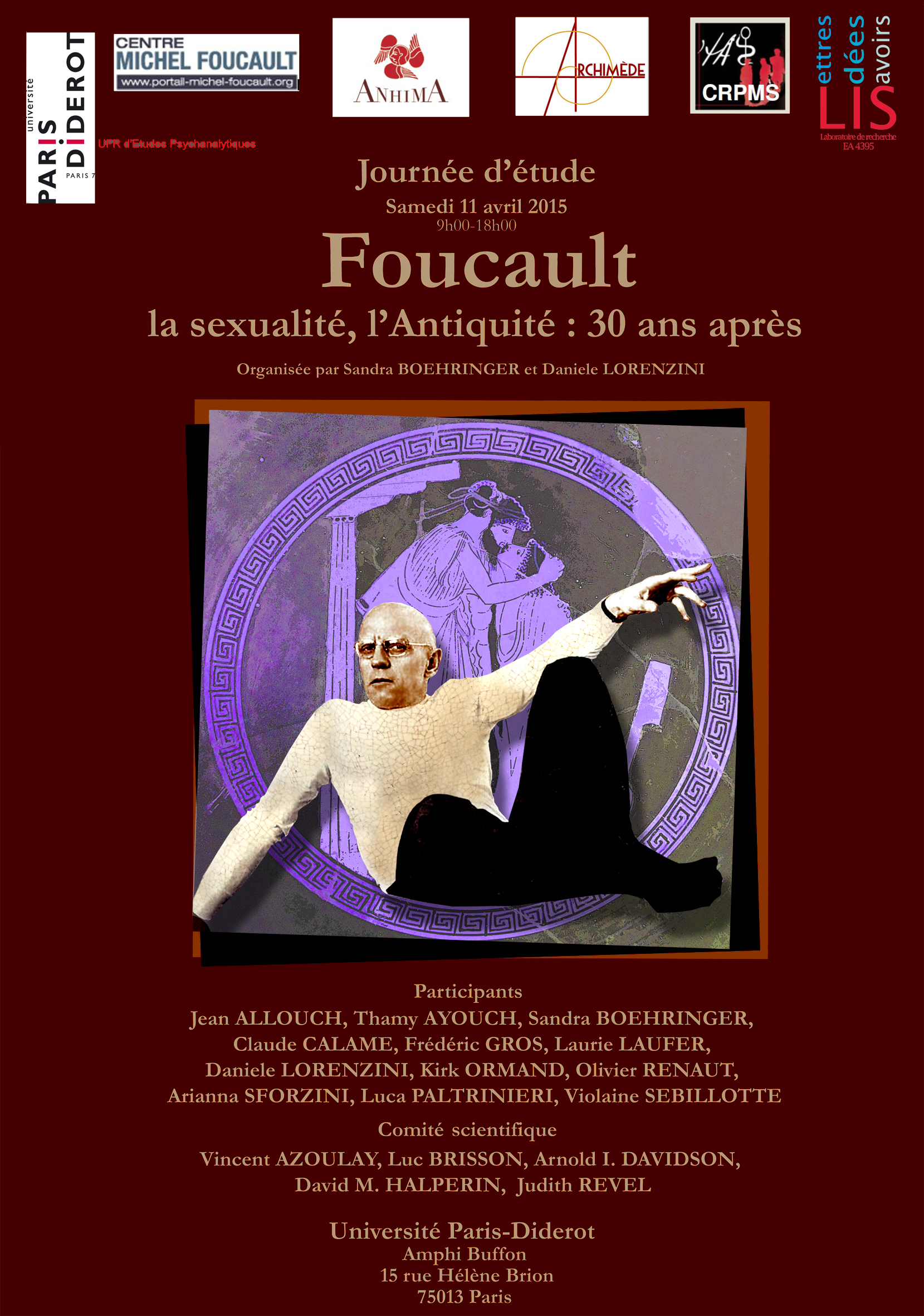
Journée d’étude
« Foucault, la sexualité, l’Antiquité : 30 ans après »
organisée par Sandra Boehringer et Daniele Lorenzini
Amphi Buffon, Université Paris Diderot-Paris 7, Paris
11 avril 2015, 9h-18h
PDF of program
The history of sexuality is one of the last major projects launched by Michel Foucault. The History of Sexuality is a momentous undertaking that profoundly affected the fields of humanities and social sciences: in the two volumes dealing with Antiquity, Michel Foucault proposed new epistemai with which specialists could approach the societies of ancient Greece and Rome; in particular, he created a new epistemological framework for analyzing the erotic realm, and the process by which the individual is required to recognize him/herself as the subject of his/her desire and his/her own existence.
Where does this leave us, thirty years later? How should we define the impact that Michel Foucault’s work on sexuality and Antiquity had on the fields of humanities and social sciences, now that the volume Subjectivity and Truth has appeared – Michel Foucault’s first course at the Collège de France entirely devoted to Greco-Roman Antiquity? How do current anthropologists of the Greek and Roman worlds do their work, twenty-five years after the pioneering book Before Sexuality: The Construction of Erotic Experience in the Ancient Greek World? In this conference, we will consider how the work of Michel Foucault reoriented the investigations of researchers and intellectuals, who today use Antiquity as a site of analysis in many fields such as ethics, gender studies, philosophy, history, anthropology, politics and psychoanalysis.
La sexualité est l’un des derniers grands chantiers ouverts par Michel Foucault. L’Histoire de la sexualité est une entreprise immense, qui marqua profondément le champ des sciences humaines : dans les deux volumes portant sur l’Antiquité, Michel Foucault allait proposer de nouveaux epistemai aux spécialistes pour aborder les sociétés grecque et romaine, et un nouveau cadre épistémologique pour penser l’érotisme et le processus par lequel l’individu est amené à se reconnaître comme sujet de son désir et de sa propre existence.
Qu’en est-il, trente ans après ? Comment définir l’impact dans le champ des sciences humaines des travaux de Michel Foucault sur la sexualité et l’Antiquité, au moment où paraît le volume Subjectivité et vérité – le premier cours de Michel Foucault au Collège de France entièrement consacré à l’Antiquité gréco-romaine ? Et quel est l’usage qu’en font actuellement les anthropologues des mondes grec et romain, vingt-cinq ans après l’ouvrage pionnier Before Sexuality : The Construction of Erotic Experience in the Ancient Greek World ? Lors de cette journée, il s’agira de comprendre comment les travaux de Michel Foucault ont infléchi les réflexions des chercheur-e-s et des intellectuel-le-s qui s’appuient aujourd’hui sur l’Antiquité dans les champs nombreux que sont l’éthique, les études de genre, la philosophie, l’histoire, l’anthropologie, la politique et la psychanalyse.
Participants :
Jean Allouch, École lacanienne de psychanalyse
Thamy Ayouch, Université de Lille 3
Sandra Boehringer, Université de Strasbourg
Claude Calame, EHESS
Frédéric Gros, Sciences Po
Laurie Laufer, Université Paris Diderot-Paris 7
Daniele Lorenzini, Université Paris-Est Créteil
Kirk Ormand, Ohio College
Olivier Renaut, Université Paris Ouest Nanterre La Défense
Arianna Sforzini, Université Paris-Est Créteil
Luca Paltrinieri, Collège International de Philosophie
Violaine Sebillotte, Université Paris 1 Panthéon-Sorbonne
Comité scientifique :
Vincent Azoulay, Université Paris-Est Marne-la-Vallée
Luc Brisson, CNRS
Arnold I. Davidson, University of Chicago
David M. Halperin, University of Michigan
Judith Revel, Université Paris Ouest Nanterre La Défense
Eduardo Rivera Vicencio, The firm and corporative governmentality. From the perspective of Foucault, International Journal of Economics and Accounting, 2014 Vol.5, No.4, pp.281 – 305
Abstract:
The fundamental base of this paper is the work of Michel Foucault and specifically during the period 1978-1979 at the Collège de France (The Birth of Biopolitics). The paper describes the relationship of power in institutional firms from the point of view of archaeological and genealogical methods, such as discourse, discipline, ethics and governmentality. Through this description, the characteristics of a new form of government – corporate governmentality – are determined and how they in turn shape the current homo economicus, the subject of law and economics in firms. At the same time, the paper describes how there has been a misappropriation of rents over time, how it is shaping a block of countries to appropriate the rents of others through large firms, and how these large corporations are imposing their objectives on states and international organisations, generating government corporations globally or what is described in this paper, as the characteristics of corporate governmentality.
Keywords: institutional firms; Michel Foucault; corporate governmentality; power relationships; ethics; rent appropriation; discourse; discipline; neo-liberalism; profit maximisation; law; economics; government corporations.