Foucault News

News and resources on French thinker Michel Foucault (1926-1984)

BA.C. (Tina) Besley
‘Finding Foucault’: orders of discourse and cultures of the self
(2014) Educational Philosophy and Theory, Volume 47, 2015 – Issue 13-14

https://doi.org/10.1080/00131857.2014.945510

Abstract
The idea of finding Foucault first looks at the many influences on Foucault, including his Nietzschean acclamations. It examines Foucault’s critical history of thought, his work on the orders of discourse with his emphasis on being a pluralist: the problem he says that he has set himself is that of the individualization of discourses. Finally, it addresses his work on the culture of the self which became a philosophical and historical question for Foucault later in his life as he investigated the historical form of relations between subjectivity and truth in Western philosophy since Antiquity and how philosophy as an activity taught about the care of the self. The conclusion suggests some ways that students might approach his work as they proceed in finding Foucault and their own selves. © 2014 © 2014 Philosophy of Education Society of Australasia.

Author Keywords
discourse; Foucault; Nietzsche; Poststructuralism; self; subjectivity

FOUCAULT IN ITALIA Testimonianze, ricezioni, attualità

PDF and more readable version of the program

Bologna locandina unica-1

Bologna locandina unica-2

Karlsen, M.P., Villadsen, K.
Foucault, Maoism, Genealogy: The Influence of Political Militancy in Michel Foucault’s Thought
(2014) New Political Science, . Article in Press.

Abstract
Foucault’s inspiration from Nietzsche in terms of writing critical histories is difficult to overestimate. However, this article advances an interpretation of Foucault’s approach to history which focuses on another, less readily evident, dialogue partner, namely the Marxist tradition and, more precisely, French Maoism. The first part of the article details Foucault’s involvement in the Maoist-inspired activist group, Groupe d’information sur les prisons (GIP). It is argued that Foucault’s practical experience from GIP left crucial marks on his contemporaneous statements on the genealogical method and his critique of “totalizing institutions,” “uniform discourse” and “juridical universality.” The second part of the article offers a close reading of Foucault’s reflections on genealogy in his 1976 lecture series which demonstrates how the Maoist activist principles noticeably resonate in these statements. The aim of the article is threefold. First, to bring attention to largely neglected sources of inspiration for Foucault’s genealogical approach, which complement those represented by Nietzsche. Second, it seeks to obtain a better understanding of Foucault’s relationship to Marxism, a relationship often portrayed as unambiguously negative. And third, the goal is to demonstrate how principles developed in Maoist political activism are not only realized in Foucault’s activities within the GIP, but also in his lecture-hall formulations of genealogy, power, and critique.

DOI: 10.1080/07393148.2014.945251

Update from organisers. Unfortunately this event is now full and there are no more places.

Neoliberalism and Biopolitics Working Group | Foucault and Marx: A Disjunctive Synthesis?
Lecture | December 9 | 5-7 p.m. | 370 Dwinelle Hall

Speaker/Performer: Etienne Balibar, Anniversary Chair of Contemporary European Philosophy at Kingston University London and Visiting Professor at Columbia University

Sponsor: The Program in Critical Theory

Étienne Balibar’s lecture revolves around connections and disjunctions between Michel Foucault and Karl Marx, using Foucault’s 1972 Collège de France lectures on La société punitive as an alternative lens for the question of “reproduction” and its relationship to class struggles. Using these thinkers as a starting point for a new confrontation, he also reconsiders the idea of “communism” today.

Etienne Balibar was born in 1942. He graduated at the Ecole Normale Supérieure and the Sorbonne in Paris, later took his PhD from the University of Nijmegen. After teaching in Algeria and France, he is currently Anniversary Chair of Contemporary European Philosophy at Kingston University London and Visiting Professor at Columbia University, New York. His books include Reading Capital (with Louis Althusser) (Verso, 1965), Race, Nation, Class. Ambiguous Identities (Verso, 1991, with Immanuel Wallerstein), Masses, Classes, Ideas (Routledge, 1994), The Philosophy of Marx (Verso, 1995), Spinoza and Politics (Verso, 1998), We, the People of Europe? Reflections on Transnational Citizenship (Princeton, 2004), Identity and Difference: John Locke and the Invention of Consciousness (Verso, 2013).

Response by Judith Butler, Professor of Comparative Literature, UC Berkeley

On December 10, The Program in Critical Theory presents a seminar with Professor Balibar on the new configurations of the “debt economy.” In preparation for the seminar, participants are asked to read Professor’s Balibar article, “Politics of the Debt.”

The Neoliberalism and Biopolitics Working Group and Conference is supported by the University of California Humanities Research Institute, organized by UC Berkeley graduate students William Callison (Political Science) and Zachary Manfredi (Rhetoric), and supervised by The Program in Critical Theory faculty Martin Jay (History) and Wendy Brown (Political Science).

Event Contact: info.cir@berkeley.edu

stuartelden's avatarProgressive Geographies

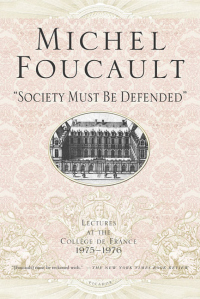
Graham Burchell has sent me the following comments on the translation of Michel Foucault’s ‘Society Must be Defended’ lecture course. Graham is the translator of all the other Paris lecture courses: this course, the first to appear, was made by David Macey.

societymustbedefended-cover-photoSome notes on the translation of “Il faut défendre la société”; “Society Must Be Defended” (pdf)

Here’s the opening explanation and disclaimer:

  1. The edition of the translation I refer to here is the first, American Picador edition of 2003. I do not know whether any of the mistakes indicated here have been picked up and corrected by other subsequent editions.
  2. These notes are not the result of a systematic check of the translation and indicate only passages where, for one reason or another, I referred back to the French while reading the translation; there may be other mistakes or questionable translation choices.
  3. The passages noted are…

View original post 128 more words

Le séminaire Actualités Foucault reprendra ses activités le jeudi 4 décembre 2014, de 17h à 19h. La première séance aura lieu à l’Ecole doctorale de Sciences Po (199 bd Saint Germain, troisième étage, métro : Saint Germain de Près – ligne 4 ; Rue du bac – ligne 12).

La séance sera consacré à la présentation du livre de Jacques Bidet : Foucault avec Marx (La fabrique2014), avec la participation de l’auteur.

(org. Frédéric Gros, Daniele Lorenzini, Ariane Revel, Arianna Sforzini)

Pierre Rivière – Infamie et Normalisation
13 avril 2014 par Maria Muhle, Ici et Ailleurs

Les trois termes qui donnent le titre à notre colloque, « Exclusion, discipline, terreur », mettent en perspective deux points fondamentaux de l’analytique du pouvoir élaborée par Michel Foucault : D’une part, il s’agit de la discussion entamée depuis la publication de la Volonté de Savoir en 1976 au moins, autour du partage entre les différents régimes de pouvoir dont parle Michel Foucault ; et d’autre part, il s’agit de la question épineuse de la « positivité » du pouvoir que Foucault semble définir en introduisant la notion de biopolitique comme « un pouvoir qui investit la vie de part en part ». Le malaise formulé dans l’exposé par rapport à ces questions étant celui de savoir si vraiment le pouvoir moderne biopolitico-gouvernemental peut se passer du recours aux techniques répressives, d’exclusion voire de terreur. Foucault lui-même a souligné dans la Volonté de savoir que le XXème siècle, siècle biopolitique donc, a été bien plus meurtrier que les siècles précédents et que le pouvoir biopolitique se doublait donc d’un « formidable pouvoir de mort » ou d’une thanato-politique. On connaît les analyses d’Agamben qui, à partir d’ici, a tenté de montrer que toute biopolitique était au fond traversée par un pouvoir souverain d’exception. Je pense, néanmoins, que cette interprétation passe à côté de l’analyse de biopouvoir de Foucault qu’elle homogénéise du côté du pouvoir souverain, et qu’il faudra repenser la « labilité des dispositifs du pouvoir » dont il est question dans l’exposé en termes généalogiques, en se tournant, justement, vers les écrits des années 1970–75 autour du rapport entre le savoir psychiatrique sur les anormaux et leur prise dans les dispositifs disciplinaires qui viennent à constituer la généalogie directe, si l’on veut, de ce que Foucault appellera en 1976 la biopolitique ou, un an plus tard, la gouvernementalité : l’exclusion, technique principale du pouvoir psychiatrique, se maintient donc à l’intérieur du dispositif biopolitico-gouvernemental à travers le pouvoir de normalisation mais elle y change d’apparence : car le trait fondamental de la normalisation comme mécanisme fondamental des dispositifs de sécurité est de projeter l’exclusion dans le futur, c’est-à-dire d’élaborer des analyses de risques futurs ainsi que de mettre à disposition des moyens pour remédier à ces risques avant d’avoir pris forme.

Read more

Ce que pense l’Historien Henri Guillemin des structuralistes (Roland Barthes, Michel Foucault, Jacques Lacan)

Video lecture

No dates or other information on this entertaining presentation, but probably from the late 1960s. See here for a collection of other televised videos lectures by Henri Guillemin

See also pdf for full program

Print