Editor: The Faculty I am located in (Education, Queensland University of Technology) is currently advertising for a new Dean. See this link for details.

Editor: The Faculty I am located in (Education, Queensland University of Technology) is currently advertising for a new Dean. See this link for details.
Partha Chatterjee, Governmentality in the East, lecture delivered 27 April, 2015, at the University of California, Berkeley.
There is a complete audio of the lecture on the site (Program in Critical Theory)
Foucault’s genealogy of governmentality as described in Security, Territory, Population is entirely West European. What would a genealogy of modern state practices look like in a former colonial country in Asia?
Looking at India, one finds that early governmental practices, including those of rational bureaucracy, rule of law and the knowledge of populations, were motivated mainly by raison d’État: it was the creation and maintenance of the sovereign power of British colonial authority that was the objective. In the 19th century, notions of liberal governmentality were introduced by officials influenced by utilitarian ideas to make Indian society the target of policy in order to improve productivity as well as morality. Indian nationalists in the 20th century rejected colonial governmentality and demanded full rights of sovereignty over the state. However, the postcolonial state retained the colonial apparatus of security based on raison d’État while expanding liberal governmentality to include an agenda of welfare of the people. In the more recent period, the spread of governmentality alongside the politics of electoral representation has produced in India forms of claim-making and resistance that go well beyond Foucault’s framework. (Chatterjee)
Partha Chatterjee is a political theorist and historian. He divides his time between Columbia University and the Centre for Studies in Social Sciences, Calcutta, where he was the Director from 1997 to 2007. He is the author of more than twenty books, monographs and edited volumes and is a founding member of the Subaltern Studies Collective. He as awarded the Fukuoka Asian Culture Prize for 2009 for outstanding achievements in the field of Asian studies. His books include: The Black Hole of Empire: History of a Global Practice of Power (2012), Lineages of Political Society: Studies in Postcolonial Democracy (2011), The Politics of the Governed: Considerations on Political Society in Most of the World (2004); A Princely Impostor? The Strange and Universal History of the Kumar of Bhawal (2002); The Nation and Its Fragments: Colonial and Postcolonial Histories (1993), and Nationalist Thought and the Colonial World: A Derivative Discourse? (1993).
Alan McKinlay, Philip Taylor Foucault, Governmentality, and Organization: Inside the Factory of the Future, Routledge Research in Employment Relations, 2014
About the Book
This book traces how abstract managerial ideas about maximizing production flexibility and employee freedom were translated into concrete, day-to-day practices at the Motorola plant in East Kilbride, UK. Using eyewitness accounts, the book describes how employees dealt with the increased freedom Motorola promoted amongst its employees, how employees adapted to managerial changes, specifically the elimination of large-scale management, and where the ‘managerless’ system came under strain. This book will be of essential reading for researchers, graduate students, and undergraduates interested in the areas of management studies, human resource management, and organizational studies, among others.
Table of Contents
1. The Will to Empower: Governing the Workplace 2. Working for the Yankee Dollar 3. Greenfield Site, Green Labour? 4. ‘Not just Another Number’: Empowerment, Discipline and Teamworking Freedom 5. Confession, Discipline and Freedom 6. ‘Just Like Any Other Factory’
Alan McKinlay is Professor of Human Resource Management, Newcastle University Business School, UK. He has written extensively about long-run developments in industrial relations and work organization. He has contributed to journals such as Business History and Organization, among others. His most recent edited book is Creative Labour Working in the Creative Industries, with Chris Smith, which has gone into a second edition.
Philip Taylor is Professor of Human Resource Management at Strathclyde University, UK. He is a world-leading expert on management strategy and work organization in call centres. He has written articles for the International Journal of Human Resource Management, Industrial Relations Journal, Human Relations, New Technology, and Work and Employment journals.He was the co-author of The Meaning of Work in the New Economy and co-edited Future of Worker Representation.
Kaye, R.A.
The new other Victorians: the success (and failure) of queer theory in nineteenth-century British studies
(2014) Victorian Literature and Culture, 17 p. Article in Press.
DOI: 10.1017/S1060150314000291
Abstract
Much of the critical writing on Queer Theory and Sexuality Studies in a Victorian context over the last decade or so has been absorbing, exploring, complicating, and working under the burden of the influence of Michel Foucault’s theoretical writings on erotic relations and identity. The first volume of Foucault’s The History of Sexuality (1978), in fact, had begun with a gauntlet thrown down before Victorian Studies, a chapter-long critique of Steven Marcus’s The Other Victorians (1966), a work that had offered an entirely new and at the time, quite bold avenue of exploring nineteenth-century culture – namely, through the pornographic imagination that Marcus taxonomized with precise, clinical flair as a “pornotopia” in which “all men . . . are always infinitely potent; all women fecundate with lust and flow inexhaustibly with sap or both. Everyone is always ready for everything” (276). In Foucault’s telling, however, Marcus demonstrated a theoretically impoverished faith in Freudian models of “repression” in Marcus’s examination of “underground” Victorian sexualities. It was Marcus’s reliance on the “repressive fallacy,” his conviction that there existed a demarcated spatial and psychic Victorian counter-world that The History of Sexuality had so forcefully undermined.
Mennicken, Andrea and Miller, Peter (2014) Michel Foucault and the administering of lives. In: Adler, Paul S., du Gay, Paul, Morgan, Glen and Reed, Michael, (eds.) The Oxford Handbook of Sociology, Social Theory, and Organization Studies: Contemporary Currents. Oxford University Press, Oxford, UK, pp. 11-38. ISBN 9780199671083
Abstract
This chapter suggests that Michel Foucault is a nuisance for scholars of organizations, albeit a productive one. Foucault disavowed the study of organizations, yet his work was fundamentally concerned with the administering of lives, a central concern of scholars of organizations. The chapter explores this tension by examining four displacements that Foucault sought to effect: first, a move from asking ‘why’ type questions to ‘how’ type questions; second, a concern with subjectivity that discards the ethical polarization of subject and object in favour of an analysis of the historically varying ways in which the capacities and attributes of subjects are constituted; third, a focus on practices rather than organizations, and a concern to analyse sets or assemblages of practices in terms of how they emerge and how they are stabilized over time; fourth, a focus on rationalities in the plural. It then examines the ‘Foucault effect’ in organization studies.
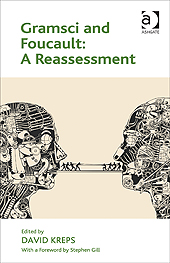 Gramsci and Foucault: A Reassessment.Edited by David Kreps, Ashgate, February 2015
Mapping the resonances, dissonances, and linkages between the thought of Gramsci and Foucault to uncover new tools for socio-political and critical analysis for the twenty-first century, this book reassesses the widely-held view that their work is incompatible.
With discussions of Latin American revolutionary politics, indigenous knowledges, technologies of government and the teaching of paediatrics in post-invasion Iraq, complexity theory, medical anthropology and biomedicine, and the role of Islam in the transition to modern society in the Arab world, this interdisciplinary volume presents the latest theoretical research on different facets of these two thinkers’ work, as well as analyses of the specific linkages that exist between them in concrete settings.
A rigorous, comparative exploration of the work of two towering figures of the twenty-first century, Gramsci and Foucault: A Reassessment will appeal to scholars and students of social and political theory, political sociology, communication and media studies, and contemporary philosophy.
Contents: Foreword: an archaeology of the future, to be excavated by the post-modern prince?, Stephen Gill; Preface; Introduction, David Kreps; The politics of truth: for a different way of life, Alex Demirović; Rethinking the Gramsci-Foucault interface: a cultural political economy interpretation oriented to discourses of competitiveness, Ngai-Ling Sum; Power and resistance: linking Gramsci and Foucault, Marcus Schulzke; Building a Gramsci-Foucault axis of democracy, Jean-Paul Gagnon; Subalternity in and out of time, in and out of history, Sonita Sarker; The passive revolution of spiritual politics: Gramsci and Foucault on modernity, transition and religion, Jelle Versieren and Brecht de Smet; Post-neoliberal regional integration in Latin America: Alianza Bolivariana para los Pueblos de Nuestra América (ALBA), Efe Can Gürcan and Onur Bakıner; The hegemony of psychology: the practice and teaching of paediatrics in post-invasion Iraq, Heather Brunskell-Evans; The complexity of social systems: could hegemony emerge from the micro-politics of the individual?, David Kreps; Index.
About the Editor: David Kreps is Senior Lecturer in Information Systems and Director of the Centre for Information Systems, Organisations and Society at the University of Salford, UK. He is the author of Cyborgs: Cyborgism, Performance and Society.
Reviews: ‘This provocative, pluralistic, and wide-ranging volume explores critically and productively convergences, dissonances, and potential synergies between the work of Gramsci and Foucault. Ranging from philosophical reflections through the staging of virtual dialogues to exemplary case studies that demonstrate significant complementarities, this is an important, timely, and unique contribution to rounding out the literature on these two critical intellectuals and political activists.’
Bob Jessop, Lancaster University, UK
‘Foucault and Gramsci is a much better alternative for our times, than the polemically overdetermined formulation Foucault or Gramsci. In reassessing Foucault and Gramsci and their respective legacies conjuncturally, this volume goes a long way in clarifying and elaborating the relationship between macropolitics and micropolitics, between a politics anchored in hegemony and post- and counter-hegemonic practices of resistance and speaking truth to power, between the world as irreducibly local and the world as necessarily global and relational.’
Rajagopalan Radhakrishnan, University of California Irvine, USA; author of Edward Said: A Dictionary and History, The Human, and the World Between
Heterotopia Remixes Vol. 2 Astral Plane Recordings .
Play list
Music available on site
1.Jacques Gaspard Biberkopf — Public Love (Air Max ’97 Bootleg)04:22
2.Kid Antoine — Nightvision (Mike G Remix)05:13
3.Rushmore — Moment X (Victoria Kim’s Kowloon Edit)03:48
4.Celestial Trax — Illuminate (Iglew Remix)05:01
5.Victoria Kim — Apgu Freeway (Rushmore Remix)04:11
6.Arkitect — Foucault’s Dream (Riley Lake Remix)06:04
See also Bandcamp and Soundcloud
Securing the social: Foucault and Social Networks | Tiziana Terranova – Academia.edu.
From Foucault and the History of Our Present, edited by Sophie Fuggle, Yari Lanci, and Martina Tazzioli
Extract
What do we talk about when we talk about social networks? Is it an actu-ally existing social reality, a structuralist paradigm in the social sciences, or a series of web-based services with specific technical features? Or, as a Foucauldian perspective might have it, a new dispositif of power taking the social as its object and the network as its form? One of the most common arguments to be found about the deploy-ment of Foucault’s work in thinking about social networks is that the latter constitutes a contemporary version of Bentham’s Panopticon – a specific organization of visibility that Foucault described in his book on disciplinary societies (Foucault, 1993; Kampmark, 2007; Bucher, 2012). Commenting on the ‘recent exposure of mass surveillance activity’ by the US National Security Agency (NSA), however, William Davies reflects on how such revelations not only expose the ways in which ‘social networks’ have become the object of the state’s gaze, but also seem to point to a larger phenomenon, what he calls the ‘revenge of the social’. Davies reminds us that for a long time neoliberals have opposed ideas of society and the social but argues that recently this trend has reversed into an ‘explosion of new types of accounting, governance and policy interven-tion which come dressed in the rhetoric of the social. Social enterprise, social media, social indicators, social impact bonds, social neuroscience’ (Davies, 2013). Realizing that ‘individuals are quite manifestly unable to operate as isolated, calculating machines, with only the law and the market to guide them’, for Davies, neoliberalism has found a model of the social in social media that suits its epistemic commitments. Social media provide the techniques by which the social can be finally known:
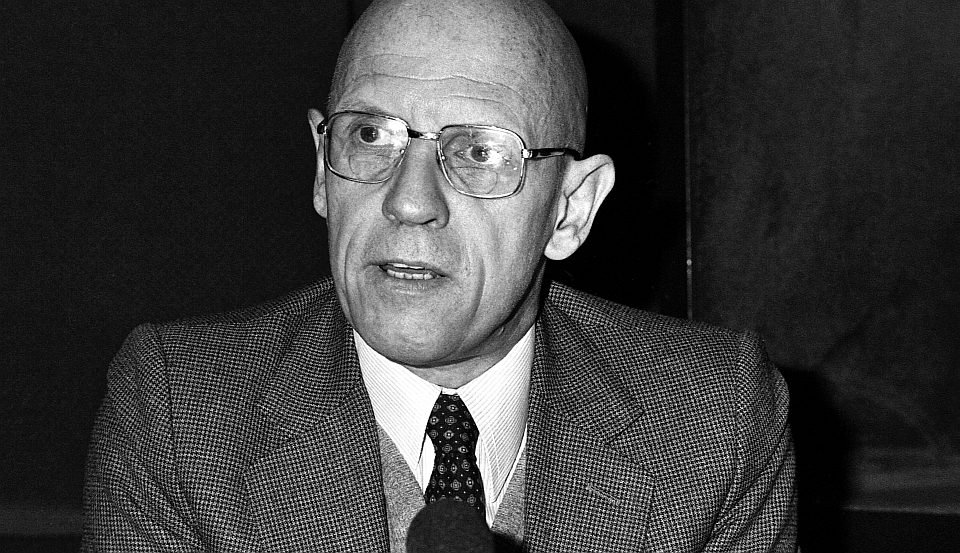
Patrick West Foucault: from libertine to neoliberal , Spiked, 3 July 2015
Was the French philosopher really a Reaganite in poststructural clothing?
Was Foucault a neoliberal?’ So asked an accusatory headline the other day in Le Nouvel Observateur, France’s centre-left news weekly. It’s a grave allegation. ‘Saint Foucault’, as the article sarcastically calls him, was a heavyweight figure in the humanities, and his theories about truth and power have filtered down into society’s mainstream. He remains a legend of postwar philosophy in France, and queer theory in general. To accuse him of Anglo-Saxon right-wingery is tantamount to lèse majesté.
Michel Foucault popularised the idea that power and truth are intimately intertwined, and that who is making a statement is as important as what is being said. As he wrote in his iconic 1975 text, Discipline and Punish: The Birth of the Prison (Surveiller et Punir: Naissance de la Prison): ‘It is not the activity of the subject of knowledge that produces a corpus of knowledge, useful or resistant to power, but power-knowledge, the processes and struggles that traverse it and of which it is made up, that determines the forms and possible domains of knowledge.’ Truth is perspectival: it is the mere creation of the strong. Might makes right. Power is knowledge.
Several generations of teachers, social-policy strategists, professors and politicians would have been taught Foucault at university at the height of his academic celebrity in the 1980s and 1990s. His thoughts have been widely disseminated as a consequence.
Foucault said that power was omnipresent. Hospitals and schools are no better or worse than factories or prisons: all are based on the same desire to inspect, classify, control, monitor. A security camera is a manifestation of power in action, but so, too, is a restaurant menu or a double-yellow line on a road.
read more
 Faire l’histoire du pouvoir “psy” après Foucault
Journées suisses d’histoire 2016
Bureau du congrès
Section d’histoire, Faculté des Lettres
Université de Lausanne
Anthropole, Bureau 5156
CH-1050 Lausanne
Les travaux sur les disciplines psychiques se rangent en deux catégories : les démarches critiques du pouvoir « psy* » (psychiatrie, psychanalyse, psychologie, psychothérapie) d’une part, contre les approches bienveillantes à l’égard de ce pouvoir, soit par une défense délibérée, comme Marcel Gauchet par exemple, soit simplement en évitant d’évoquer les dimensions politiques des pratiques et des discours psy. La tradition critique se donne comme pères fondateurs — il n’y a que des hommes — des chercheurs tels que Erving Goffman, Robert Castel, et bien sûr Michel Foucault. Elle est liée à des mouvements sociaux qui contestent le pouvoir psychiatrique, que l’on qualifie souvent d’ « antipsychiatriques », notamment des mouvements de personnes psychiatrisées, mais qui compte aussi des psys célèbres comme Franco Basaglia, Ronald D. Laing, David Cooper ou Thomas Szasz. Cette première vague critique s’en prend principalement à la psychiatrie comme « régime disciplinaire » (Foucault), à l’asile comme « institution totalitaire » (Goffman) ou au « mythe de la maladie mentale » comme prétexte d’un contrôle étatique politique (Szasz).
Cette histoire du « complexe psy » se conjugue souvent avec une conception foucaldienne du pouvoir relevant moins d’une oppression matérielle que d’une forme d’« aliénation mentale » que produirait le discours psychologique en offrant des catégories de pensée sous la forme d’un langage pour « dire le sujet ». Les sociétés occidentales, en particulier, seraient ainsi devenues des « sociétés thérapeutiques » dominées par cette grille d’analyse. Par ailleurs, on voit se multiplier des travaux qui s’intéressent à ce qui est nommée la « psychologisation » de phénomènes sociaux. Bien souvent, ces travaux envisagent les pratiques psychologiques, notamment psychothérapeutiques, en suivant Foucault, comme autant de « dispositifs de pouvoir », de perfectionnement de « technologies du soi », qui ne laissent aucune possibilité de concevoir une transformation des rapports de pouvoir dans ces institutions psy. Il semble au contraire nécessaire de pouvoir faire une histoire des pratiques et discours psy qui prennent en compte non seulement les rapports de pouvoir, mais également un projet d’émancipation, de façon à non seulement mieux saisir les ambitions politiques de nombre de psy* qui n’opposent pas leur pratique à une lutte politique, voire la conçoive au contraire comme liée à celle-ci, mais surtout pour penser de façon plus réaliste les liens entre l’individuel, comme le psychologique est conçu, et le collectif.
Ce panel veut constituer un lieu de débat de ces questions. Les contributions peuvent ainsi amener des positions historiographiques variées, pour autant qu’elles s’inscrivent dans cette interrogation du traitement du pouvoir psy* dans les travaux d’histoire des disciplines psychiques.
 Foucault News