
Foucault News

News and resources on French thinker Michel Foucault (1926-1984)

Kaspar Villadsen, Foucault’s Technologies. Another Way of Cutting Reality, Oxford University Press, 2024

The aims of this book:

1. To shed new light on a neglected theme in one of the most influential contemporary thinkers by exploring Foucault’s thinking on technology. Foucault’s Technologies argues that Foucault’s thinking, especially in the 1970s and 1980s, is fundamentally technological.

2. To re-situate Foucault among his key sources of inspiration: Nietzsche, Heidegger, Althusser, and Deleuze, focussing on how his technological thinking developed in dialogue with these inspirational figures.

3. To present Foucault’s technological thought with an emphasis on how researchers and students can use it to pursue their own research.

Description

Michel Foucault is rarely viewed as a philosopher of technology, yet academics and students routinely refer to his terms ‘technologies of power’, ‘governmental technologies’, and ‘technologies of the self’. This book is a response to the contradiction between the paucity of research into Foucault’s technological thought and the abundance of technological vocabulary and metaphors in his own writings as well as in the commentary literature; it provides the most extensive examination of the role of technology in Foucault’s work so far.

Villadsen argues that technology serves neither as an object of Foucault’s analysis nor as a convenient metaphor for making arguments, but as rather integral to his thinking and writing. As the book’s title, Foucault’s Technologies indicates, it explores not Foucault and modern technology understood as technical devices like television, smartphones, or industrial machines, but rather Foucault’s approach to the theme of technology and his use of technological terms. The book provides an extensive exploration of Foucault’s technological thought, arguing that he offers a distinct framework that confronts commonsensical understanding and other scientific approaches to technology. The reader will travel a route paved with discussions of how Foucault’s work intersects with that of other key thinkers, particularly Heidegger, Althusser, Nietzsche, and Deleuze.

While presenting efforts in intellectual history, the book ultimately focusses on the analytical implications for ‘users’, showing how researchers can benefit from Foucault’s technological approach. As such, the book offers an analytical framework effective for the study of problems in present-day welfare states and the emergent world of data-capitalism.

Kaspar Villadsen specializes in Michel Foucault’s authorship, modern technology, and organization studies. Villadsen received his PhD in Sociology from Copenhagen University in 2004, and took a position as Assistant Professor at Copenhagen Business School (CBS) in 2005. Villadsen became an Associate Professor at CBS in 2008 and a Professor in 2015. He has been a visiting Professor at City University of New York, UC-Berkeley, Oslo University, and Amherst College. Villadsen has published around 65 international journal articles, writing at the intersections of sociology, philosophy, and intellectual history.
Simon, J.‘After Neoliberalism’ and on the ‘Dark Side’? Governmentality and Counter-Conduct in Times of Growing Autocratisation (2024) Global Society

DOI: 10.1080/13600826.2024.2401552

Open access

Abstract
The political world today in many ways seems vastly different from the context in which the concepts of governmentality and counter-conduct were initially elaborated by Foucault in the late 1970s. Especially the past decade has seen significant struggles over the principles and knowledges traditionally drawn on to enact (neo)liberal government both locally and (inter-)nationally. Strikingly, these ruptures have often perpetuated, revived or diversified rather than countered dark-liberal and authoritarian forces and articulations, also in formally liberal-democratic countries. Distinguishing different readings of governmentality, the introduction engages with the particular neoliberal drift in the literature and elucidates how the contributions to this special issue revisit, complicate, and illuminate tendencies, binaries, and gaps that may impair our vision or unintentionally set limits to how we can study and critically sound out present struggles and forms of (self-)conduction. It concludes by outlining directions for further conceptual and empirical scholarship on governmentality and counter-conduct. © 2024 The Author(s). Published by Informa UK Limited, trading as Taylor & Francis Group.

Rudnyckyj, D.
The Protestantism of neoliberalism (2024) Culture, Theory and Critique, .

DOI: 10.1080/14735784.2024.2313602

Abstract
This essay illuminates the affinity between of Protestantism and neoliberalism. Drawing on the insights of Max Weber and Michel Foucault, the essay demonstrates how both Protestantism and neoliberalism are premised on a common set of norms and ethical practices. In so doing, I seek to diagram the points of convergence between these two formations to account, in part, for the persistence of neoliberalism. The affinity between Protestantism and neoliberalism is evident in the fact that both entail the rationalisation of a totalising system, reflexive responsibilisation, recasting the pastoral function, the assimilation of labour, the compulsion for action in conditions of unknowability, and the economisation of power. © 2024 Informa UK Limited, trading as Taylor & Francis Group.

Author Keywords
assimilation of labour; Max Weber; Michel Foucault; Neoliberalism; protestantism

Beck, Daniel
Put in Humour: Creating Indifference Through the Generation of Grotesque Memes (2024) Alternatives

DOI: 10.1177/03043754241283956

Open access

Abstract
This article proposes a power-focused perspective for International Relations to specifically undertake an examination of grotesque and ridiculous representations of leader figures. This is illustrated by examples of Vladimir Putin in public media and online. By bringing together the theoretical insights of Achille Mbembe and Michel Foucault on the grotesque, the paper elaborates how displaying Putin in public in grotesque ways contributes to political power through creating indifference towards excessive behaviour and the truthfulness of representations among the audience. The theoretical concept of the grotesque enables an innovative and context-sensitive understanding of power mechanisms underlying the public representations of Putin’s governance. The article highlights how ridiculous performances can be a source of political power. Mbembe observed how elements of the grotesque are fundamental to any dominance structure. Grotesque leaders operate outside of the establishment and thereby can subvert the existing power hierarchy. Consequently, Putin seems to be immune to ridicule and even benefits from being ridiculed in public. By being represented and perceived as laughable, the grotesque protects dictators through a pre-emptive critique from fierce and sustainable opposition as the satisfaction of joking about the most powerful is highly fascinating and thereby disincentivises resistance. Simultaneously, audiences encounter indifferences in distinguishing between reality and the imaginative creations of meme creators. By analysing prominent examples of grotesque media representations, such as depictions of Putin seated on an oversized table or riding shirtless on horses, the study explores the connection between grotesque representations, humour, and indifference towards rude behaviour. © The Author(s) 2024.

Author Keywords
grotesque; humour; legitimation; ridiculous; state

Michael-Luna, S.C., Castner, D.J.
Rising Authoritarian Practice in Early Childhood Curriculum: A Case Study (2024) Cultural Studies – Critical Methodologies, .

DOI: 10.1177/15327086241271898

Abstract
Amid the ideological shift from democratic neoliberalism to authoritarian neoliberalism, spearheaded by right-wing Christian nationalists, early childhood educational policy has become a weapon in the “culture war” in many parts of the United States. Neoliberalism has outgrown the constraints of democracy and is being supplanted with nihilistic views on science and knowledge and leaning toward authoritarianism. This is evidenced in a tidal wave of local and state-based educational policy, which restricts individual freedom of expression and access to knowledge while sabotaging government accountability and transparency. However, a practical approach is to observe how local authoritarianism, within the bounds of a recognized democracy, is lacking. The recent surge of early childhood educational policy in right-wing (historically conservative) states in the United States creates an opportunity to understand what values, norms, and knowledge are reified or restricted in the policies that govern early childhood curriculum policy and curriculum. Using a critical discourse analysis in a case study methodology, we shed light on authoritarian practices in early childhood curriculum policy and practice in Florida during the 2021–2024 legislative sessions. The case study examines the implications of educational reform policies for early childhood social studies curriculum to address two questions: How are dominant discourses in early childhood curriculum in Florida changing to reflect a shifting regime of truth? How are authoritarian practices used in Florida’s early childhood education policy system of curriculum evaluation and selection restricting knowledge, limiting critique, and reducing meaningful accountability of government policymakers and technocrats to policy stakeholders, including children, teachers, and parents? © 2024 SAGE Publications.

Author Keywords
authoritarian practice; early childhood; Foucault; neoliberalism; policy

Dean, Mitchell. 2024. “The Concept of Authoritarian Governmentality Today.” Global Society, June, 1–20..

DOI: 10.1080/13600826.2024.2362739

Open access

Abstract
The paper examines “authoritarian governmentality”. It argues that there are salient differences between the contemporary intellectual and political context and those of the 1990s when it was first developed. Chief among these is the confidence by which we can approach liberal governing itself as the norm of contemporary governmentality. The first wave of governmentality studies identified authoritarian governmentality in both non-liberal regimes and in the consequences of liberalism’s norm of the self-responsible subject and its governing through civil society. This paper extends these observations: first by proposing an analysis of the kinds of order that different rationalities and technologies invoke, and secondly, by arguing for the linking of an analytics of government to both the practical capacities of sovereignty and the practices through which supreme authority is constituted. While liberal and authoritarian governmentalities are far from mutually exclusive, the absent concept of authority helps clarify what is at issue. © 2024 The Author(s). Published by Informa UK Limited, trading as Taylor & Francis Group.

Author Keywords
authority; Foucault; Government; order; sovereignty

[…]
Today, the rise of what is called populism, particularly in its hard right-wing versions, in liberal-democracies, and the awareness of diverse forms of autocratic rule throughout the world, has sharpened the concern for authoritarian measures and potentials in the way in which governing occurs. It was one thing to point to the necessity of authoritarian practice within the relatively stable liberal political and economic orders of the late twentieth century; it is quite another to note the rise of opportunistic, messianic, volatile, and apparently anti-rational movements and forces within and outside these liberal orders today (Vasilache 2023). However one diagnoses the present, the last decade has witnessed a series of mutations and disruptive forces in liberal-democracies and in the international order.

Joranger, L.
The Evolution and Integration of Life and Theory in Foucault’s Work on Power
(2024) Integrative Psychological and Behavioral Science

DOI: 10.1007/s12124-024-09862-8

Abstract
The article is a response to Kaldybekov and his colleague’s, 2024 paper about Foucault’s theory on power. I argue that it is difficult to understand Foucault’s theory of power without looking into his intellectual life and experiences, especially his war experiences. The objective of my study is to show that there is a connection between Foucault’s ideas about power and his own lived life, and that he always has been critical of totalitarian theories although he seems influenced by Marxist theories, early in his career. In the paper I show how he deals with this dilemma by incorporating some of Nietzsche’s ideas into his thinking. To illustrate the connection between Foucault’s lived life and his theories about power, I take a particular point of departure in Foucault’s lecture series on psychiatric power in the 1970s and an interview conducted by the Italian journalist Trombadori. © The Author(s) 2024.

Author Keywords
Collective experiences; Culture; Evolution; Foucault; Ideas; Integration; Life experiences; Power; Revolution; Theory

Index Keywords
article, career, cultural anthropology, evolution, human, integration, interview, male, personal experience, special situation for pharmacovigilance, theory, thinking, war

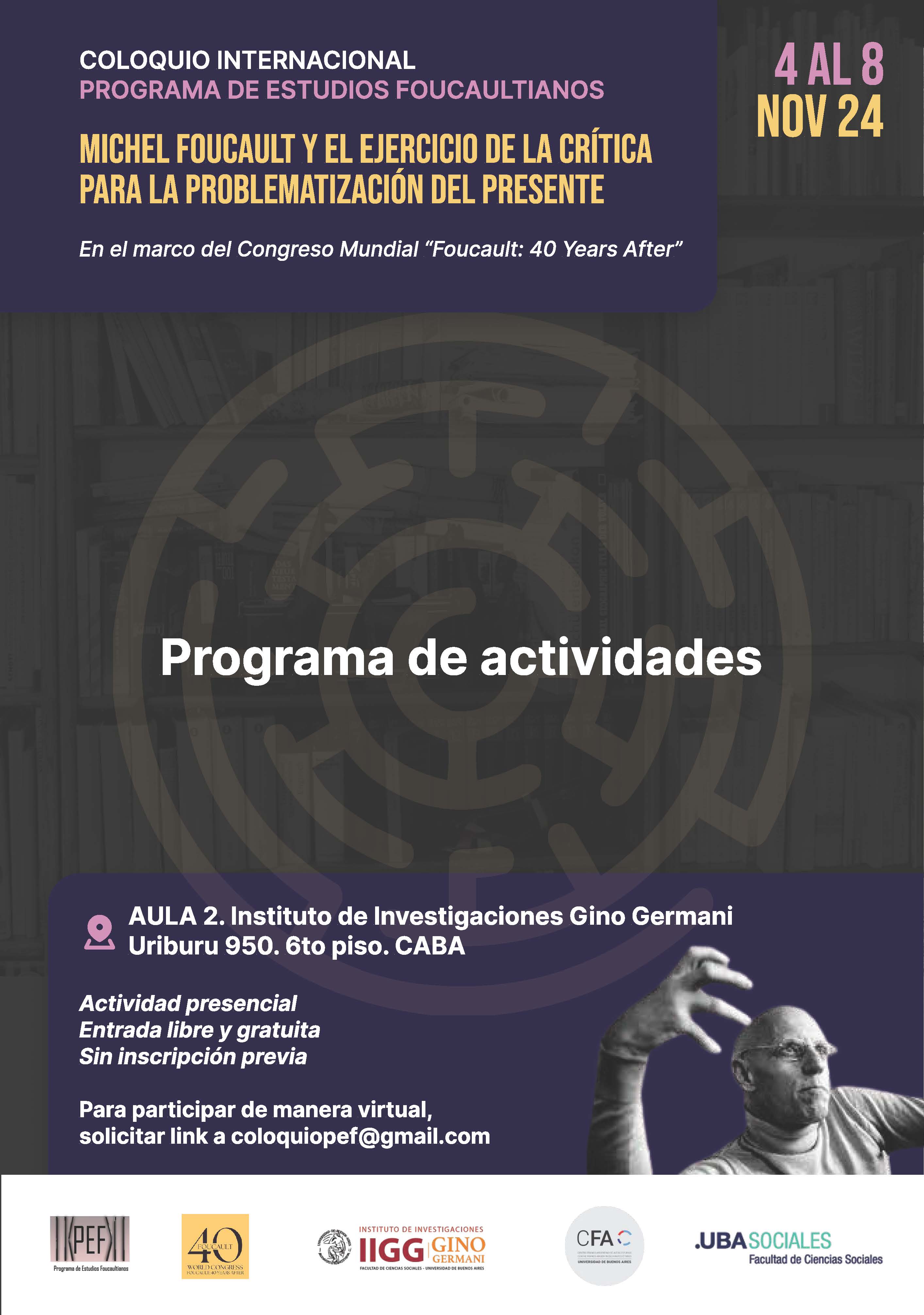
PDF of program

Taheri, H.
Censoring Iranian cinema: normalization of the “modest” woman (2024) Feminist Media Studies

DOI: 10.1080/14680777.2024.2328089

Abstract
This research examines the structure of Iranian film that has normalized the image of the “modest” Iranian woman, which has little to no relation to the reality of Iranian women. This power structure includes not only the modesty censorship rules of the Islamic Republic but also international film festivals. Utilizing the concepts of reactive and proactive censorship measures, I argue that censorship not only limits and reacts but also creates the image of the modest woman. Counterintuitively, film festivals play a substantial role in this normalization process. In addition, I contest the popular conceptions of “resistance” when discussing Iranian cinema at foreign film festivals and in academia, arguing that the resistance of films and artists is restricted to the structure that governs them. In addition, I challenge the concept of “Iranian national cinema,” in which film festivals promote a repressive government to oppose another power system; specifically, they reward the image of the Islamic Republic’s ideal woman to oppose popular Hollywood portrayals of women. My objective is not to downplay the value of Iranian cinema but to highlight its flaws and encourage a more critical approach to the international power system regulating Iranian films. © 2024 The Author(s). Published by Informa UK Limited, trading as Taylor & Francis Group.

Author Keywords
censorship; Iranian cinema; Michel Foucault; modesty rules; resistance

Pavlich, G.
Plaguing Segregations: Paradigms of Rule at The Cape of Good Hope
(2024) Canadian Journal of Law and Society

DOI: 10.1017/cls.2023.25

Abstract
Power, while fundamental to sociality, might be exercised with haphazard ferocity or more judiciously in legally constrained ways. Such constraint requires us first to understand how ruling paradigms work, and the effects of their powers, before entertaining suitable forms of legal limitation. Transposing Kuhn’s famous concept, this paper examines a ruling paradigm of biopolitical sovereignty at the Cape of Good Hope through two examples: the 1891 census’ racialized categorizations of the “population”; and a racialized segregation responding to the 1901 bubonic plague. Prefiguring apartheid, both examples indicate how colonial laws authorized discretionary biopowers and yet exempted themselves from monitoring how officials demarcated and governed racialized population groups. The paper touches on the growing maladroitness of positivist ideas about a sovereign “rule of law” in regulating arbitrary biopolitical forces. It concludes by briefly indicating the promise of legal pluralism and Indigenous legalities to check capricious biopowers while pursuing legitimate life-affirming forces. © The Author(s), 2024.

Author Keywords
biopolitics and law; Cape of Good Hope; colonial rule of law; Foucault and governance; law and society