Foucault News

News and resources on French thinker Michel Foucault (1926-1984)

Special Issue: Foucault Meets EU Studies
Global Society (2016), Vol. 30, No. 3, pp. 387-506.

Table of contents:

Introduction: Foucault Meets EU Studies Lucie Chamlian & Dirk Nabers

The Colonisation of the Future: Power, Knowledge and Preparedness in CSDP Lucie Chamlian
Exploring the Security/Facilitation Nexus: Foucault at the `Smart´ Border Matthias Leese
Knots, Port Authorities and Governance: Knotting Together the Port of Hamburg Luis Lobo-Guerrero & Anna Stobbe
The Sight of Migration: Governmentality, Visibility and Europe´s Contested Borders Martina Tazzioli & William Walters
Conducting Government: Governmentality, Monitoring and EU Counter-Terrorism Stef Wittendorp
Local Practices of Immigration: The “Right of Death and Power over Life” in German Asylum Discourses Dirk Nabers

Thanasis Lagios, Foucauldian Genealogy and Maoism
20th March 2015 | 12:00 – 12:45

Conference paper, audio podcast on The Voice Republic site

Thanasis Lagios studied Philosophy, Pedagogy & Psychology (specialization: Philosophy), at the National and Kapodistrian University of Athens, Greece (1998 – 2003). Having completed his postgraduate studies (MA) in Political Philosophy at the University of York (UK, 2004-5), he successfully defended his doctoral thesis at the National and Kapodistrian University of Athens on “Stirner, Nietzsche, Foucault: The death of God and the end of Man” (2009), which was published by futura in 2012. He has published a Greek translation of Foucault’s 1978 interview “Considérations sur le marxisme, la phénoménelogie et le pouvoir” (futura, 2013). He has published several articles on the history of philosophy, epistemology and political philosophy. Since 2010, he has been teaching in the postgraduate program on Ethics at the Department of Philosophy, at the National and Kapodistrian University of Athens, Greece. Since 2013, he also teaches philosophy (epistemology/political philosophy) in the EU-sponsored program at the National and Kapodistrian University of Athens, “Plato’s Academy”.

McMahon, J., Barker-Ruchti, N.
The media’s role in transmitting a cultural ideology and the effect on the general public
(2016) Qualitiative Research in Sport, Exercise and Health, 8 (2), pp. 131-146.

DOI: 10.1080/2159676X.2015.1121912

Abstract
Previous research investigating Australian swimming culture revealed a deeply entrenched ‘slim to win’ ideology, a notion that is centred on the swimmer body needing to be lean in order to achieve competitive performance. While previous research revealed that ‘slim to win’ was occurring in situ, this study examines how media representations might come to be possible contributors to this ideology being proliferated to outsiders of the culture. Specifically, three professional sports photographs are examined for materiality criteria. Further, an affect perspective is employed through Foucault’s idea of ‘dispositive’ to consider how the messages provided by the images, their captions and the titles of the news items they were included in, were consumed. We argue that the media representations included in this investigation are highly problematic because they reinforce the ‘slim to win’ ideology. Further, we argue that many people who contributed to the online forums relating to these media representations reproduced and to a certain extent negotiated ‘slim to win’ through their comments. This latter point occurred via the representations which provided a platform for critical interpretation. © 2016 Taylor & Francis.

Author Keywords
affect; body; dispositive; Foucault; Materiality; media; online forum comments; photographs; slim to win; swimming


Des jardins autres, L’Harmattan ,
Sous la direction de Alexandre Néné et Sarah Carmo
Archives Karéline
ENVIRONNEMENT, NATURE, ÉCOLOGIE PHILOSOPHIEURBANISME, AMÉNAGEMENT, SOCIOLOGIE URBAINE

ISBN : 978-2-35748-111-4 • mai 2015 • 324 pages

L’extension des villes, la dissolution de leur espace et le phénomène de périurbanisation font du jardin une composante du paysage urbain de plus en plus convoitée. Perçu très souvent comme une bouffée d’air permettant d’échapper à des espaces citadins de plus en plus violents, il est une donnée relationnelle importante à partir de laquelle on pense les villes de demain. Les jardins jouent également sur un effet de sortie : ils sont un espace déviant dans la logique du monde…

See also

PDF programme

Reprenant ainsi la formule consacrée par Michel Foucault, la journée d’étude « Des Jardins Autres » vise à interroger, dans une approche pluridisciplinaire, l’altérité caractéristique du jardin. Les études de cas seront privilégiées bien que les approches théoriques soient aussi acceptées. Nous proposons ainsi plusieurs axes de recherches :

See also this silent video of photos from the conference and gardens

Elise Hunkin, Deploying Foucauldian genealogy: Critiquing ‘quality’ reform in early childhood policy in Australia, Power and Education March 1, 2016 8: 35-53

doi: 10.1177/1757743815624114

Abstract
The last two decades have seen the emergence of a global education paradigm that has reimagined education through the lens of neo-liberal ideology. Education policy agendas and discourses in current times are globally governed through transnational networks, which have increased the opaqueness of education policymaking. For critical policy researchers, the challenge is to respond with new methodologies that can capture and critique the increasingly diffuse, fractured nature of contemporary policy processes. This article presents one such methodology, where Foucauldian genealogy is used to construct a history of the discourse of ‘quality’ in early childhood reform policy in Australia. The genealogical approach is combined with ‘network ethnography’, which uses interviews with policy actors and the construction of policy network and mobility maps to undertake a governmentality analysis of discourse production. The preliminary findings emphasize the global spread of a positivist discourse of quality, and discuss its neo-liberal ideological ties and policy uses in Australian early childhood policy. The tactical use of human capital theory in the Australian Early Years Learning Framework is uncovered, wherein government discourse control resulted in the creation of learning outcomes for children, intended for use as a performativity structure.

Keywords
Early childhood education quality critical policy analysis genealogy discourse Australia

Ole B. Jensen, New ‘Foucauldian Boomerangs’: Drones and Urban Surveillance, Surveillance and Society, Vol 14, No 1 (2016)

Full PDF

Abstract
This paper uses the metaphor of ‘boomerangs’ articulated by Michel Foucault to discuss the potential for drones to become the ‘next layer’ of urban surveillance in our cities. Like earlier Western technologies and techniques of government that were ‘tested out’ in foreign warzones and then ‘brought back’ to urban centres (the helicopter and its utilization in Vietnam and its return to urban police forces is a clear illustration hereof), contemporary unmanned aerial vehicles hold the potential to act as proverbial ‘Foucauldian boomerangs’ and return from warzones in Afghanistan, Iraq, and Pakistan to Western cities. The paper explores how a nexus of Surveillance Studies and mobilities research may be a fruitful way into comprehending this new phenomenon. En route the practical applications of drones as well as the historical importance of aerial power are connected to a situational understanding of mobilities. The paper points at a number of challenges for the future and should be understood as a first tentative attempt to set this on the research agenda.

Keywords
Mobilties; Situational Mobilities; Urban Studies

nettletonSarah Nettleton, Power, Pain and Dentistry, Open University Press, May 1992

[Editor: This book appears to be out of print at present, but an interesting and worthwhile read if you can get hold of it]

This text presents a genealogy of dentistry. It is about relations between dental power and dental knowledge. Drawing on the work of Michel Foucault, the central concept on which the book is based is that of disciplinary power and the associated notions of surveillance, monitoring and normalization. The routine practices of the profession of dentistry provide a tangible example of these ideas. Furthermore, it is aruged that “prevention” forms the conceptual and practical base of dentistry and as such it has much in common with public health. The book should be of interest to medical sociologists, health educators, historians and dentists.

Katherine Bischoping, Selom Chapman-Nyaho, Rebecca Raby, Linking Visuality to Justice through International Cover Designs for Discipline and Punish, Annual Review of Interdisciplinary Justice Research, Visualizing Justice (IJR) Volume 5: Winter 2016, pp. 180-214

Full PDF

Abstract:
Discipline and Punish revolves around the demise of a brief impulse to develop a juridical subject. We employ cover designs of this book from around the world as lenses through which to focus on how Foucault links visuality to justice. From examining covers showing the envisioning of “model men” that justify the inspection of others, we move to covers drawing attention to the measured rationalities and restless irrationalities of such inspection, and to the ubiquity of the resulting “carceral complex” across interconnected institutions. We turn next to cover images that spur our attention to the contemporary significance of torture, either when consumed in spectacular forms of “dark tourism” or when perpetrated secretly under state sponsorship – a possibility that Discipline and Punish appears not to anticipate. In response, we develop an understanding of how torture may nonetheless cohere with Foucault’s conception of discipline. Finally, we discuss how cover designs remind us that we, like Foucault, are caught up in disciplinary gazes, and ask where the possibilities of resistance and hope might lie.

ecologies
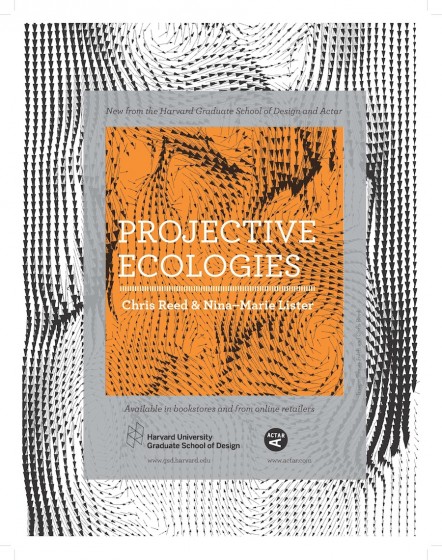
A review of Projective Ecologies, edited by Chris Reed and Nina-Marie Lister. 2014. Second edition 2020. ISBN: 1940291127. ACTAR, Harvard Graduate School of Design. 314 pages.

Review by Anne Trumble

Several months ago, I reviewed Landscape Imagination, a collection of essays by James Corner, a professor at University of Pennsylvania and the landscape architect who designed New York City’s celebrated High Line. Composed over twenty years, his essays examine the many factors hindering the advancement of the cultural medium of landscape. One factor Corner repeatedly addresses is the hoary old dichotomy between nature and culture still pervasive in landscape architecture—the belief in a pristine nature separate from humans.

[…]

Projective Ecologies aims to recover a critical sense of ecology for the design professions because they operate at the intersection of nature and culture—particularly landscape architecture, since its medium holds unique environmental, social, and existential opportunities and responsibilities. Emerging from a multi-year research initiative at Harvard’s Graduate School of Design, Reed and Lister drew on Foucault’s The Archaeology of Knowledge to present three “parallel genealogies,” or intellectual traditions, dealing with the concept of ecology: natural sciences, the humanities, and design.

read more

Helena Ostrowicka, On the Reception of Foucauldian Ideas in Pedagogical Research, European Educational Research Journal, September 2011 vol. 10 no. 3 433-444

doi: 10.2304/eerj.2011.10.3.433
Full text

Abstract
The article is devoted to the presentation of the reception of Foucauldian ideas in Polish pedagogical research over the past twenty years. This movement of thought is described as an oscillation between heterotopia and utopia, autonomy and heteronomy, emancipation and repression. As results of this analysis indicate, Polish pedagogues are most interested in those of Foucault’s analyses which undertake an inquiry into the problems of discursive power or reveal the generative conditions shaping particular discursive formations. The concepts of disciplinary and pastoral power are adopted and utilised for analysing power relations inscribed in discourses of gender, market, childhood, youth, disability, homelessness and subjectivity. Apart from this, the article discusses the Polish reception of Foucauldian texts devoted to the critique of the autonomous subject and to his project of heterotopology. In conclusion, the author points to the inspirations issuing from the works of the French philosopher which encourage us to depart from a dualistic mode of reasoning.