Foucault News

News and resources on French thinker Michel Foucault (1926-1984)

Johanna Oksala, Foucault, Marx and Neoliberal Subjects, Theory, Culture and SocietyFebruary 16, 2015

Daniel Zamora’s edited volume Critiquer Foucault: Les années 1980 et la tentation néolibérale, published in November 2014, has been the subject of a heated debate recently on the philosophical blogosphere. Many Foucault scholars have been puzzled and surprised by the stir it has caused. Verena Erlenbusch (2015) suggests that the controversy has more to do with Zamora’s interview with Jacobin Magazine, provocatively titled “Can We Criticize Foucault?” than with the book itself because many of the arguments presented in it are neither as revolutionary nor as provocative as the interview would make it seem. Stuart Elden (2014) notes that Zamora’s ‘revelations’ are not in fact based on any new material that would have come to light recently and that Foucault’s relationship with neoliberalism has already been subject to critical scrutiny for a number of years by a host of thinkers.

Source: Johanna Oksala on Foucault, Marx and Neoliberal Subjects

Work by Michele Khazak, Cats and Quotes

Work by Michele Khazak, Cats and Quotes

Work by Michele Khazak posted on her now defunct Quotes and Cats site.

Update October 2025: Link above is to the site archived on Internet Archive Wayback Machine. Pictures however were not saved.

Elisabetta Basso, À propos d’un cours inédit de Michel Foucault sur l’analyse existentielle de Ludwig Binswanger (Lille 1953–54), Revue de Synthèse. December 2016, Volume 137, Issue 1, pp 35–59
https://doi.org/10.1007/s11873-016-0297-3

Résumé
Cet article examine la manière dont Michel Foucault se rapporte à la psychologie et à la psychopathologie phénoménologiques dans les années 1950, à la lumière des nouvelles sources documentaires que nous avons aujourd’hui à notre disposition. Notre contribution se concentre en particulier sur le manuscrit inédit de l’un des cours donnés par Foucault à l’université de Lille entre 1952 et 1954 : le cours sur « Binswanger et la phénoménologie » (1953-54). L’analyse de ce cours, conçu par Foucault dans le contexte d’une réflexion philosophique sur le problème anthropologique de la psychopathologie, nous permettra enfin de restituer à Foucault la place qui lui revient dans le domaine de la « philosophie de la psychiatrie ».

Mots-clés
Daseinsanalyse psychopathologie anthropologie philosophique philosophie de la psychiatrie

Elisabetta Basso, née en 1976, est postdoctorante au « Centro de Filosofia » de l’Université de Lisbonne et membre associée de l’UMS-3610 CAPHÉS (CNRS-ENS, Paris). Ancienne boursière de la Fondation A. v. Humboldt, elle est aussi chercheuse associée de l’« Innovationszentrum Wissensforschung » de la Technische Universität, Berlin. Elle a publié plusieurs articles sur Michel Foucault et sur l’histoire du mouvement phénoménologique en psychiatrie. Parmi ses publications, Foucault e la Daseinsanalyse : un’indagine metodologica (Milano, Mimesis, 2007) ; l’édition italienne de Ludwig Binswanger, Il sogno (Macerata, Quodlibet, 2009) ; le volume collectif Foucault à Münsterlingen. À l’origine de l’Histoire de la folie, avec Jean-François Bert (Paris, EHESS, 2015).

On Michel Foucault’s unpublished lectures on Ludwig Binswanger’s existential analysis (Lille 1953–54)

Abstract
This paper aims to analyze Michel Foucault’s position toward phenomenological psychology and psychopathology during the 1950s, in light of the new documentary sources available today. Our investigation is especially focused on one of the courses given by Foucault at the University of Lille between 1952 and 1954, namely, the course on “Binswanger and phenomenology” (1953-54). The analysis of this course, which was conceived by Foucault within the context of a philosophical reflection on the anthropological problem of psychopathology, will finally allow us to re-ascribe Foucault the place he deserves in the field of “philosophy of psychiatry”.

Keywords

Daseinsanalyse psychopathology philosophical anthropology philosophy of psychiatry

stuartelden's avatarProgressive Geographies

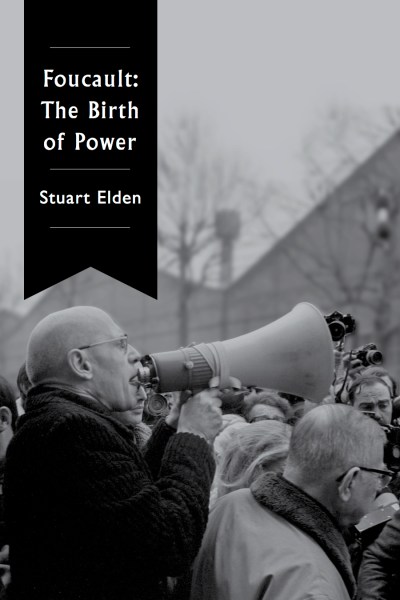
FBP cover.jpgHere is the cover for Foucault: The Birth of Power. The book is forthcoming in early 2017 with Polity, and the design fits with Foucault’s Last Decade which came out earlier this year. There is a lot about Foucault’s political activism in this second book, so the covers make a nice contrasting pair. More information on the two books here.

Michel Foucault’s The Archaeology of Knowledge was published in March 1969; Discipline and Punish in February 1975. Although only separated in time by six years, the difference in tone is stark: the former is a methodological treatise, the latter a call to arms. What accounts for the radical shift in Foucault s approach?

Several transitions took place during this period. Foucault returned to France from Tunisia, first to the experimental University of Vincennes and then to a prestigious chair at the Collège de France. Tunisia was a political awakening for…

View original post 150 more words

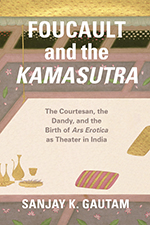
gautamSanjay k. Gautam, Foucault and the Kamasutra. The Courtesan, The Dandy, And The Birth Of Ars Erotica As Theater In India, University of Chicago Press, 2016

The Kamasutra is best known in the West for its scandalous celebration of unbridled sensuality. Yet, there is much, much more to it; embedded in the text is a vision of the city founded on art and aesthetic pleasure. In Foucault and the “Kamasutra”, Sanjay K. Gautam lays out the nature and origin of this iconic Indian text and engages in the first serious reading of its relationship with Foucault.

Gautam shows how closely intertwined the history of erotics in Indian culture is with the history of theater-aesthetics grounded in the discourse of love, and Foucault provides the framework for opening up an intellectual horizon of Indian thought. To do this, Gautam looks to the history of three inglorious characters in classical India: the courtesan and her two closest male companions—her patron, the dandy consort; and her teacher and advisor, the dandy guru. Foucault’s distinction between erotic arts and the science of sexuality drives Gautam’s exploration of the courtesan as a symbol of both sexual-erotic and aesthetic pleasure. In the end, by entwining together Foucault’s works on the history of sexuality in the West and the classical Indian texts on eros, Gautam transforms our understanding of both, even as he opens up new ways of investigating erotics, aesthetics, gender relations, and subjectivity.

Contents
Preface
Acknowledgments
Introduction

1 Foucault and the Notion of Ars Erotica: Pleasure as Desubjectivation
2 Pleasure and Patriarchy: The Discourse of Dharma and the Figure of the Wife
3 The Courtesan and the Birth of Ars Erotica asTheater
4 The Courtesan and the Origins of the Na?yasastra: From Ars Erotica to Ars Theatrica
5 The Dandy-Guru and the Birth of the Discourses of Erotics and Theater
6 The City Dandy and the Vision of the City Based on Art
7 Foucault and the Kamasutra: Parting Ways

Special Issue: Bioethics, Biopolitics and Selfhood, (2016) European Journal of Cultural Studies, 19 (1)

McCormack, D., Salmenniemi, S.
The biopolitics of precarity and the self
(2016) European Journal of Cultural Studies, 19 (1), pp. 3-15.

DOI: 10.1177/1367549415585559

Abstract
This Special Issue explores the biopolitics of precarity and the self. In so doing, its aim is to critically examine the changing landscape of technologies of the self and techniques of domination in late capitalism. It brings Foucault’s work on biopolitics into conversation with recent feminist, Marxist, postcolonial, disability and queer scholarship on precarity. In a feminist tradition of thinking through relationality and ethics, this Special Issue engages with those moments when technologies of regulation, surveillance and normalization do not quite work. ‘The Biopolitics of Precarity and the Self’ analyzes recent debates on precarity and precariousness in relation to migration and labour, health and illness, and the formation of the self and collectivities. It identifies temporality and care of both the self and others as key dimensions of precarity and explores how biopolitical structures of neoliberal capitalism institutionalize precarity that exacerbates existing global and local inequalities. We therefore raise questions around what it means to live, endure, survive and make life and labour possible without doing harm to the self or others. In this sense, this Special Issue brings to the fore the temporalities, politics and ethics of what is not always recognized in biomedical practices, labour migrations, media representations, labour of the self and everyday agency. © 2015, © The Author(s) 2015.

Author Keywords
ethics; Judith Butler; Lauren Berlant; precarity; the self

bouveresse Editor: I posted up a review of this book earlier. It is attracting quite a bit of attention in France hence the repost. See the links at the end of this post

Jacques Bouveresse, Nietzsche contre Foucault Sur la vérité, la connaissance et le pouvoir. Agone, 25/01/2016

Avant-propos de Benoit Gaultier et Jean-Jacques Rosat.

Et si Nietzsche, dont Foucault s’est tant réclamé, parlait souvent contre lui ?

La plupart des expressions typiques de Foucault dans lesquelles le mot « vérité » intervient comme complément – « production de la vérité », « histoire de la vérité », « politique de la vérité », « jeux de vérité », etc. – reposent sur une confusion peut-être délibérée entre deux choses que Frege considérait comme essentiel de distinguer : l’être-vrai et le tenir-pour-vrai. Or peu de philosophes ont insisté avec autant de fermeté que Nietzsche sur cette différence radicale qui existe entre ce qui est vrai et ce qui est cru vrai : « La vérité et la croyance que quelque chose est vrai : deux univers d’intérêts tout à fait séparés l’un de l’autre, presque des univers opposés ; on arrive à l’un et à l’autre par des chemins fondamentalement différents », écrit-il dans L’Antéchrist. Foucault, alors qu’il n’a jamais traité que des mécanismes, des lois et des conditions historiques et sociales de production de l’assentiment et de la croyance, en a tiré abusivement des conclusions concernant la vérité elle-même.

Sur la vérité, l’objectivité, la connaissance et la science, il est trop facilement admis aujourd’hui – le plus souvent sans discussion – que Foucault aurait changé la pensée et nos catégories. Mais il y a dans ses cours trop de confusions conceptuelles entre vérité, connaissance et pouvoir, trop de questions élémentaires laissées en blanc – et, tout simplement, trop de non-sens pour qu’on doive se rallier à pareille opinion. Quant au nietzschéisme professé par Foucault, il repose sur une lecture trop étroite, qui ne résiste pas à une confrontation attentive avec les textes, notamment ceux du Nietzsche de la maturité.

À l’écart aussi bien des panégyriques que des verdicts idéologiques, le philosophe Jacques Bouveresse, professeur au Collège de France, lit Nietzsche et Foucault à la hauteur où ils doivent être lus : avec les mêmes exigences intellectuelles qu’il applique à Wittgenstein et à Musil, et une libre ironie qu’il fait sienne plus que jamais.

Sommaire : I. L’objectivité, la connaissance et le pouvoir (conférence, 2000) ; II. Remarques sur le problème de la vérité chez Nietzsche et sur Foucault lecteur de Nietzsche (essai inédit, 2013-2015) : 1. Ce qui est connu doit-il être vrai ? ; 2. La connaissance sans vérité et la vérité sans vérité ; 3. La vérité pourrait-elle n’être pas la cause de la connaissance, mais son effet ?; 4. La volonté du vrai et la volonté de la distinction du vrai et du faux ; 5. Nietzsche, la « preuve de force » et la « preuve de vérité » de la foi ; 6. La volonté de savoir et la volonté de croire ; 7. La recherche de la connaissance véritable et de la vérité vraie ; 8. Peut-il y avoir une histoire de la vérité ? ; 9. Le concept d’« alèthurgie » : la vérité et ses manifestations.

Professeur au Collège de France, Jacques Bouveresse a publié de nombreux ouvrages de philosophie du langage et de la connaissance mais aussi sur des écrivains comme Robert Musil et Karl Kraus. Il est aussi l’un des principaux commentateurs français de Ludwig Wittgenstein.

Pour visiter la page consacrée à Jacques Bouveresse sur le site du Collège de France

Critiques, comptes rendus et essais

Autour de Jacques Bouveresse blog. Ce blog est là pour diffuser les informations (audio/video/livres/articles) autour des travaux du philosophe Jacques Bouveresse

La vérité en question, Le Monde diplomatique

Actu philosophia

Bouveresse, Opération vérité, Libération

Philosophie-magazine

Ouvertures, le temps du citoyen magazine

Strass de la philosophie blog

Émissions • Les Nouveaux chemins de la connaissance • Nietzsche contre Foucault par Jacques Bouveresse, France Culture, audio podcast

Librairie Tropiques. Includes two videos of debates

Life at the Nowhere Office

BY MIYA TOKUMITSU AND JOERI MOL
New Republic, September 6, 2016

Today’s workplace design asks us to be permanently on call—and demands that we vanish at a moment’s notice.

Extract
If we want to get any work done, we can only do so on the terms afforded by technology, which includes our ever-dispersing workspaces.

Gilles Deleuze envisioned a transition from Michel Foucault’s enclosed disciplinary societies to “societies of control” that superficially appeared more open and amenable to free movement. Power is no longer only exercised through the top-down power structures, but is increasingly manifested in the cloud’s capacity to include or exclude. In an excellent analysis of round-the-clock capitalism, Jonathan Crary argues that while indeed now that our lives are organized by machines, a perfect storm awaits us; rather than one evil (technological determinism) replacing another (the boss), Deleuze’s society of control actually enhances Foucault’s disciplinary society and accelerates us towards a hyper-monitored world, where the all-seeing, all-knowing managerial dashboard keeps us in check by making use of computerized panopticons.

Jen Pan astutely notes that the cost of having a flat, or bossless, work environment is that the work of management (and attendant surveillance) spreads throughout the workforce; when no one is the boss, everyone is. The office as a cyberized version of Hotel California: You can clock-in anytime you like but you can never clock-out.

Miya Tokumitsu is a lecturer of art history at the University of Melbourne and a contributing editor at Jacobin. She is the author of Do What You Love. And Other Lies about Success and Happiness.

Joeri Mol is a senior lecturer of organization studies at the University of Melbourne.

read more

vincencioEduardo Rivera Vicencio, Teoría de la Gubernamentalidad CorporativaAspectos Generales y Conformación Monetaria, Megustaescribir, 2016

“Teoría de la gubernamentalidad corporativa” es recomendable para todo tipo de público interesado en conocer la realidad de la economía y sus crisis, es imprescindible para todas las personas que trabajan en el sector público y en la política, y es fundamental para los empresarios de la economía real, directivos y los profesionales del área económica. La primera parte corresponde al respaldo teórico para aquellos que quieran profundizar en el tema, la segunda parte describe los aspectos generales de esta teoría y en la tercera parte se hace una descripción histórica y económica de la conformación monetaria, que ha permitido la concentración de la riqueza, la apropiación de las rentas y de sus rendimientos. Esta teoría tiene como hilo conductor la metodología de Michel Foucault histórica y filosófica (arqueológica y genealógica), con la argumentación y respaldo teórico económico, junto a las manifestaciones de las relaciones de poder, como el discurso, la disciplina, la ética y la gubernamentalidad. Este libro describe la conformación del “homo economicus”, de la empresa y de los primeros bancos centrales, hasta el sistema de dinero-deuda actual, como herramientas de dominación.

Eduardo Rivera Vicencio nació en Santiago de Chile en 1959, es profesor de la Universitat Autònoma de Barcelona, miembro del Consejo Editorial de International Journal of Critical Accounting, miembro del Consejo Editorial de African Journal of Accounting, Auditing and Finance, miembro de Global Center for Corporate Governance y presidente para Sudamérica de la Research Section of the Critical Accounting Society.

Pierre Macherey, 10 – Foucault lecteur de Roussel : la littérature comme philosophie, Pierre Macherey À quoi pense la littérature ?, Presses Universitaires de France, 1990, édition numérique (2016)

Premières lignes
Dans son travail, Foucault a réservé une place exceptionnelle à la littérature, à laquelle il a reconnu le statut d’un révélateur théorique : Les mots et les choses, dont le titre évoque directement les problèmes de la littérature, en témoignent particulièrement. Foucault a fait plus que réfléchir sur la littérature, il a travaillé avec la littérature : ce qui le préoccupait, c’était d’en faire un…