Foucault News

News and resources on French thinker Michel Foucault (1926-1984)

David Garland, ‘What is a “history of the present”? On Foucault’s genealogies and their critical preconditions’ Punishment & Society (2014) 16(4)365 – 384
https://doi.org/10.1177/1462474514541711

Abstract
In this article Michel Foucault’s method of writing a “history of the present” is explained, together with its critical objectives and its difference from conventional historiography. Foucault’s shift from a style of historical research and analysis conceived as “archaeology” to one understood as “genealogy” is also discussed, showing how the history of the present deploys genealogical inquiry and the uncovering of hidden conflicts and contexts as a means of re-valuing the value of contemporary phenomena. The article highlights the critical observations of present-day phenomena from which a history of the present begins, paying particular attention to Foucault’s concept of “dispositif” and his method of problematization. Foucault’s analyses of Bentham’s Panopticon, of the disciplinary sources of the modern prison, and of the technology of confession are discussed by way of illustration.

Schuilenburg, M., & Peeters, R. (2017). Gift politics: exposure and surveillance in the anthropocene. Crime, Law and Social Change, 1-16.

Open access

Abstract
This article discusses the role of gift relations in the Anthropocene. We reinterpret Mauss’s original concept of the gift to understand its application and transformation in a social context that increasingly sees human behavior as a resource for the realization of governmental and corporate objectives. Contemporary gift relations focus on reciprocity through personal data instead of physical artifacts, and on promoting control and consumerism instead of forging moral and personal obligations. In our analysis, we distinguish two important elements. First, gifts are used to elicit voluntary exposure of personal data by individuals. In exchange for personal data, people are granted material or immaterial rewards. Second, gift relations have a pervasive element of surveillance that aims to influence behavior through personalized feedback or mechanisms of punishment and reward for good behavior.

stuartelden's avatarProgressive Geographies

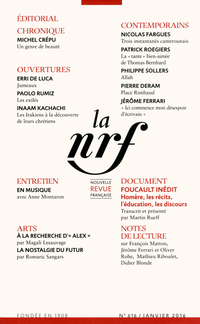
mediumAnother piece of Foucault from the archive was published last year – Michel Foucault, ‘Homère, les récits, l’éducation, les discours‘ edited by Martin Rueff in NRF. Apparently these notes date from the drafting of The Archaeology of Knowledge.

I’ve ordered a copy of this issue, but I found the reference just by chance – I’m wondering if there is a composite list of recently published short pieces by Foucault. My own piece, ‘The Uncollected Foucault‘ appeared in Foucault Studies in 2015 (open access), and was an attempt at a comprehensive list, but it’s already eighteen months out of date. I have a Google Scholar alert but it didn’t pick this one up. There was also an interesting piece on literature and madness in Critique last year. Is anyone else keeping track of new pieces of evidence?

View original post

Workload survival guide for academics, Advice on how to cope with all the work and when to say no to opportunities, Times Higher Education, February 18, 2016

[Editor: This piece by Stuart Elden is part of a larger feature on current workload problems in the university]

‘I try to agree only to talks that move the writing forward, using them as deadlines for producing parts of a wider whole’

I recently spent three days at the Institut Mémoires de l’Edition Contemporaine at the Abbaye d’Ardenne, outside Caen in Normandy. This houses the archives of many French writers, publishers and institutions, including a valuable collection of papers by and relating to Michel Foucault.

The reading room is in the abbey itself; the other buildings have been converted into study-bedrooms, a refectory and conference rooms. Most people using the collections stay on site, take meals together and work in the reading room all the time it is open. There is a shared collective endeavour, a comfortable silence in working hours and a genuine interest in each other’s work in the communal spaces.

All this is at some distance from the working lives of most academics today. Teaching, preparation, marking, office hours, meetings, emails, phone calls and so on make consolidated and protected time for individual study very difficult to obtain and protect. Yet much of our most important work, perhaps especially for academics in the social sciences and humanities, happens alone, in time that cannot easily be quantified, measured or evaluated. Journal articles, chapters and books need consolidated, isolated and protected time; the slow accumulation of reading, thinking and writing, repeated and repeated.

I’m in a privileged position in general in terms of my academic role, and especially this academic year, when I am on sabbatical. But I have an ambitious plan: one book was submitted in the summer before the sabbatical began, I have another that I want to complete and a third with which I want to make good progress. So I set myself some rules to try to structure the days and make the most of the time available (these work just as well for isolated research days, or even just a few hours of writing time).

Number one is not to check email in the morning; email has a habit of setting the day’s agenda for you, instead of being but one of the tasks you need to address. I try to keep nothing in my inbox. This does not mean that every email is already answered, or the associated task completed. It means that the only ones in there are ones I have never seen. Some messages are sorted into consolidated folders – things to do in the office, things to read at some point – others are turned into tasks with scheduled dates and times. So, if nothing in my inbox is older than half a day, it can’t be that urgent. If it is, it’s the sender’s problem, not mine.

I try to keep the morning, or the whole of a shorter slot, as consolidated writing time. I set the agenda. If I’ve had a few productive hours of writing, and feel I am moving things forward, then I am better placed to deal with other tasks – review work, editorial duties, reading PhD students’ work, answering messages. I restrict social media use, usually by using a plug-in to block or limit time. I can always use my phone or iPad, but then it’s really obvious that I’m not working.

I try to agree only to talks that move the writing forward, using them as deadlines for producing parts of a wider whole. There are always exceptions, but preparing a talk can become a major diversion from a focus. The same goes for writing or editing projects – often intriguing, flattering and tempting, and I do those that I can, but they have a cost.

Certain places are also associated with productive work. The specialist archives are one; I’ve also done good work in the British Library Rare Books room in the past. But the best place is still my home study. Close the door – physical and virtual – and get back to writing.

Stuart Elden is professor of political theory and geography at the University of Warwick and author of the forthcoming Foucault’s Last Decade. He blogs at Progressive Geographies.

Paul Sutton, Lost souls? The demoralization of academic labour in the measured university, Higher Education Research & Development Vol. 36 , Iss. 3,2017
DOI: 10.1080/07294360.2017.1289365

ABSTRACT
In this conceptual paper, I contend that the soul of academic labour is becoming lost in performativity. Performativity, I explain, is a form of regulation and control that deploys technical rationality and judgements to incentivize and punish academics. Indeed, performativity is central to the culture of measurement within contemporary universities. This, I contend, is demoralizing academic labour as performativity only measures and values those dimensions of academic labour that can be captured by quantitative performance indicators. To critique this process, I firstly locate performativity within a moral economy perspective. I argue that the university economy is no longer structured by the moral norm of education as a public good. It has been restructured, commodified and marketized by neo-liberal capitalism. Secondly, I explore how the reorganization of institutional practices and academic identity within the university by performativity wreaks terror in the academic’s soul. Thirdly, I critique the unsatisfying post-structural reduction of the soul to a synonym for subjectivity and offer a sociological conception of the soul as the spiritual dimension of academic labour emerging from deep, rich social relations of production. My conjecture is that the soul is the moral energy and purpose central to species-being: the peculiarly human ability to transform the socio-human world for the good of all. Finally, I suggest that within the soulless technical measure of academic labour that now dominates the university lies the possibility for developing a more soulful normative measure. My aim then is to articulate a dialectical humanist conception of the soul of academic labour in order to critique the reductive positivism of the measured university.

KEYWORDS: Academic labour, dialectical humanism, performativity, soul, species-being

Stephen J Ball, Neoliberal education? Confronting the slouching beast, Policy Futures in education, Volume: 14 issue: 8, page(s): 1046-1059
Article first published online: August 23, 2016;Issue published: November 1, 2016

DOI: 10.1177/1478210316664259

Abstract
A major aim of this paper is to draw attention to the insidious manner in which the deficit discourse and practices associated with neoliberal reform are de- or re-professionalising educationists through an acculturation process. In the context of Ireland, as elsewhere, the author identifies how the three ‘technologies’ of Market, Management and Performance have inconspicuously but harmfully changed the subjective experience of education at all levels. It is argued that the power of privatisation in service delivery gives rise to change in education as part of a slow burn; how management is altering social connections and power relations to less democratic and caring forms, and how performativity and accountability agendas are radically undermining the professionalism of teachers in the hunt for measures, targets, benchmarks, tests, tables, audits to feed the system in the name of improvement. The paper adopts a personal tenor exhorting all educationists to become increasingly critically reflexive, politically aware and urging them to reawaken to their real educational work – the ethical and moral project that most signed up to but which has since become lost.

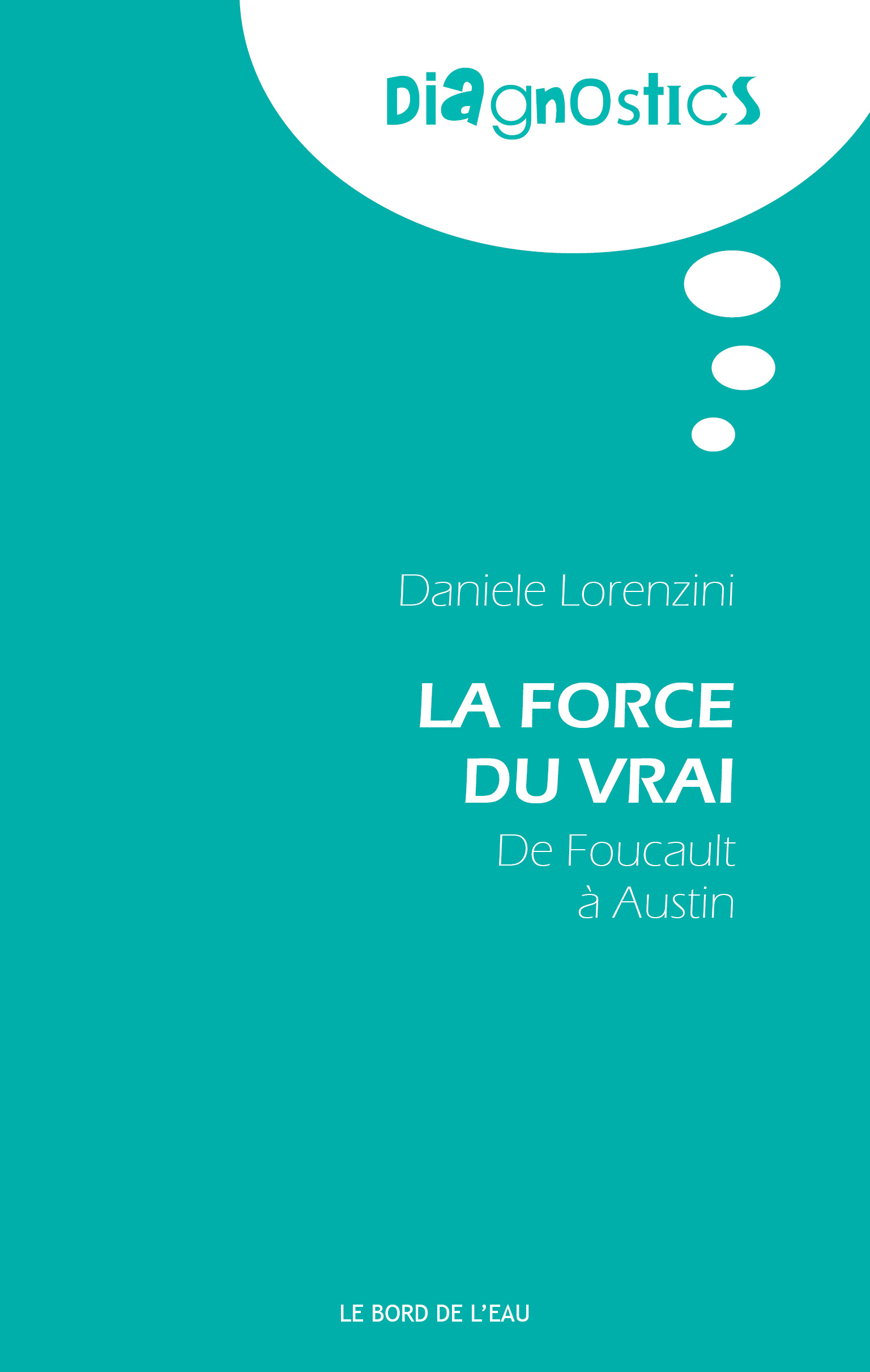
Daniele Lorenzini, La force du vrai. De Foucault à Austin
Le bord de l’eau

Format 13×20 cm – 156 p. – 20 €
Isbn 9782356875310
Collection « diagnostics » dirigee par Fabienne brugere & Guillaume le Blanc
En librairies en juillet 2017

PDF of flyer

Cet ouvrage propose une lecture originale du projet foucaldien d’une histoire de la vérité qui vise à en mettre clairement en lumière les enjeux éthiques et politiques, grâce à l’établissement d’une confrontation entre les analyses de Foucault sur la parrêsia antique, les travaux de J.L. Austin sur l’énoncé performatif et l’étude de l’énoncé passionné par Stanley Cavell. Le problème qui est ainsi posé, en lien mais également en décalage avec les réflexions traditionnelles sur le pouvoir des mots, est celui de la force du vrai : est-il possible ou légitime d’affirmer que la vérité est une force qui s’inscrit, de manière toujours « stratégique », à l’intérieur d’un champ de bataille ? En répondant par l’affirmative, cet ouvrage entreprend d’interroger sous un angle inédit les rapports entre vérité, critique et vie au sein d’une éthique et d’une politique du dire-vrai.

Daniele Lorenzini, docteur en philosophie de l’Université Paris-Est et de l’Université « La Sapienza » de Rome, est chercheur postdoctoral au Centre Prospéro de l’Université Saint-Louis – Bruxelles. Auteur de nombreux ouvrages dont Éthique et politique de soi (Vrin, 2015), il a tout récemment établi l’édition critique de M. Foucault, Dire vrai sur soi-même (Vrin, 2017).

Julia Toynbee Lagoutte, Getting Personal: How Biosecurity Gets Under Our Skin, Green European Journal, vol 15, April 2017

The term security has acquired such breadth and been remoulded so often that it can start to seem meaningless. It is the mantra that will be invoked to justify human rights infringements or to start a war, but also the term that includes ‘climate’ and ‘energy’ issues. How does it encompass so much and why does it mobilise such power? A book review of Frédéric Gros’s book which outlines the mind-changing concept of biosecurity.

Looking at the word afresh is a guaranteed result of Frédéric Gros’s book Le Principe Sécurité (The Principle Security, 2012). Gros is a French philosopher, Michel Foucault expert, and author of the bestseller A Philosophy of Walking (2014). No less intellectually stimulating and philosophical for being a readable ride through history, Gros sets out a Foucauldian-style genealogy of the concept of security. He sets out what he calls its four main usages, contextualising them within their historic Western origins, and ending with biosecurity (a nascent, under-theorised Foucauldian concept that Gros defines anew).

One of the book’s most intriguing elements is how Gros conceives these four disparate senses of security to interact with each other, and how they disappear and re-emerge, modernised and updated to the situation, throughout time and space. Most salient is the way he maps out the increasing importance of biosecurity and its contradictory, potent synthesis with other senses of security to make up our current notion of security.

read more

Parrhesía y estética de la existencia, Dorsal. Revista de Estudios Foucaultianos, Núm. 2 (2017)

DORSAL ISSN 0719-7519 es una Revista digital publicada por CENALTES Ediciones con acceso abierto a su contenido, de periodicidad semestral y editada por la Red Iberoamericana Foucault. En ella se publican artículos de investigación procedentes de distintas disciplinas científicas que utilicen las herramientas teóricas de Michel Foucault o que se centren en el estudio de diversos aspectos de su investigación o de las proyecciones de este trabajo tanto en las humanidades como en las ciencias sociales.

Artículos

La parrêsía en el marco de la obra foucaultiana: verdad y filosofía PDF
Jorge Álvarez Yagüez 11-31
Statues visibles de la vérité: L’askêsis corporelle entre éthique et politique PDF
Daniele Lorenzini 33-47
La interpretación foucaultiana de la figura de Sócrates en la producción de la parresía PDF
Marcelo Raffin 49-65
Cinismo y analítica del poder: el inicio de una inquietud foucaultiana PDF
Juan Horacio de Freitas 67-79
Michel Foucault, el placer del otro y la estética de la existencia PDF
Fernando Sánchez-Ávila Estébanez 81-109
El último Foucault: entre la modernidad y las prácticas de existencia PDF
Claudia Zorrilla 111-127
Agencia y “técnicas de sí”: apuntes sobre la virtud en Foucault PDF
Remedios Bravo Reyes 129-152
Da estética da existência à parresía cínica: “A dor” de Marguerite Duras PDF
Stela Maris da Silva 153-172
Bíos y parrhesía desde la “piedra de toque” PDF
Ricardo J. Jiménez Rodríguez 173-193
Filósofos, psicagogos, parresiastas… ¿impostores? PDF
Fernando Fuentes Megías 195-217
La práctica de la escritura en Foucault: literatura, locura, muerte y escritura de sí PDF
Marina Aguilar Salinas 219-244
Hacia un nuevo diálogo entre Foucault y el psicoanálisis: parrhesía, transferencia y emancipación PDF
Ramón Chaverry Soto 245-261
El silencio de los dioses, la palabra de los hombres: fundamentos de la democracia ateniense PDF
Aitor Alzola Molina 263-280

Materiales

Pensar como perros: Foucault y los cínicos PDF
Diogo Sardinha 283-300
Foucault sobre ética y subjetividad: ‘cuidado de sí’ y ‘estética de la existencia PDF
Daniel Smith 301-321

Reseñas

Reseña de: La sociedad punitiva. Curso en el Collège de France (1972-1973), Michel Foucault. Buenos Aires, Fondo de Cultura Económica, 2016. PDF
Miguel Savransky 325-330
Reseña de: ¿Qué hacen los hombres juntos? Michel Foucault. Madrid, Cinca, 2015. PDF
Ana Velasco Lázaro 331-332
Reseña de: Ley y ser: Derecho y ontología crítica en Foucault (1978-1984), Marco Díaz Marsá. Madrid, Escolar y Mayo, 2016. PDF
Sara Ferreiro Lago 333-338
Reseña: Néolibéralisme(s). Une archéologie intellectuelle. Serge Audier. París, Grasset, 2012. PDF
Luis Diego Fernández 339-341
Reseña: Oeuvres, 2 vols. Michel Foucault. Paris, Éditions Gallimard, Bibliothèque de la Pléiade, 2015. PDF
Edgardo Castro

O’Brien, Peter C. (2017). The adaptive professional: Teachers, school leaders and ethical-governmental practices of (self-) formation. Educational Philosophy and Theory, Pages 1-15 | Published online: 16 Jun 2017

DOI: 10.1080/00131857.2017.1339585

Abstract
This article analyses the relations that teachers and school leaders establish with themselves and with others—especially those who would seek to govern them—through the professional and personal–professional activities that increasingly accompany pedagogical and administrative practice today. Specifically, the article seeks to analyse the conditions under which such ‘ethical-governmental’ relations have become possible and to clarify the lines of power, truth and ethics that are in play within them. In this way, it is argued, their intelligibility may be recovered; their contingencies disclosed. The article first posits a non-psychologised, ‘enfolded’ notion of the self on which analysis rests before turning to an analytics of (self-) government of the conditions themselves. An important element within this entanglement of diverse events, discourses, practices and foldings is the ensemble of policies and practices developed by the Australian Institute for Teaching and School Leadership. The article argues that the programmes of this national agency are a salient and widespread force for acting upon teachers’ and school leaders’ self-constitution as a subject of their own actions—a subject which, in consequence, is enjoined to be more agile, self-reliant, engaged and entrepreneurial than its ‘routine-bound’ predecessors; a subject we describe as the ‘adaptive professional’.

Keywords: Self, ethics, governmentality, neoliberalism, professional standards