Foucault News

News and resources on French thinker Michel Foucault (1926-1984)

stuartelden's avatarProgressive Geographies

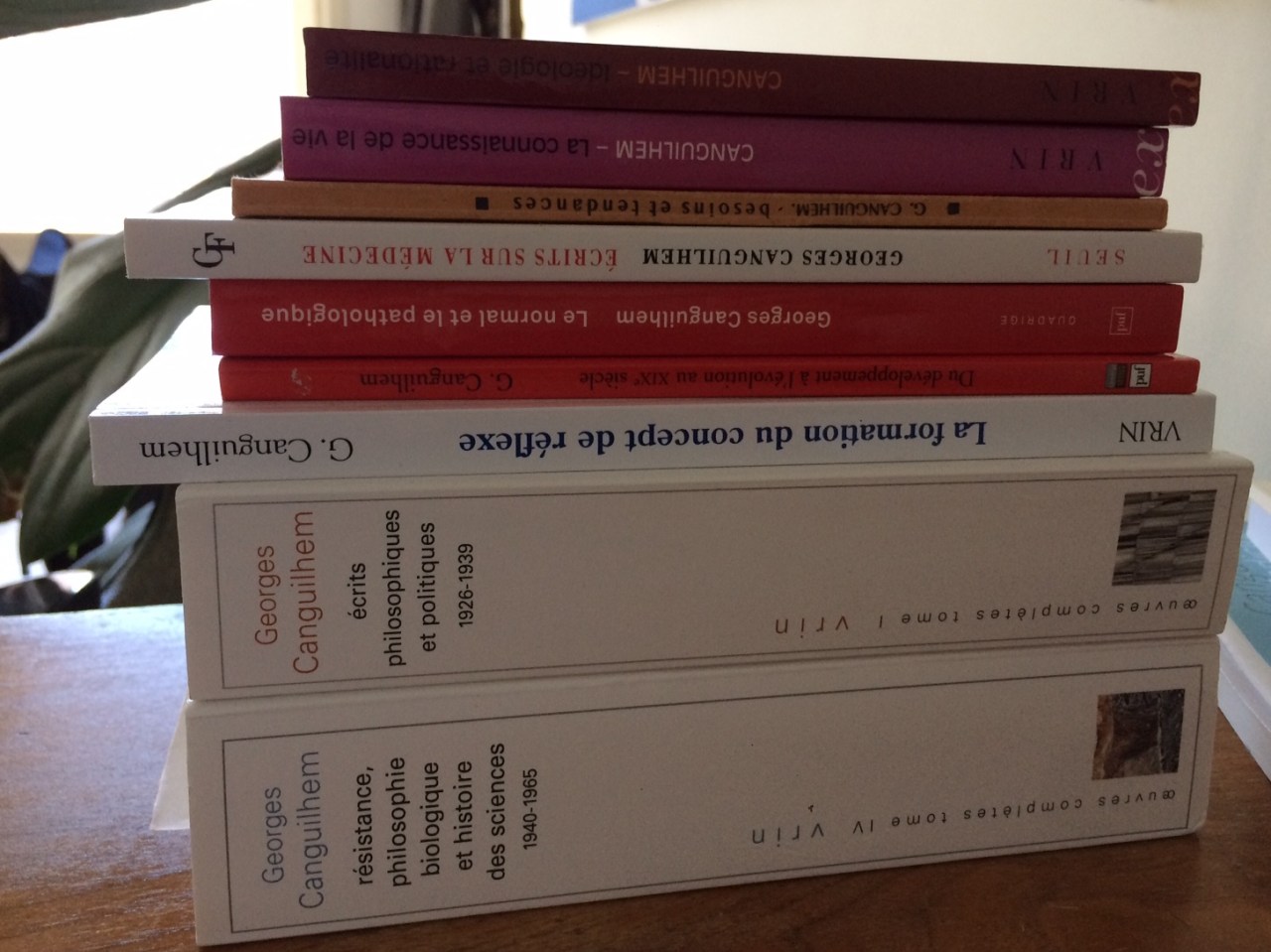
IMG_2389

I don’t plan to write detailed posts on the work I’m doing on Georges Canguilhem for the book for Polity’s Key Contemporary Thinkers series, unlike the ones which I’ve been writing on the work on Foucault. (More background on this project here.)

Part of the reason for this is that the research and writing for this book are likely to run in parallel with the work for The Early Foucault, and so the updates for the writing of that book will cover some of the material for this one. In addition, because I will be writing a single book on the whole of Canguilhem’s work, and for an introductory series, it will necessarily be a different type of book to the Foucault ones. The Foucault ones are written, as should be obvious, for an audience who already know at least something about Foucault. They are not, and…

View original post 1,653 more words

Biancamaria Fontana, Would you mind imprisoning my wife? Times Literary Supplement, May 17, 2017

Review of Arlette Farge and Michel Foucault, Disorderly Families. Infamous letters from the Bastille archives. Edited by Nancy Luxon. Translated by Thomas Scott-Railton 344pp. University of Minnesota Press. $35.

Imagine living in a country where your domestic conflicts could be solved by having persons troublesome to you swiftly and legally arrested and taken away. You would simply address your grievances to some sympathetic public official, and your obstreperous spouse, eccentric mother-in-law or delinquent son could be discreetly moved out of your life to be detained indefinitely in some suitable institution at the king’s pleasure. In the late 1970s Michel Foucault took a break from writing his History of Sexuality to work on an edition of the intriguing set of letters he had come upon while researching in the Bastille archives. The letters, dating from the first half of the eighteenth century, were addressed to the lieutenant of police (and indirectly to the king) by people who requested imprisonment for some member of their own family by means of a lettre de cachet, the special royal order that bypassed normal legal procedures.

read more

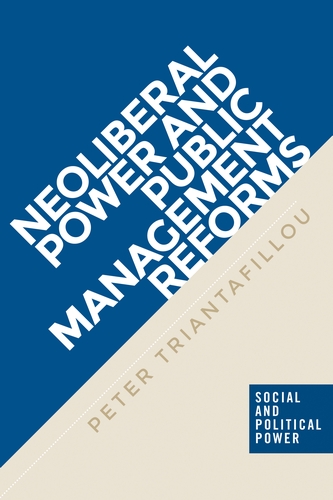
Peter Triantafillou, Neoliberal power and public management reforms, Manchester University Press, April 2017

DESCRIPTION
This book examines the links between major contemporary public sector reforms and neoliberal thinking. The key contribution of the book is to enhance our understanding of contemporary neoliberalism as it plays out in the public administration and to provide a critical analysis of generally overlooked aspects of administrative power. The book examines the quest for accountability, credibility and evidence in the public sector. It asks whether this quest may be understood in terms of neoliberal thinking and, if so, how? The book makes the argument that while current administrative reforms are informed by several distinct political rationalities, they evolve above all around a particular form of neoliberalism: constructivist neoliberalism. The book analyses the dangers of the kinds of administrative power seeking to invoke the self-steering capacities of society and administration itself.

AUTHOR
Peter Triantafillou is Professor in Public Policy and Performance Management at the Department of Social Sciences and Business at Roskilde University

CONTENTS
1. Introduction
2. Critical approaches to public administration and management
3. Neoliberalism: Epistemological finitude or infinite freedom?
4. Accountability: The reflection and expansion of government?
5. Democratic accountability and the institutionalisation of performance auditing
6. Accreditation: The ultimate technique for governing government?
7. Evidence-based policymaking: Towards epistemological infinitude?
8. A new civil-servant persona?
9. Conclusion
Index

Journée d’étude Michel Foucault – IEA Collegium de Lyon/ENS de Lyon – 6 June 2017

PDF program

« ‘Le temps de l’histoire’ : Michel Foucault à l’épreuve de la psychiatrie et de la psychanalyse »,

coorganisée par l’IEA Collegium de Lyon, le programme EURIAS et le laboratoire Triangle UMR 5206 – ENS de Lyon

Elle aura lieu à l’ENS de Lyon, Site Descartes, Salle F 04.

La journée est ouverte à tous

Programme

Matinée présidée par Laurent Dartigues (Triangle, UMR 5206 – ENS de Lyon)

9h-9h15
Ouverture par Michel Senellart (Triangle, UMR 5206 – ENS de Lyon)

9h15-9h30
Présentation de la Journée par Elisabetta Basso et Laurent Dartigues

9h30-10h10
Emmanuel Delille (Max-Planck-Institut für Wissenschaftsgeschichte, Berlin)
Relire Foucault à la lumière du fonds Ellenberger : le tournant historiciste des années 1950

10h25-11h10
Samuel Lézé (IHRIM, UMR 5317 – ENS de Lyon)
Foucault lecteur de Freud

11h30-11h45
Pause-café

11h45-12h25
Elisabetta Basso (Université de Lisbonne et IEA-Collegium de Lyon)
« Entre l’histoire et l’éternité » : le choix de Foucault dans les années 1950
Après-midi présidé par Aurélie Pfauwadel (enseignante et agrégée en philosophie, docteure en philosophie Université Paris 1 Panthéon-Sorbonne)

14h30-15h10
Clotilde Leguil (Université Paris VIII)
Sujet lacanien/sujet sartrien, un « je » sans identité

15h30-16h10
Laurent Dartigues (Triangle, UMR 5206 – ENS de Lyon)
Les statuts de l’inconscient chez Foucault

16h30
Pause-café

16h50-17h30
Sandrine Marsaudon (docteure en philosophie Université Paris VIII)
Foucault, Lacan, la philosophie à l’envers

17h30-18h00
Discussion et clôture de la journée avec la projection du film tourné par G. Verdeaux lors du voyage des époux Verdeaux et Michel Foucault à Münsterlingen

Orazio IRRERA,« De l’archéologie du savoir aux archives coloniales. L’archive comme dispositif colonial de violence épistémique.” Práticas da História, Journal on Theory, Historiography and Uses of the Past, n. 3, 2016, pp. 51-70

Résumé:
Dans cet article il sera question de problématiser l’archive comme lieu d’intersection de matrices épistémologiques et de matrices juridico-politiques, et de montrer la manière dont il a caractérisé la modernité européenne et son projet d’expansion coloniale dans des mondes extra-européens. En un premier temps on se focalisera sur la manière dont l’archive se lie aux processus d’extraction et enregistrement des savoirs pour permettre certaines formes de gouvernement. Sur cet arrière-plan, ensuite, on problématisera l’archive coloniale prise dans son spécificité, en analysant ses rapports avec les formes de violence épistémique qui y sont entremêlées à partir deux perspectives différentes : la première porte sur ce que dans les archives coloniales demeure en soi inaccessible par un geste de mise sous silence qui néanmoins produit des effets considérables sur le statut des archives elles-mêmes. La seconde se concentre sur les manières dont les archives coloniales témoignent constamment d’une angoisse liée à un manque de correspondance entre les plans de la gouvernementalité coloniale et ses réalisations concrètes ainsi qu’aux troubles que cet écart engendre par rapport à toute tentative de fixer une identité raciale et sexuelle.

Mots-clés:
Archéologie; Archive; Études Subalternes; Gouvernementalité Coloniale; Histoire Coloniale; Violence Épistémique.

Kaveh L. Afrasiabi, Shiraz Diaries & Jallad: A Novel on Contemporary Iran. CreateSpace Independent Publishing Platform (April 20, 2016)

Featuring two interconnected stories set in contemporary Iran, Shiraz Diaries & Jallad tells the story of a young girl’s growing up in pre-revolutionary Iran and her traumatic experiences during and after the Islamic Revolution. Jallad (executioner), on the other hand deals with the hallucinatory world of a novelist working on a fiction — that focuses on some of the female characters introduced to the reader in the diaries.

Dr. Kaveh Afrasiabi has taught political science at Tehran University, Boston University, and Bentley College. Afrasiabi has been a visiting scholar at Harvard University, UC Berkeley, Binghamton University, Center For Strategic Research, Tehran and Institute For Strategic Studies in Paris.

Editor: A fictional Foucault appears in the pages of this novel. An extract from an earlier version of the novel:

A suburb of Paris, 1986. Professor Foucault was serious but sarcastic. I could barely hear him with all the television and children noise in the background; holding the phone tightly against my ear, I laughed after hearing his reply to my remark that I thought he had passed away a year or so ago. “I am afraid the news about my death have been extremely, extrement, exaggerated.” We then got on with business. He wanted to know how far I had progressed and how soon I could finish the translation and send it to him. From the way he talked, I got a feeling that he might have wanted to drop the “extrement” from his sarcastic remark. “I have gone to a great length to find you,” he said, “you did not leave a forwarding address in Geneva. I was lucky to run into Dr. Zarabi who happens to know Mr. Farahi, who I understand is a friend of yours. He kindly furnished me with your telephone number.”

Catherine Malabou Critical Inquiry interview, Podcast on Soundcloud, May 2017

Catherine Malabou stopped by the office of Critical Inquiry for a short and informal audio interview during her visit to the University of Chicago last week. We talked about her two CI essays, her new book (Before Tomorrow: Epigenesis and Rationality [2017]), and her work in progress.

[Editor:] This article is causing quite a stir at present so I am posting it here. Read with a large grain of salt. Perhaps the problem is more that intellectuals such as Foucault and Lyotard have been misread and their warnings ignored. A current reading of Discipline and Punish provides insights into how much further things have advanced down the disciplinary track since Foucault wrote the book in 1975.

See a link below this extract to a response on The Disorder of Things blog.


Helen Pluckrose, How French “Intellectuals” Ruined The West: Postmodernism And Its Impact, Explained, Areo Magazine, 27 March 2017

Update September 2025. Areo magazine appears to no longer be available. Link above to the archived article on the Wayback Machine.

[…]
Michel Foucault’s work is also centered on language and relativism although he applied this to history and culture. He called this approach “archeology” because he saw himself as “uncovering” aspects of historical culture through recorded discourses (speech which promotes or assumes a particular view). For Foucault, discourses control what can be “known” and in different periods and places, different systems of institutional power control discourses. Therefore, knowledge is a direct product of power. “In any given culture and at any given moment, there is always only one ‘episteme’ that defines the conditions of possibility of all knowledge, whether expressed in theory or silently invested in a practice.”[1]

Furthermore, people themselves were culturally constructed. “The individual, with his identity and characteristics, is the product of a relation of power exercised over bodies, multiplicities, movements, desires, forces.”[2] He leaves almost no room for individual agency or autonomy. As Christopher Butler says, Foucault “relies on beliefs about the inherent evil of the individual’s class position, or professional position, seen as ‘discourse’, regardless of the morality of his or her individual conduct.”[3] He presents medieval feudalism and modern liberal democracy as equally oppressive, and advocates criticizing and attacking institutions to unmask the “political violence that has always exercised itself obscurely through them.” [4]

We see in Foucault the most extreme expression of cultural relativity read through structures of power in which shared humanity and individuality are almost entirely absent. Instead, people are constructed by their position in relation to dominant cultural ideas either as oppressors or oppressed. Judith Butler drew on Foucault for her foundational role in queer theory focusing on the culturally constructed nature of gender, as did Edward Said in his similar role in post-colonialism and “Orientalism” and Kimberlé Crenshaw in her development of “intersectionality” and advocacy of identity politics. We see too the equation of language with violence and coercion and the equation of reason and universal liberalism with oppression.

read more

L.J Shepherd, In defence of the apparently indefensible (or, French ‘intellectuals’ did not ruin the West and can we please stop postie-bashing because it’s not actually terribly helpful thank you). Disorder of Things blog, April 6 2017

Foucault was profoundly concerned with medico-legal texts, government documents, and carceral practices. Derrida and Said were concerned with literature, cultural texts and film. All of them read their chosen set of empirical materials as communicative acts, asking What kinds of realities are made possible in the way that these texts claim to understand or represent political life?. It is manifestly not the case that these theorists avoided or were suspicious of ‘empirical evidence’.

Roberto Machado – Michel Foucault e a diferença (Parte I)

Roberto Machado – Michel Foucault e a diferença (Parte II)

Gordon Hull, Republican Thanatopolitics, New APPS: Art, Politics, Philosophy, Science blog, 8 May 2017

Foucault reminds us that biopolitics is describes a kind of power structure according to which some will be compelled to live (or have their lives as members of a favored population optimized), while others will be allowed to die. As he puts it, “the ancient right to take life or let live was replaced by a power to foster life or disallow it to the point of death” (HS1, 138). Although much work has focused on techniques by which biopower works to optimize a population, it is worth attending to the disallowance of life, the thanatopolitics that is the other half of biopower, because the Republican party is engaged in producing a very effective case study.

read more