
Foucault News

News and resources on French thinker Michel Foucault (1926-1984)

Any Answers: Christian Caujolle, Interview with Michael GrieveBritish Journal of Photography, 21 August 2017

The chief picture editor of Libération between 1981 and 1986, Christian Caujoulle left to co-found Agence Vu’ and, a decade later, Galerie Vu’. He has curated and edited countless photofestivals, exhibitions, and books, and is associate professor at the ENS Louis Lumière school

[…]

Roland Barthes was one of my professors. After my studies, when I was writing for Libération, he would often ask my advice on the photographers I was writing about at the time. He helped me understand that teaching is not about transmitting facts, it’s about method.

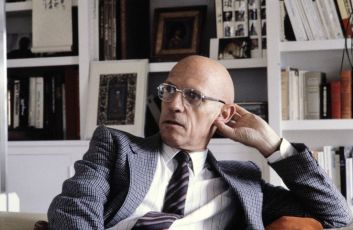
The philosopher Michel Foucault was another. We became close friends and I collaborated with him on different projects, including the movie, Moi, Pierre Rivière. During this radically political and creative time we had hours and days of discussion.

At each moment, Foucault was pushing you to be curious. The last dinner with him will always stay with me. A few days before he finally went to hospital, and weeks later passed away, I was at his home with friends and it was so much fun; a beautiful memory to be with this brilliant man.

Without money, with total freedom: this was the most exciting and creative moment of my professional life. That was my experience as chief picture editor of Libération!

stuartelden's avatarProgressive Geographies

738_foucaultokLeçon inaugurale de Michel Foucault – L’ordre du discours

Quelle est cette volonté de vérité dans nos discours, qui a traversé tant de siècles de notre histoire ? demande Michel Foucault dans sa leçon inaugurale. Qu’est ce qui est en jeu, sinon le désir et le pouvoir? Quelles sont les procédures de contrôles et de délimitation du discours?

https://www.franceculture.fr/player/export-reecouter?content=23619276-1b2b-43d1-93ba-5e3ca08ac882
This isn’t nearly as interesting as I’d imagined when I found the link. Foucault’s inaugural lecture at the Collège de France from 2 December 1970 has been re-recorded by Léon Bonnaffé. As far as I am aware, there are no recordings of the original lecture, which is a shame for two reasons – first, obviously it would be nice to be able to hear Foucault give the talk; but also because the version published as L’ordre du discoursis not the text as actually delivered, as it includes some additional passages.

View original post 61 more words

Frieder Vogelmann (2017). Critique as a practice of prefigurative emancipation. Distinktion: Journal of Social Theory, 18(2), 196–214..
https://doi.org/10.1080/1600910X.2017.1359645

ABSTRACT
Although the various interpretations of Foucault’s model of critique often seem to differ only in minor details, they seriously diverge by situating critique on different levels of abstraction in Foucault’s work. Mapping interpretations of Foucault’s critique according to this criterion shows that none of them pays full attention to all three of Foucault’s methodological imperatives which he calls nihilism, nominalism and historicism. The article offers such a reading of Foucault’s critique, interpreting it as a diagnostic practice of prefigurative emancipation. The task of diagnosing the present explains how Foucault’s critique functions as a philosophical practice, and by making explicit in which ways it emancipates us, it gives us reasons why we might be interested in doing critique like that.

KEYWORDS: Critique, prefigurative politics, emancipation, power, knowledge, subjectivation, archaeology, genealogy, Michel Foucault

Ariel Handel and Hilla Dayan, Multilayered surveillance in Israel/Palestine: Dialectics of inclusive exclusion, Surveillance and Society, Vol 15 No 3/4 (2017): Surveillance and the Global Turn to Authoritarianism

Abstract
The paper examines the surveillance apparatuses in Israel/Palestine as mechanisms aiming to secure support for the Israeli regime, and to preserve its domination over the entire territory in dispute. We analyze three layers of surveillance: “exclusionary surveillance” towards Palestinians; “normalizing surveillance” towards Jewish-Israeli citizens; and finally, “globalizing surveillance” using Zionist constituencies as agents for building a “domain of defense” for Israel in their own countries. Taking into consideration these power and surveillance dispositives we draw insights on the global authoritarian turn and suggest a post-Foucauldian transnational approach to the study of the relations between surveillance, socialization, and subjectification processes.

Lydia Davis, Foucault and Pencil (short story)
The author reading her story (audio file)

‘The Collected Stories of Lydia Davis’
Review by Michelle de Kretser, The Monthly, Australian politics and culture, October 2010

In the United States, Lydia Davis has long been acclaimed for her experiments in short fiction. Elsewhere, she is best known as a translator of French literature and philosophy; in particular, for the 2002 translation of Marcel Proust’s In Search of Lost Time, where Davis provided the first volume. Her Collected Stories showcases a remarkable formal range, while preserving the impress of Davis’ second profession in recurrent strategies and motifs.

Several stories dissect a statement, an idea, a situation. Consider ‘Foucault and Pencil’: “Sat down to read Foucault with pencil in hand. Knocked over glass of water onto waiting-room floor. Put down Foucault and pencil, mopped up water, refilled glass. Sat down to read Foucault with pencil in hand.” Here the nouveau roman, with its minute scrutiny of objects and actions, is echoed and – along with Foucault – gently mocked.

read more

Julia Toynbee Lagoutte, Getting personal: how biosecurity gets under our skin., Green European Journal Volume 15, April 2017
Review of Frédéric Gros’s book Le Principe Sécurité (The Security Principle, 2012).

The term security has acquired such breadth and been remoulded so often that it can start to seem meaningless. It is the mantra that will be invoked to justify human rights infringements or to start a war, but also the term that includes ‘climate’ and ‘energy’ issues. How does it encompass so much and why does it mobilise such power? A book review of Frédéric Gros’s book which outlines the mind-changing concept of biosecurity.

Looking at the word afresh is a guaranteed result of Frédéric Gros’s book Le Principe Sécurité (The Principle Security, 2012). Gros is a French philosopher, Michel Foucault expert, and author of the bestseller A Philosophy of Walking (2014). No less intellectually stimulating and philosophical for being a readable ride through history, Gros sets out a Foucauldian-style genealogy of the concept of security. He sets out what he calls its four main usages, contextualising them within their historic Western origins, and ending with biosecurity (a nascent, under-theorised Foucauldian concept that Gros defines anew).

read more

stuartelden's avatarProgressive Geographies

IMG_2710.JPGI’ve spent most of the first half of the summer revising my Shakespeare manuscript, which is now resubmitted. But I have been doing a little work on the early Foucault in the meantime, and on Canguilhem. With the latter, much of the work has been reference checking from the extensive notes I took on his work while I was in Amsterdam. Canguilhem references a lot of historical texts in biology and medicine, and I wanted to check all of his quotations at a minimum. I discussed some of the reasons why this was important, and challenging, here. Some of this work was done in Paris, and also at various libraries in London – the British Library, Senate House and the Wellcome Trust.

The reason I was in Paris was for another short visit to the Bibliothèque Nationale, where I worked through some more boxes of Foucault material…

View original post 349 more words

Barker, D., Quennerstedt, M.
Power and group work in physical education: A Foucauldian perspective
(2017) European Physical Education Review, 23 (3), pp. 339-353.

DOI: 10.1177/1356336X15620716

Abstract
Group work is used in physical education (PE) to encourage student-directed, collaborative learning. Aligned with this aim, group work is expected to shift some power from teacher to students and enable students to make decisions and co-construct meaning on their own. There are, however, very few investigations focusing on power in group work situations in PE, with most research focusing on learning and content. Assumptions about the nature of power and its mechanisms have been largely implicit. The purpose of this paper was consequently to explore power relations in PE group work. To do this, we have drawn primarily on observational data of three groups working together to choreograph a dance performance in a Swedish PE lesson. A small amount of pre- and post-lesson interview material is used as a complementary data source. Michel Foucault’s notion of power as action-on-action is used to identify different types of power relations in this group work. Four specific kinds of relations are presented concerning: (1) the students’ task; (2) other cultures; (3) gender; and (4) interactions with one another. These relations suggest that power relations are not simply created locally between group members, nor are power relations only a function of the members’ proficiency in the task. In these respects, the results encourage a reconsideration of learning in group work and open up new avenues for further research. The paper is concluded with practical considerations that relate to common assumptions about student power, teacher authority and the potential benefit of ambiguous tasks in group work. © 2016, © The Author(s) 2016.

Author Keywords
Foucault; Group work; interaction; power relations

Michel Foucault on prisons, power and the origin of our beliefs 

Big Thinkers series by The Ethics Centre, 13 July 2017

Michel Foucault (1926-1984) was a French philosopher, historian and psychologist whose work explored the underlying power relationships in a range of our modern institutions.

Given Foucault’s focus on the ways institutions wield power over us, and that trust in institutions is catastrophically low around the world today, it’s worth having a look at some of the radical Frenchman’s key ideas.

HISTORY HAS NO RHYME OR REASON

At the centre of Foucault’s ideas is the concept of genealogy – the word people usually use when they’re tracing their family history. Foucault thought all of history emerged in the same way a family does – with no sense of reason or purpose.

Just like your existence was the result of a bunch of random people meeting and procreating over generations, he thought our big ideas and social movements were the product of luck and circumstance. He argued what we do is both a product of the popular ways of thinking at the time (which he called rationalities) and the ways in which people talked about those ideas (which he called discourses).

read more

Öhman, M.
Losing touch – Teachers’ self-regulation in physical education
(2017) European Physical Education Review, 23 (3), pp. 297-310.

DOI: 10.1177/1356336X15622159

Abstract
The question of physical interaction is especially relevant in school physical education, where a lot of the teaching and activities are based on body movements. However, the issue of ‘touching’ has been questioned in recent years. This paper takes its starting point in the discourse of child protection and the growing anxiety around intergenerational touch in educational settings. The purpose is to examine PE teachers’ self-regulation in relation to the child protection discourse and no touch policies. What sort of strategies have the teachers developed for dealing with physical contact in their teaching? It is a matter of problematising teachers’ pedagogical interactions in PE practice. The study takes its starting point in a discourse-analytical tradition using a methodology based on Foucault’s ideas about governmentality. Twenty-three teachers (10 women and 13 men) aged 30–63 and at different stages in their careers were interviewed. The results show two different self-regulating processes: (1) adaptation using avoidance-oriented strategies and (2) resistance using downplaying-oriented strategies. The paper discusses potential consequences for PE teachers’ pedagogical work if they feel that they have to protect themselves instead of operating in a way that is in the best interest for students’ learning and development. The study aims to contribute to the literature on child protection and ‘no touch’ policies and to a more multifaceted understanding of physical interaction in PE. © 2016, © The Author(s) 2016.

Author Keywords
Foucault; Physical education; physical interaction; self-regulation; touching