Abstract
In this paper, I argue that the appropriate answer to the question of the form contemporary neoliberalism gives our lives rests on Michel Foucault’s definition of neoliberalism as a particular art of governing human beings. I claim that Foucault’s definition consists in three components: neoliberalism as a set of technologies structuring the ‘milieu’ of individuals in order to obtain specific effects from their behavior; neoliberalism as a governmental rationality transforming individual freedom into the very instrument through which individuals are directed; and neoliberalism as a set of political strategies that constitute a specific, and eminently governable, form of subjectivity. I conclude by emphasising the importance that Foucault’s work on neoliberalism as well as the ancient ‘ethics of the care of the self’ still holds for us today.
Henderson, J.
Post-critical writing praxis as a qualitative researcher
(2018) International Journal of Qualitative Studies in Education, pp. 1-10. Article in Press.
Editor: I am working on amalgamating my old michel-foucault.com Foucault resources site with Foucault News and am bringing across the ‘quotes of the month’ from the old site as ‘quotes of the week’ here. I have commented briefly on some of these quotations (as well as others) on my own personal writing blog. You can find what I have brought across from my old site so far under ‘Foucault resources’ in the top menu bar (more to come).
‘It seems to me that the real political task in a society such as ours is to criticise the workings of institutions, which appear to be both neutral and independent; to criticise and attack them in such a manner that the political violence which has always exercised itself obscurely through them will be unmasked, so that one can fight against them.’
Noam Chomsky and Michel Foucault, (2011) [1974]. Human Nature: Justice vs Power. The Chomsky-Foucault Debate(London: Souvenir Press), Edited by Fons Elders, p. 49.
Ball, M. (2018). Mariana Valverde (2017) Michel Foucault. Oxon: Routledge.. International Journal For Crime, Justice And Social Democracy, 7(1), 143-145. DOI: 10.5204/ijcjsd.v7i1.469
In this short and accessible volume, Mariana Valverde adopts the unenviable task not only of surveying Michel Foucault’s contributions to criminology and criminal justice but also of summarising relevant parts of the voluminous Foucaultian scholarship which has appeared since his death. Despite some minor critiques to which I shall return , the book is an important contribution and particularly a good reference tool.
This book explores the theoretical contribution of Michel Foucault to the fields of criminology, law, justice and penology. It surveys both the ways in which the work of Foucault has been applied in criminology, but also how his work can be used to understand and explain contemporary issues and policies. Moreover, this book seeks to dispel some of the common misconceptions about the relevance of Foucault’s work to criminology and law.
Mariana Valverde clearly explains the insights that Foucault’s rich body of work provides about different practices found in the fields of law, security, justice, and punishment; and how these insights have been used or could be used to understand and explain issues and policies that Foucault himself did not write about, including those that had not yet emerged during his lifetime.
Drawing on key texts by Foucault such as Discipline and Punish, and also lectures he gave at the College de France and Louvain Criminology Institute which offer a more nuanced account of the development of criminal justice, Mariana Valverde offers the essential text on Foucault and his contribution and continued relevance to criminology. This book will be important reading for students and scholars of criminology, law, sociolegal studies, security studies, political theory and sociological theory.
Antti Saari, Emotionalities of rule in pedagogical mindfulness literature, Journal of Management, Spirituality & Religion, 15:2, 141-154.
DOI: 10.1080/14766086.2017.1359796
Abstract
Since the turn of the millennium, mindfulness discourses have penetrated various areas of governing health, well-being, and happiness. A recent sub-genre of popular mindfulness literature is teaching and parenting. This sub-genre includes technologies of the self that inculcate responsible, autonomous subjects who control their own emotions and are present, authentic, and available. The article uses the concept of the fold to analyze the way mindfulness discourses aid in constituting a notion of a private sphere of subjective autonomy in teaching and parenting while also demonstrating that subjectivity is an area of governmental intervention in neoliberal rule.
How would Michel Foucault interpret the Skripal affair unfolding before our eyes into a major crisis between Russia and the West? This article seeks to draw on the methodology and insights of critical legal theory to analyze and deconstruct the Western narrative of the Skripal case that has resulted in a sharp deterioration of diplomatic relations between Russia and several Western nations following the British government’s formal accusation of Russia as the culprit behind the alleged nerve gas attack on Mr. Sergei Skripal and his daughter, Yulia Skripal, in Salisbury, England, on March 4th.
As a sub-set of modern Western legal tradition, critical legal theory, and with it the methodology of legal deconstruction, enables us to explore in legal narratives the ‘signs’ and ‘traces’ of bias, predisposition of evidence, and the often subtle ‘pile on’ of hidden political agendas in specific legal conjunctures. In contrast to the positivist and mainstream approach in legal studies, this ‘school of legal thought’ relies on the insights and methodological skills provided by the growing literature on critical legal analysis that draws on such critical thinkers as Michel Foucault and Jurgen Habermas. Foucault’s insights on knowledge/power and the disciplinary nature of law in functioning with the requirements of maintaining hegemony, as well as Habermasian understanding of “systematic distortions” in legal discourses and their “validity norms” by the “mediatizing” influence of power (and geopolitics) are relevant to any work seeking to go beyond the self-rationalizing legal postures, by subjecting the latter to critical legal scrutiny and seeking plausible answers from the totality of intrinsic and extrinsic factors, including the domestic and international variables, probed as objectively and dispassionately as possible.
About the author: Kaveh L. Afrasiabi is a political scientist and author of several books — on Iran, the Middle East, UN, and international affairs — and numerous articles including in New York Times, Guardian, UN Chronicle, Harvard International Review, and Der Tagesspiegel. His latest book, co-authored with Nader Entessar is titled Iran Nuclear Accord and the Remaking of the Middle East (Rowman & Littlefield, 2018)
Philosopher, curator and transgender activist Paul B. Preciado gave the 2017 Benno Premsela Lecture during Thursday Night Live! at Het Nieuwe Instituut. Preciado is one of the leading thinkers in the study of gender and sexual politics, in this lecture he addressed architecture as a technology of subject production.
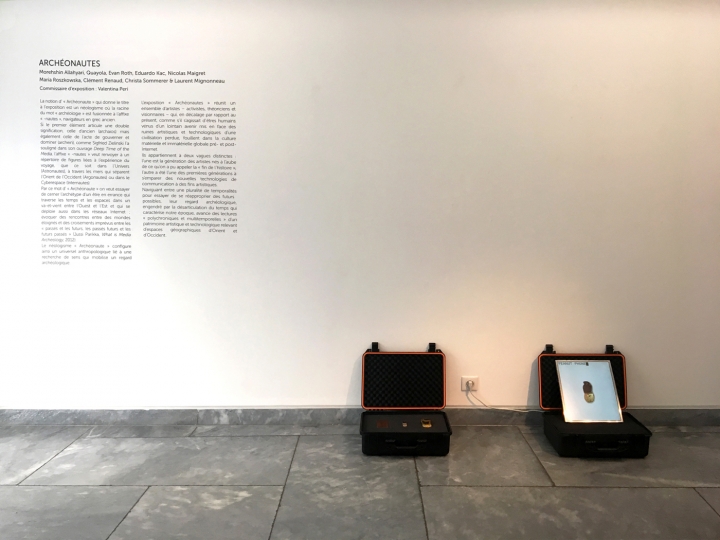
A group show at Paris’s Galerie Charlot uses bygone tools and techniques to explore modern media.
PARIS — Curator Valentina Peri has made smart, cross-generational, idea-based choices when formulating her excellent group show Archéonauts, the best of the Paris season. Citing Michel Foucault’s Archeology of Knowledge, the Siegfried Zielinski essay “Deep Time of the Media,” and Jussi Parikka’s book What is Media Archeology, Peri has created (or identified) something ambitious: the archetype of a wayfarer physically moving back and forth between west and east while surfing on the internet. This multidimensional traveler, who also crosses between the past and the present, is identified by, and possesses, what Peri calls the archeological gaze.