Foucault News

News and resources on French thinker Michel Foucault (1926-1984)

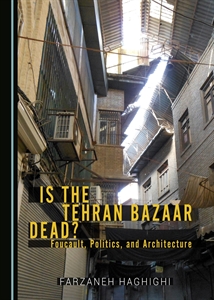
Farzaneh Haghighi, Is the Tehran Bazaar Dead? Foucault, Politics, and Architecture (Cambridge Scholars Publishing, 2018)

Book Description:
To examine the political role of architecture, this book presents an original engagement with the largest center of attraction in Tehran, namely, its bazaar. Through a rigorous study, it goes beyond the conventional sociopolitical and architectural discourses of this marketplace by considering architecture as an event. This book offers alternative modes of spatial thinking on a micropolitical level. Emphasis is placed on the focused exploration of key notions mainly drawn from the works of Michel Foucault. It deploys effective methods and shows how philosophical concepts can be deployed as a tool to analyse the ways through which architecture transforms individuals through the act of exchange—whether of words, things, bodies, or thoughts.

Review:
“Farzaneh Haghighi’s meticulously assembled book brings together the philosophy of the event (principally from Michel Foucault, but interpreted and tested in conjunction with the work of several other contemporary Continental philosophers) and the Tehran Bazaar. Taken together, these two ingredients are put to work to develop a lengthy meditation on the event. Informed as much by the spirit of Foucault as by the detail of his writings, this text operates across a wide range of scales and places, official and unofficial histories, to present the reader with a rich and sophisticated portrait of the Bazaar, as well as with an expanded collection of narratives—archaeologies, even—that can resonate with and challenge broader architectural thinking. Haghighi advocates persuasively for the promise that event philosophy can hold for architectural understanding, explicating the former and extending the latter to account more fully for the relations between the built environment, human action and experience. In this, the resonance of Haghighi’s book far exceeds its detailed engagement with the Bazaar, offering the reader a stimulus that can reach around the globe and across history, to anywhere that things happen.” Dr Stephen Walker, Head of Architecture, University of Manchester, UK.

Author Bio:
Farzaneh Haghighi is a Lecturer in Architecture (Theory and Criticism), at the School of Architecture and Planning of the University of Auckland, New Zealand. Her work is concerned with the intersection of political philosophy, architecture and urbanism. Currently, she is exploring the architecture of the act of exchange (of words, things, bodies) by deploying the political philosophy of Michel Foucault through her teaching and writing. Her research seeks new avenues to enrich our creative analysis of complex built environments through investigating the implications of critical and cultural theory for architectural knowledge.

Daniela Blei How the Index Card Cataloged the World – The Atlantic, Dec 1, 2017

[…]
The index card was a product of the Enlightenment, conceived by one of its towering figures: Carl Linnaeus, the Swedish botanist, physician, and the father of modern taxonomy. But like all information systems, the index card had unexpected political implications, too: It helped set the stage for categorizing people, and for the prejudice and violence that comes along with such classification.

[…]

The act of organizing information—even notes about plants—is never neutral or objective. Anyone who has used index cards to plan a project, plot a story, or study for an exam knows that hierarchies are inevitable. Forty years ago, Michel Foucault observed in a footnote that, curiously, historians had neglected the invention of the index card. The book was Discipline and Punish, which explores the relationship between knowledge and power. The index card was a turning point, Foucault believed, in the relationship between power and technology. Like the categories they cataloged, Linnaeus’s paper slips belong to the history of politics as much as the history of science.

Thoughts on the History of Telos, 1968–2018
By Timothy W. Luke, Telos Wednesday, July 11, 2018

On June 8, 2018, Telos celebrated its fiftieth anniversary at a special event held in New York City. Speakers included Telos Press publisher Maria Piccone, Telos editors Russell Berman, Tim Luke, David Pan, and Adrian Pabst, as well as Jacob Siegel, who delivered a talk on “Telos, Post-liberal Politics, and a Veteran’s Reading of Ernst Jünger.” Videos of the event are available at the Telos-Paul Piccone Institute website. Telos 183 (Summer 2018), our fiftieth anniversary issue, is available for purchase in our store. Presented below is a revised transcript of Tim Luke’s remarks at the anniversary event.

‘What is to be understood by the disciplining of societies in Europe since the eighteenth century is not, of course, that the individuals who are part of them become more and more obedient, nor that all societies become like barracks, schools or prisons; rather, it is that an increasingly controlled, more rational and economic process of adjustment has been sought between productive activities, communications networks, and the play of power relations.’

Michel Foucault, (2000) [1981] ‘The Subject and Power’. In J. Faubion (ed.). Power The Essential Works of Michel Foucault 1954-1984. Volume Three. Tr. Robert Hurley and others. New York: New Press, p. 339.

Editor: reflections on my blog

Editor: Jeremy Bentham would be in his element

Panopto
The Video Platform for Businesses and Universities

Panopto is the easiest way to manage, live stream, record, and share videos across your organization.

The easy-to-use, all-in-one video platform
With Panopto, you’ve got a single tool for video management, recording, live streaming, inside-video search, quizzing, analytics, mobile, and more.

MSCP Evening School Sem 2 2018

The Melbourne School of Continental Philosophy is proud to present the Evening School Semester 2 curriculum.  Both courses are 24 hours in length. As always significant discounts apply for those enrolling in multiple courses. If you have any questions which aren’t in our FAQs please email admin@mscp.org.au.

Full Details and Registration:
https://mscp.org.au/courses/evening-school-semester-2-2018

Courses

12 x Wed 6.30-8.30pm Starting 1 Aug
The Works of Gilles Deleuze, part 2 (1972-1994)
Lecturer: Dr Jon Roffe

12 x Thur 6.30-8.30pm Starting 2 Aug
On the real and the imaginary
Lecturer: Dr Lachlan Ross

Daniel Verginelli Galantin, A presença de Georges Bataille no pensamento de Michel Foucault: entre o ser da linguagem, insurreição e atitude crítica, Doispontos, volume 14, número 1, pp. 213-228, abril de 2017

Resumo:
Neste artigo propomos uma análise da presença do pensamento de Georges Bataille na obra de Michel Foucault. A partir de certos elementos textuais, alguns deles inéditos, defendemos que sua importância não se restringe apenas aos escritos sobre linguagem e literatura, mas que parece haver, da parte de Foucault, uma constante apropriação e diálogo com certos elementos do pensamento batailliano. Tal apropriação e diálogo diz respeito aos temas da crítica e da ontologia, da finitude, assim como da experiência como processo de transformação de si mesmo num campo político.

Palavras‑Chave: Linguagem; experiência; espiritualidade; crítica; Foucault; Bataille.

The presence of Georges Bataille in the thought of Michel Foucault: between the being of language, insurrection and critical attitude

Abstract:
This text aims to analyze the presence of Georges Bataille’s thought in the work of Michel Foucault. Basing our arguments on certain textual elements, some of them yet unpublished, we defend that Bataille’s importance isn’t restrained just to Foucault’s writings on language and literature. In what concerns Foucault, there seems to be a constant appropriation and dialogue with some elements of Bataillian thought. These appropriations and dialogues refer to the themes of critique, ontology, finitude and to experience as a process of self-transformation in the political arena.

Key‑words: Language; experience; spirituality; critique; Foucault; Bataille

Teófilo Espada-Brignoni, (2018) Complexity and Ambivalence: The Ethics of Jazz in Sidney Bechet’s and Warren Dodds’s Autobiographies, Jazz Perspectives, Published online: 16 Jul 2018

DOI: 10.1080/17494060.2018.1492243

ABSTRACT
During the twentieth century, jazz was at the center of multiple debates about social life and American experience. Jazz music and its performers were framed in both positive and negative manners. The autobiographies of New Orleans musicians Sidney Bechet and Warren Dodds provide insight into the general frames they used to frame jazz experience and agency sometimes at odds with dominant discourses. Through Michel Foucault’s notion of ethical substance, I analyze the way in which jazz is constructed in their autobiographies. Several themes are used by both autobiographers to frame their actions, which are constructed in a complex and ambivalent manner revealing both the ethics of jazz and its covert culture.

Call for Papers: The body productive: A one-day conference about capitalism, work and the body

How are bodies produced under capitalism?

How, in turn, does capitalism make bodies productive?

How is the body (and knowledge of the body) shaped by demands of production, consumption and exchange, and how can these logics be resisted, challenged and overcome?

These are the questions at the heart of François Guéry and Didier Deleule’s Productive Body. First published in French in 1972, The Productive Body asks how the human body and its labour have been expropriated and re-engineered through successive stages of capitalism. The Productive Body challenges us to rethink the relationships between the biological and the social; the body and the mind; power and knowledge; discipline and control. Finally, it invites us to think about the body as a site of resistance and revolutionary potential.

At this one-day, interdisciplinary conference, we invite scholars and activists to assess the contribution of The Productive Body, and to address its relevance as a theoretical tool for understanding and challenging contemporary ideologies of bodily health, efficiency and productivity.

We invite submissions from scholars, activists and artists for 20-minute papers, or 10-minute provocations on the relationships – past and present – between capitalism, work and the body. Collaborative papers are welcome, and proposals for longer workshops and panel discussions will also be considered. Please contact the organisers if you are unsure. Proposals that explore or are inspired by any of the following areas are welcome:

  • Critical responses to Guéry and Deleule – the biological, the social, and the productive
  • Materialist vs. discursive approaches to the history of the body
  • Conceptualising discipline in Marx and Foucault
  • The body as an object of discipline vs. the body as a site of dissent
  • The psychology and corporeality of activism, organising and resistance
  • Hierarchies of gender and race in the division of labour
  • (Re)productive bodies; intimate and emotional labour, sex work, body work
  • How are ideas of health and disability shaped by the demands of wage labour?
  • How do queer bodies disrupt or challenge logics of productivity? How are queer bodies in turn, commodified or appropriated by capital?
  • How do the demands of productivity complicate/interact with the body as a site of intimacy?
  • Biopolitics and neoliberalism
  • Body-machines – technology and automation; robotics, cybernetics and transhumanism; digital surveillance, ‘lifelogging’ and the ‘quantified self’
  • Counterproductive bodies: pre-capitalist, non-capitalist, and post-capitalist bodies

Please send abstracts of no more than 300 words to thebodyproductive@gmail.com by 24th August 2018. Submissions are especially encouraged from graduate students, early-career researchers, and groups typically underrepresented in the academy.

Perhaps the role of the philosopher, the role of philosopher at present, is not to be a theoretician of totality, but the diagnostician, if you will allow me to use this word, the diagnostician of today.

Raymond Aron and Michel Foucault, (2007) Dialogue, Paris: Nouvelles Editions Lignes, p. 22. This passage trans. Clare O’Farrell