Foucault News

News and resources on French thinker Michel Foucault (1926-1984)

Kerr, R.
The role of science in the practice of talent identification: a case study from gymnastics in New Zealand
(2018) Sport in Society, pp. 1-15. Article in Press.

DOI: 10.1080/17430437.2018.1435032

Abstract
Talent identification is an example of a practice where ‘scientism threatens to engulf us all.’ Talent identification and development are areas where models perceived to be scientific have been uncritically adopted into sporting practice due to the belief that they represent best practice. In this article, I track the changing talent identification systems adopted in the sport of rhythmic gymnastics in New Zealand over approximately 20 years. The findings revealed that those in decision-making positions originally adopted the perspective of scientism in introducing a physical ability test which they perceived to have scientific value. However, scientific testing was later removed owing to the now empowered gymnastics coaches drawing on what Foucault referred to as local knowledge, acquired through their own experiences. Their experiences resulted in the coaches believing in the importance of what Latour described as social practices being more significant in talent identification than scientific testing. © 2018 Informa UK Limited, trading as Taylor & Francis Group

Index Keywords
article, decision making, drawing, human, human experiment, New Zealand, physical capacity, sport

CALL FOR PAPERS

The nineteenth annual meeting of the Foucault Circle

Stonehill College
North Easton, MA
April 5-7, 2019

We seek submissions for papers on any aspect of Foucault’s work, as well as studies, critiques, and applications of Foucauldian thinking.

Paper submissions require an abstract of no more than 750 words. All submissions should be formatted as a “.doc” or “.docx” attachment, prepared for anonymous review, and sent via email to the attention of program committee chair Don Deere (dtdeere@gmail.com) on or before December 14, 2018. Indicate “Foucault Circle submission” in the subject heading. Program decisions will be announced during the week of January 15, 2019.

In light of the recent publication of Les Aveux de la chair (The History of Sexuality IV), this year’s meeting will include a discussion session on Foucault’s complex engagement with Christianity (relevant English texts will be made available on our website). The conference will begin with a Friday afternoon panel session and an evening reception. Morning and afternoon paper sessions will be held on Saturday, followed by a business meeting and dinner. The conference will conclude with paper sessions on Sunday morning. Presenters will have approximately 40 minutes for paper presentation and discussion combined; papers should be a maximum of 3500 words (20-25 minutes reading time).

Logistical information about lodging, transportation, and other arrangements will be available after the program has been announced.

For more information about the Foucault Circle, please see our website:
http://www.foucaultcircle.org
or contact our Coordinator, Ed McGushin:
emcgushin@stonehill.edu

Sept. 14, 1982 (from L to R): French intellectuals Maxime Rodinson, Pierre Nora, Michel Foucault, Simone de Beauvoir, Alain Finkielkraut, Jean Daniel, Claude Lanzmann and Regis Debray pose at the Elysee Palace after a meeting with then French President Francois Mitterrand. /VCG Photo

Editor: Foucault is behind Simone de Beauvoir

Claude Lanzmann, director of Holocaust film ‘Shoah’, dies at 92. CGTN, 6 July 2018

French filmmaker and writer Claude Lanzmann, whose landmark 1985 documentary “Shoah” revealed the horrors of the Holocaust over nine hours of chilling eyewitness accounts, died in Paris on Thursday aged 92.

Vegter, M.W.
Towards precision medicine; a new biomedical cosmology
(2018) Medicine, Health Care and Philosophy, pp. 1-14. Article in Press.

DOI: 10.1007/s11019-018-9828-z

Abstract
Precision Medicine has become a common label for data-intensive and patient-driven biomedical research. Its intended future is reflected in endeavours such as the Precision Medicine Initiative in the USA. This article addresses the question whether it is possible to discern a new ‘medical cosmology’ in Precision Medicine, a concept that was developed by Nicholas Jewson to describe comprehensive transformations involving various dimensions of biomedical knowledge and practice, such as vocabularies, the roles of patients and physicians and the conceptualisation of disease. Subsequently, I will elaborate my assessment of the features of Precision Medicine with the help of Michel Foucault, by exploring how precision medicine involves a transformation along three axes: the axis of biomedical knowledge, of biomedical power and of the patient as a self. Patients are encouraged to become the managers of their own health status, while the medical domain is reframed as a data-sharing community, characterised by changing power relationships between providers and patients, producers and consumers. While the emerging Precision Medicine cosmology may surpass existing knowledge frameworks; it obscures previous traditions and reduces research-subjects to mere data. This in turn, means that the individual is both subjected to the neoliberal demand to share personal information, and at the same time has acquired the positive ‘right’ to become a member of the data-sharing community. The subject has to constantly negotiate the meaning of his or her data, which can either enable self-expression, or function as a commanding Superego. © 2018 The Author(s)

Author Keywords
Big data; Foucault; Medical cosmology; Participatory medicine; Precision medicine; ’All-of-Us’ research program

Ralph Lamar Turner & Carol Gassaway (2018) Between kudzu and killer apps: Finding human ground between the monoculture of MOOCs and online mechanisms for learning, Educational Philosophy and Theory,Published online: 07 May 2018

DOI: 10.1080/00131857.2018.1465816

Abstract
Although MOOCs have not lived up to previously breathless predictions of disruption, they have had an outsized influence on university administrators who see online learning as a “savior solution” for ever-shrinking budgets. Despite lower student persistent rates, faculty skepticism, and burdensome faculty workloads, the general public and administrative embrace of online learning has been enthusiastic, which may be explained in part using Foucault’s concept of the episteme to view the convergence of the parallel tracks of educational and technological development–the idea of a kind of mechanism for learning. While MOOCs once promised “best professors,” other institutions now promise the “best designed” mechanisms for learning, certified through corporatized quality assurance programs and learning management systems. While this may be appropriate for shopping educational products in a neoliberal marketplace, it seldom addresses human needs. Moreover, the temporal and human constraints that online promises to banish, in fact, continue to exist. Therefore, a more realistic examination of psychological and social factors, pedagogical tools, and the nature of online communication, is needed in order to create a more humane way of teaching, and learning.

Keywords: MOOCs, neoliberalism, Foucault, online education, constructivism, digital episteme, locus of cognition

Annie Dorsen, Hello, Hi there

Hello Hi There uses the famous television debate between the philosopher Michel Foucault and linguist/activist Noam Chomsky from the Seventies as inspiration and material for a dialogue between two custom-designed chatbots: every evening, these computer programs, designed to mimic human conversations, perform a new – as it were, improvised – live text.

As Chomsky and Foucault debate language, creativity, the roots of scientific discovery and the nature of political power, the chatbots talk on and on, endlessly circling the questions of the debate, and frequently veering off into unexpected, at times nonsensical, digressions. Purposely low-tech, the chatbots remind us of the optimism of the late 60s/early 70s, when natural language programming was thought to soon crack the code of human language production. This optimism in the face of repeated failure echoes the dynamic in the politics of Chomsky and Foucault — reflecting a similarly fading optimism in the possibility of people to remake our world.

Matthews, M.
Counter hegemony in post-compulsory art and design and gallery education, through Sartre and Foucault
(2018) Pedagogy, Culture and Society, pp. 1-16. Article in Press.

DOI: 10.1080/14681366.2018.1428220

Abstract
Austerity politics in Britain are edging towards compressed learning and teaching identities, driven by competition for resources and normative standards. Policy changes since 2010 have impacted particularly on the arts, and have had an adverse effect on cultural diversity across society. This situation has international resonance for those encountering protectionist reactions to globalisation. Practitioners in creative fields face dilemmas of agency, as they seek to maintain the presence of their roles, and ability to make choices. This paper focuses on how practitioners in post-compulsory art and design and gallery education challenge hegemonic constructions of the self through practice. It reflects on Herne’s research of relational differences between teachers and gallery educators, raising points for connective interventions as boundary work. A comparative lens draws upon theories of agency to support critically engaged practice. Empirical data is investigated through Sartre’s concept of free will, and Foucauldian negotiations of autonomy. © 2018 Pedagogy, Culture & Society

Author Keywords
Agency; art education; counter hegemony; Foucault; gallery; post-compulsory; Sartre

Language of Original Document: English
Document Type: Article in Press
Source: Scopus

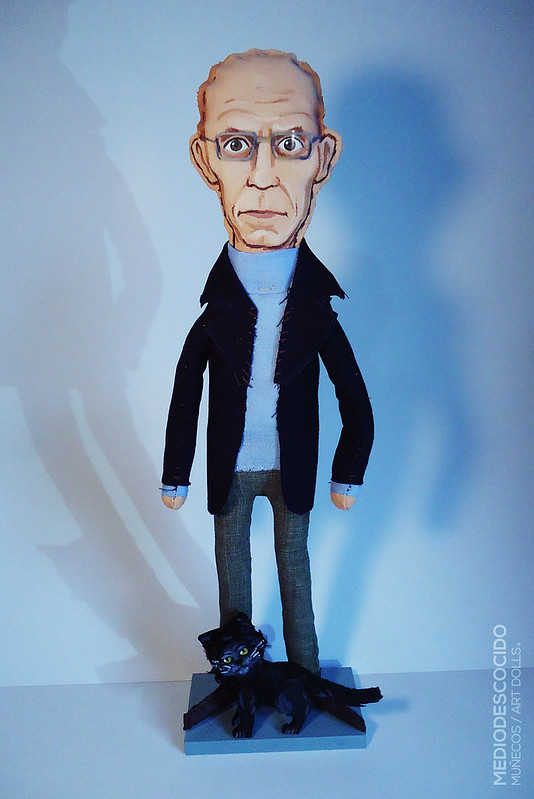
Michel Foucault
from flickr

MEDIODESCOCIDO ART DOLLS es una creación del Artista Plástico argentino Uriel Valentín. Se basa en una fusión de Pintura y Diseño con el concepto de Objeto de Arte. Todos los Dolls de aproximadamente 36 cm de altura son pintados y cosidos a mano; y en su interior, poseen un esqueleto de alambre para darles cierta articulación. Todos son únicos e irrepetibles: No contienen procesos industrializados. Los personajes seleccionados por Uriel están basados en Artistas en los que él se inspira pero también se realizan pedidos Custom a pedido del cliente.

Uriel Valentín nace en Capital federal en el año 1981. Cursa el Magisterio en Bellas Artes (Centro Polivalente de Arte de San Isidro. 1995-1999) donde se recibe de Maestro Nacional de Dibujo. En 2002 Cursa Caracterización Teatral (Instituto Superior de Arte del Teatro Colón. Capital Federal). Realizo talleres de Dibujo y Pintura con el Maestro Víctor Hugo Bethencourt. Actual mente vive y trabaja en Capital Federal. En 2002 creó MEDIODESCOCIDO con la idea de poder vivir del Arte por medio de sus pequeñas Obras que combinan Pintura y Dibujo con el Concepto del Objeto.
http://www.facebook.com/urielvalentinpinta

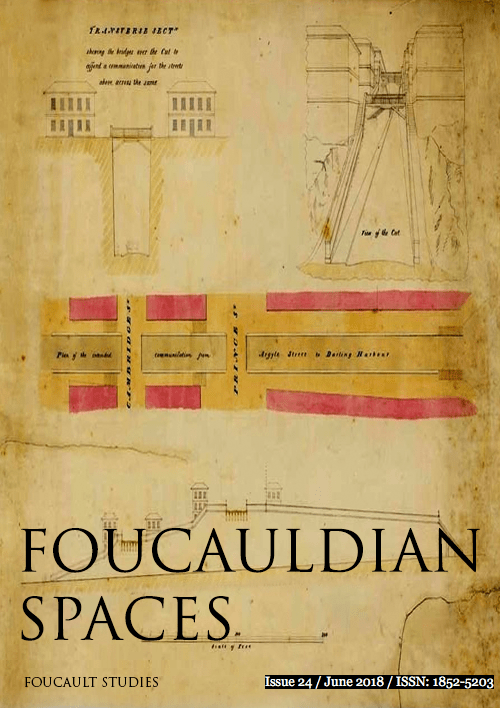
Foucault Studies

Number 24, June 2018: Foucauldian Spaces

Table of Contents

Editorial – Special Issue, Foucauldian Spaces
Sverre Raffnsøe

Section in collaboration with Foucault Circle
Introductory Essay: Foucauldian Spaces
Dianna Taylor, Joanna Crosby

Articles
South Africa as postcolonial heterotopia: The racialized experience of place and space
Charles Villet

The 2015 Baltimore Protests: Human Capital and the War on Drugs
Joanna Crosby

Foucault’s functional justice and its relationship to legislators and popular illegalism
Sylvain Lafleur

Round Table Discussion with Lynne Huffer, Steven Ogden, Paul Patton, and Jana Sawicki
Lynne Huffer, Steven Ogden, Paul Patton, Jana Sawicki

Monsters of Sex: Michel Foucault and the Problem of Life
Sarah K. Hansen

From the End of Man to the Art of Life: Rereading Foucault’s Changing Aesthetics
Kenneth Berger

Governing the Voice: A Critical History of Speech-Language Pathology
Joshua St. Pierre, Charis St. Pierre

Translations

Introduction: The Analytic Philosophy of Politics
Giovanni Mascaretti

The Analytic Philosophy of Politics
Giovanni Mascaretti, Michel Foucault

Book Reviews
Subjectivity and Truth review
Stuart Elden

The multiple Foucault and the Modern/Colonial International
Victor Coutinho Lage

Mariana Valverde, Michel Foucault
Christian Hammermann

Richard A. Lynch: Foucault’s Critical Ethics
Oscar Larsson

Heike Delitz, Architectural Modes of Collective Existence: Architectural Sociology as a Comparative Social Theory (2018) Cultural Sociology, 12 (1), pp. 37-57.
https://doi.org/10.1177/1749975517718435

Abstract
This article proposes a cross-cultural, comparative architectural sociology as a means of sociological analysis. It also emphasizes the social positivity of architecture. After a short overview of architectural sociology and its history, the article outlines a sociological theory which sees architecture and related practices as a constitutive ‘mode of collective existence’. The article argues that architecture (in a broad sense) is not a mere ‘reflection’ or ‘mirror’ of society, but rather a constitutive and transformative medium of the imaginary institution of society (Castoriadis), its assemblages (Deleuze), as well as its subjects (Foucault). In other words, it claims that architecture is a material and symbolic ‘mode’ through which societies and individuals are constituted and transformed. As architecture is a cultural technique, which is primarily enacted in relation to bodies, perceptions and affects (rather than in a discursive, reflective way), the social effects of architecture can best be understood and analysed through a comparative lens. Finally, therefore, the article unfolds a tableau of diverse architectural modes of collective existence, thus providing an overview of different socio-architectural constellations. Such a comparative and synchronical view of different societies allows for a sociology of architecture which analyses architectural transformations – both historical and contemporary. © 2017, © The Author(s) 2017.

Author Keywords
comparative method; material culture; post-foundational thought; social imaginary; sociological theory; sociology of architecture; theory of society