
Foucault News

News and resources on French thinker Michel Foucault (1926-1984)

Angelaki, Journal of the Theoretical Humanities Special Issue: Problems in twentieth-century French philosophy Vol 23, no. 2 2018
Issue editors: Sean Bowden and Mark G.E. Kelly

Introduction
PROBLEMS IN TWENTIETH-CENTURY FRENCH PHILOSOPHY
Sean Bowden & Mark G.E. Kelly
Page: 1

Editorial
PROBLEMATIZING PROBLEMS
Sean Bowden & Mark G.E. Kelly
Pages: 2-7

THE MISADVENTURES OF THE “PROBLEM” IN “PHILOSOPHY”
from kant to deleuze
Giuseppe Bianco
Pages: 8-30

BERGSON’S METHOD OF PROBLEMATISATION AND THE PURSUIT OF METAPHYSICAL PRECISION
Craig Lundy
Pages: 31-44

AN ANTI-POSITIVIST CONCEPTION OF PROBLEMS
deleuze, bergson and the french epistemological tradition
Sean Bowden
Pages: 45-63

CAVAILLÈS, MATHEMATICAL PROBLEMS AND QUESTIONS
Pierre Cassou-Noguès
Pages: 64-78

LAUTMAN ON PROBLEMS AS THE CONDITIONS OF EXISTENCE OF SOLUTIONS
Simon B. Duffy
Pages: 79-93

SIMONDON ON THE NOTION OF THE PROBLEM
a genetic schema of individuation
Daniela Voss
Pages: 94-112

ON THE PROBLEM AND MYSTERY OF EVIL
marcel’s existential dissolution of an antinomy
Jill Hernandez
Pages: 113-124

TOWARDS A PHENOMENOLOGY OF SAGESSE
uncovering the unique philosophical problematic of pierre hadot
Matthew Sharpe
Pages: 125-138
Published online: 10 Apr 2018

THE ERRORS OF HISTORY
knowledge and epistemology in bachelard, canguilhem and foucault
Alison Ross
Pages: 139-154

PROBLEMATIZING THE PROBLEMATIC
foucault and althusser
Mark G.E. Kelly
Pages: 155-169

FOUCAULT, PSYCHOANALYSIS, AND CRITIQUE
two aspects of problematization
Amy Allen
Pages: 170-186

PROBLEMATIZATION IN FOUCAULT’S GENEALOGY AND DELEUZE’S SYMPTOMATOLOGY
or, how to study sexuality without invoking oppositions
Colin Koopman
Pages: 187-204

Judith Fathallah, Fanfiction and the Author – E-book | Amsterdam University Press, 2017

The production, reception and discussion of fanfiction is a major aspect of contemporary global media. Thus far, however, the genre has been subject to relatively little rigorous qualitative or quantitative study-a problem that Judith M. Fathallah remedies here through close analysis of fanfiction related to Sherlock, Supernatural, and Game of Thrones. Her large-scale study of the sites, reception, and fan rejections of fanfic demonstrate how the genre works to legitimate itself through traditional notions of authorship, even as it deconstructs the author figure and contests traditional discourses of authority. Through a process she identifies as the ‘legitimation paradox’, Fathallah demonstrates how fanfic hooks into and modifies the discourse of authority, and so opens new spaces for writing that challenges the authority of media professionals.

See review

Earlier pages suggest this work intends to draw heavily from vanguard postmodernist Michel Foucault. Fortunately, Fathallah steadies a relatable and digestible understanding of Foucault’s contributions to discourse analysis. The researcher combines an assessment of discourse analysis with taut reviews of Internet Studies and Fan Studies. As a trained academic, her work is robust and impressive. Delving through the research references will be a treat to grad students and faculty readers alike. Fathallah remixes old and new sources that showcase a quality of fit between the author and her subject. In effect, she’s practicing meta-genre mixing in textual and mixed methods form.

Zoë Brigley Thompson,From safe spaces to precarious moments: teaching sexuality and violence in the American higher education classroom(2018) Gender and Education, 32(3), 395–411.
https://doi.org/10.1080/09540253.2018.1458077

Abstract
Critics of safe spaces in campus teaching often fail to understand the complexity of instructors’ practices in teaching controversial topics. Beginning with recent controversy regarding safe spaces in the higher education classroom, this paper explores strategies for fostering more complex learning when teaching classes on sensitive topics, whilst encouraging a resilient mind-set in approaching disturbing subjects. Based on experience of teaching a mixed undergraduate/graduate course on ‘Sexuality and Violence’, the discussion focuses on moments of precarity in the classroom, drawing on Judith Butler’s work on ethical cohabitation and Michel Foucault’s writings on ethics. The precarious moment is defined, not simply as a tense or difficult exchange, but a moment when an ethical demand is made through an exchange between members of the classroom. Ultimately, this paper argues that what the university classroom needs is not safe space, but a space of precarity that is generative, dynamic, and valuable. © 2018 Informa UK Limited, trading as Taylor & Francis Group

Author Keywords
critical & literary theory; heteronormativity; higher education; Sexualities education; violence

‘It seems to me that the philosophical choice confronting us today is the following. We have to opt either for a critical philosophy which appears as an analytical philosophy of truth in general, or for a critical thought which takes the form of an ontology of ourselves, of present reality. It is this latter form of philosophy which from Hegel to the Frankfurt School, passing through Nietzsche, Max Weber and so on, which has founded a form of reflection to which, of course, I link myself insofar as I can.’

Michel Foucault, (2010) [2008]. The Government of Self and Others. Lectures at the Collège de France, 1982- 1983. Tr. Graham Burchell. Houndmills and New York: Palgrave Macmillan, p. 21

Editor: Reflections on my blog

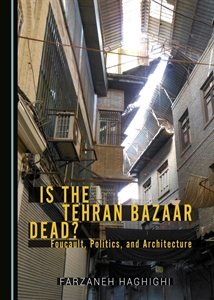
Farzaneh Haghighi, Is the Tehran Bazaar Dead? Foucault, Politics, and Architecture (Cambridge Scholars Publishing, 2018)

Book Description:
To examine the political role of architecture, this book presents an original engagement with the largest center of attraction in Tehran, namely, its bazaar. Through a rigorous study, it goes beyond the conventional sociopolitical and architectural discourses of this marketplace by considering architecture as an event. This book offers alternative modes of spatial thinking on a micropolitical level. Emphasis is placed on the focused exploration of key notions mainly drawn from the works of Michel Foucault. It deploys effective methods and shows how philosophical concepts can be deployed as a tool to analyse the ways through which architecture transforms individuals through the act of exchange—whether of words, things, bodies, or thoughts.

Review:
“Farzaneh Haghighi’s meticulously assembled book brings together the philosophy of the event (principally from Michel Foucault, but interpreted and tested in conjunction with the work of several other contemporary Continental philosophers) and the Tehran Bazaar. Taken together, these two ingredients are put to work to develop a lengthy meditation on the event. Informed as much by the spirit of Foucault as by the detail of his writings, this text operates across a wide range of scales and places, official and unofficial histories, to present the reader with a rich and sophisticated portrait of the Bazaar, as well as with an expanded collection of narratives—archaeologies, even—that can resonate with and challenge broader architectural thinking. Haghighi advocates persuasively for the promise that event philosophy can hold for architectural understanding, explicating the former and extending the latter to account more fully for the relations between the built environment, human action and experience. In this, the resonance of Haghighi’s book far exceeds its detailed engagement with the Bazaar, offering the reader a stimulus that can reach around the globe and across history, to anywhere that things happen.” Dr Stephen Walker, Head of Architecture, University of Manchester, UK.

Author Bio:
Farzaneh Haghighi is a Lecturer in Architecture (Theory and Criticism), at the School of Architecture and Planning of the University of Auckland, New Zealand. Her work is concerned with the intersection of political philosophy, architecture and urbanism. Currently, she is exploring the architecture of the act of exchange (of words, things, bodies) by deploying the political philosophy of Michel Foucault through her teaching and writing. Her research seeks new avenues to enrich our creative analysis of complex built environments through investigating the implications of critical and cultural theory for architectural knowledge.

Daniela Blei How the Index Card Cataloged the World – The Atlantic, Dec 1, 2017

[…]
The index card was a product of the Enlightenment, conceived by one of its towering figures: Carl Linnaeus, the Swedish botanist, physician, and the father of modern taxonomy. But like all information systems, the index card had unexpected political implications, too: It helped set the stage for categorizing people, and for the prejudice and violence that comes along with such classification.

[…]

The act of organizing information—even notes about plants—is never neutral or objective. Anyone who has used index cards to plan a project, plot a story, or study for an exam knows that hierarchies are inevitable. Forty years ago, Michel Foucault observed in a footnote that, curiously, historians had neglected the invention of the index card. The book was Discipline and Punish, which explores the relationship between knowledge and power. The index card was a turning point, Foucault believed, in the relationship between power and technology. Like the categories they cataloged, Linnaeus’s paper slips belong to the history of politics as much as the history of science.

Thoughts on the History of Telos, 1968–2018
By Timothy W. Luke, Telos Wednesday, July 11, 2018

On June 8, 2018, Telos celebrated its fiftieth anniversary at a special event held in New York City. Speakers included Telos Press publisher Maria Piccone, Telos editors Russell Berman, Tim Luke, David Pan, and Adrian Pabst, as well as Jacob Siegel, who delivered a talk on “Telos, Post-liberal Politics, and a Veteran’s Reading of Ernst Jünger.” Videos of the event are available at the Telos-Paul Piccone Institute websiteTelos 183 (Summer 2018), our fiftieth anniversary issue, is available for purchase in our store. Presented below is a revised transcript of Tim Luke’s remarks at the anniversary event.

‘What is to be understood by the disciplining of societies in Europe since the eighteenth century is not, of course, that the individuals who are part of them become more and more obedient, nor that all societies become like barracks, schools or prisons; rather, it is that an increasingly controlled, more rational and economic process of adjustment has been sought between productive activities, communications networks, and the play of power relations.’

Michel Foucault, (2000) [1981] ‘The Subject and Power’. In J. Faubion (ed.). Power The Essential Works of Michel Foucault 1954-1984. Volume Three. Tr. Robert Hurley and others. New York: New Press, p. 339.

Editor: reflections on my blog

Editor: Jeremy Bentham would be in his element

Panopto
The Video Platform for Businesses and Universities

Panopto is the easiest way to manage, live stream, record, and share videos across your organization.

The easy-to-use, all-in-one video platform
With Panopto, you’ve got a single tool for video management, recording, live streaming, inside-video search, quizzing, analytics, mobile, and more.

MSCP Evening School Sem 2 2018

The Melbourne School of Continental Philosophy is proud to present the Evening School Semester 2 curriculum.  Both courses are 24 hours in length. As always significant discounts apply for those enrolling in multiple courses. If you have any questions which aren’t in our FAQs please email admin@mscp.org.au.

Full Details and Registration:
https://mscp.org.au/courses/evening-school-semester-2-2018

Courses

12 x Wed 6.30-8.30pm Starting 1 Aug
The Works of Gilles Deleuze, part 2 (1972-1994)
Lecturer: Dr Jon Roffe

12 x Thur 6.30-8.30pm Starting 2 Aug
On the real and the imaginary
Lecturer: Dr Lachlan Ross