
Foucault News

News and resources on French thinker Michel Foucault (1926-1984)

Nicholas de Villiers. Porno Cultures Podcast, July 10, 2019. Interview with Brandon Arroyo.

facebook.com/AcademicSex

When we think about the rhetoric around sex workers it’s often easier to hear or read opinions advocating for the abolishment of sex work coming from politicians or “concerned citizens” who are not sex workers, or have never bothered to speak to a sex worker. The degree to which the voices of sex workers are suppressed in mainstream outlets throughout the West speaks to how dangerous their voices are considered. What on earth can sex workers be saying that so many people feel the need to speak for them instead of letting them speak for themselves? Well, that’s one of the primary issues that Nicholas de Villiers looks to solve in Sexography: Sex Work in Documentary (University of Minnesota Press, 2017).

Sexography analyzes a series of films centered around interviewing sex workers. These films represent some of the few instances where sex workers are actually allowed to speak for themselves. Of course, these films are not without their own tensions. Many of the films are directed by non-sex workers and some of the portrayals of sex work in these films is quite negative. This is where de Villiers’ dynamic analysis of these films through a queer perspective helps us think about the nature of sex work, the interview, documentary aesthetics, and the concept of “truth” in new and interesting ways.

Sexography is an exploration of how we can go about reading for, and exploring the sexual practices of, not only sex workers, but our own ideas about sexuality as well. How can the financial aspects of sex work help us understand the power dynamics of our own sexual relationships? What can sex workers teach us about sex and pornographic literacy? What is the relationship between sex work, pornography, and drag performance? And how can the work of Foucault help us think about the contemporary nature of sexual practice? These are just some of the questions explored in this wide-ranging interview. De Villiers is one of the most interesting and bold queer theorists working today, so you’re not going to want to miss out on his compelling analysis of these films or his thoughts on contemporary sexuality!

More work from Nicholas de Villiers
Opacity and the Closet: Queer Tactics in Foucault, Barthes, and Warhol
Nicholas’ appearance on the Critical Theory podcast discussing Opacity and the Closet
“Afterthoughts on Queer Opacity”

“FBI Seized 23 Tor-hidden Child Porn Sites, Deployed Malware from Them”
“How the FBI Became the World’s Largest Distributor of Child Sex Abuse Imagery”
“Transgender, at War and in Love”
“What Teenagers are Learning from Online Porn”
Paris is Burning (1990)
Love Meetings (1964)
Not Angels But Angles (1994)
Body Without Soul (1996)
Tales of the Night Fairies (2002)
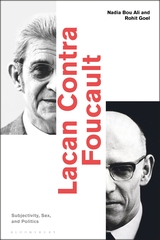
Nadia Bou Ali, Rohit Goel (eds). Lacan Contra Foucault. Subjectivity, Sex, and Politics, Bloomsbury

Review at Notre Dame Philosophical Reviews

Lacan Contra Foucault seeks to ground the divergences and confluences between these two key thinkers in relation to contemporary philosophy and criticism. Specifically the topics of sexuality, the theory of the subject, history and historicism, scientific formalization, and ultimately politics. In doing so, the authors in this volume open up new connections between Lacan and Foucault and shine a light on their contemporary relevance to politics and critical theory.

Contents
Introduction: ‘Measure against Measure: Why Lacan contra Foucault?’ Nadia Bou Ali, merican University of Beirut, Lebanon

Chapter 1: Cutting Off the King’s Head, Mladen Dolar, University of Ljubljana, Slovenia

Chapter 2: Author, Subject, Structure: Lacan contra Foucault, Lorenzo Chiesa, European University at St Petersburg, Russia

Chapter 3: Better Failures: Science and Psychoanalysis, Samo Tomšic, Humboldt University, Germany

Chapter 4: Merely Analogical: Structuralism and the Critique of Political Economy, Anne van Leeuwen, James Madison University, USA

Chapter 5: Battle Fatigue: Kiarostami and Capitalism, Joan Copjec, Brown University, USA

Chapter 6: Foucault’s Neo-liberal Post-Marxism, Zdravko Kobe, University of Ljubljana, Slovenia

stuartelden's avatarProgressive Geographies

It’s been over five months since I posted an update on The Early Foucault, and it is only in the last couple of weeks that I’ve really been back at work on the manuscript. In the spring and early summer I gave a number of lectures on Shakespeare, some connected to Foucault, but not to the early work, and a few presentations on terrain. The last of those, “Terrain, Politics, History”, will be given at the RGS-IBG conference at the end of August as the Dialogues in Human Geography lecture. Because there will be three responses, I had to send it off a month before. These, and other duties, took me away from the focus on Foucault’s early career. After the Dialogues lecture I have no other speaking commitments in the diary, though it’s likely I’ll be speaking about the Foucault work in New York in the spring…

View original post 511 more words

Tim Christiaens, The entrepreneur of the self beyond Foucault’s neoliberal homo oeconomicus, European Journal of Social Theory 23(4), 2019, 493-511.
https://doi.org/10.1177/1368431019857998

Abstract
In his lectures on neoliberalism, Michel Foucault argues that neoliberalism produces subjects as ‘entrepreneurs of themselves’. He bases this claim on Gary Becker’s conception of the utility-maximizing agent who solely acts upon cost/benefit-calculations. Not all neoliberalized subjects, however, are encouraged to maximize their utility through mere calculation. This article argues that Foucault’s description of neoliberal subjectivity obscures a non-calculative, more audacious side to neoliberal subjectivity. Precarious workers in the creative industries, for example, are encouraged not merely to rationally manage their human capital, but also to take a leap of faith to acquire unpredictable successes. It is this latter risk-loving, extra-calculative side to neoliberal subjectivity that economists usually designate as ‘entrepreneurial’. By confronting Foucault with the theories of entrepreneurship of the Austrian School of Economics, Frank Knight, and Joseph Schumpeter, the Foucauldian analytical framework is enriched. Neoliberal subjectivation is not the monolithic promotion of utility-maximizing agents, but the generation of a multiplicity of modes for entrepreneurs to relate to oneself and the market.

Jemma Tosh, Psychology and Gender Dysphoria. Feminist and Transgender Perspectives, Routledge, 2105

Description

Psychiatry and psychology have a long and highly debated history in relation to gender. In particular, they have attracted criticism for policing the boundaries of ‘normal’ gender expression through gender identity diagnoses, such as transvestism, transsexualism, gender identity disorder and gender dysphoria.

Drawing on discursive psychology, this book traces the historical development of psychiatric constructions of ‘normal’ and ‘abnormal’ gender expression. It contextualizes the recent reconstruction of gender in the 5th edition of the Diagnostic and Statistical Manual of Mental Disorders (DSM-5) and its criteria for gender dysphoria. This latest diagnosis illustrates the continued disagreement and debate within the profession surrounding gender identity as ‘disordered’. It also provides an opportunity to reflect on the conflicted history between feminist and transgender communities in the changing context of a more trans-positive feminism, and the implications of these diagnoses for these distinct but linked communities.

Psychology and Gender Dysphoria examines debates and controversies surrounding psychiatric diagnoses and theories related to gender and gender nonconformity by exploring recent research, examples of collaborative perspectives, and existing feminist and trans texts. As such, the book is relevant for postgraduate and postdoctoral researchers of gender, feminism, and critical psychology as well as historical issues within psychiatry.

Extract
With this volatile context in mind, I will describe the role psychology and psychiatry have played in defining gender ‘normality’ and ‘abnormality’, as well as the responses and challenges posed by those more likely to be positioned in the latter category: women (cisgender and transgender) and those with gender identities and bodies that exist outside of the binaries of man/woman, male/female. I do this with an appreciation of the historical and changing contexts in which these perspectives occurred. I echo the aim of many who have positioned the ‘psy’ disciplines as the subject of study and analysis (Foucault, 1975; Rose, 1979). I provide a genealogical tracing as well as a critical questioning of present assumptions and misconceptions (Pilgrim, 1990). I show how long-standing problems within the psy professions impact on present discourses and experiences. (p.2)

With thanks to Diana Kuhl for this reference

Heather Brunskell-Evans, Mini-Symposium on Sex and Gender: Foucault and the Construction of Transgender Children, The Electric Agora
A modern symposium for the digital age
blog, July 2019

Thirty years ago, ‘the transgender child’ would not have made sense to the general public, nor would it have made sense to young people. Today, children and adolescents declare themselves transgender, the NHS refers some children for ‘gender-affirming’ therapy, and laws and policy are invented which uphold young people’s ‘choice’ to transition and to authorize the stages at which medical intervention is permissible and desirable.

The current narrative of the transgender child has numerous, attendant strands: although previously unrecognized, children born in ‘the wrong body’ are alleged to have always existed; parents are ‘brave’ when they accept their daughter is ‘really’ a boy (and vice versa); active cultural support of children’s gender self-identification helps revolutionize hide-bound, sexist and outdated ideas about gender; and medical intervention is a sign of a tolerant, liberal and humane society. What is the provenance of such a narrative? On what scientific medical/ psychological/philosophical bases are these composite ‘truths’ founded?

[…]
In order to examine the component parts that make up the narrative of the transgender child as a real, ahistorical, naturally occurring figure I use the genealogical method of the philosopher Michel Foucault who traces histories of the present power/knowledge/ ethics relations out of which sex and gender identities emerge.

Niko Besnier, Susan Brownell, Thomas F. Carter, The Anthropology of Sport. Bodies, Borders, Biopolitics, University of California Press, 2017

Few activities bring together physicality, emotions, politics, money, and morality as dramatically as sport. In Brazil’s stadiums or China’s parks, on Cuba’s baseball diamonds or Fiji’s rugby fields, human beings test their physical limits, invest emotional energy, bet money, perform witchcraft, and ingest substances. Sport is a microcosm of what life is about. The Anthropology of Sport explores how sport both shapes and is shaped by the social, cultural, political, and historical contexts in which we live. Core themes discussed in this book include the body, modernity, nationalism, the state, citizenship, transnationalism, globalization, and gender and sexuality.

Interview (podcast) with Susan Brownell on the New Books network

[…]
As my first guest, I’d would like to introduce Susan Brownell, Professor of Anthropology at the University of Missouri – St Louis, one of the authors of The Anthropology of Sport: Bodies, Borders, Biopolitics (University of California Press, 2018). During the course of the interview, we covered the subfield of sport anthropology, the marginalization of traditional games, the recent Caster Semenya case, and the contemporary transnationalism of sport.

In The Anthropology of Sport, understandably, the authors enlighten us about what the subfield entails, how anthropology is well suited to dissect the nature of sport, and provide us with ample anecdotes and observations of the world of sport through an ‘anthropological gaze.’ The chapters are structured in a way that cover all the relevant aspects in the study of sport, including history, class, race/ethnicity, sex/gender, nationalism, and globalization. Two important additions to the field of sport studies include a chapter on sport, health, and the environment (3), as well as sport as a cultural performance (6). In the former, which can be taken as a foundational text on the subject, the history of sport medicine and non-Western perspectives on sport and the body are enlightening, with anecdotes about the history of yoga and the Falun Gong movement. In the latter, the performative turn and ritual theory are used to dissect the contemporary global sport mega-event infrastructure. In conclusion, the authors point out that “more than any other form of human activity, sport embodies some of the fundamental questions that anthropology poses” (258), and this book lives up to its lofty title.

Brownell, Besnier, and Carter’s work is a new text in a yet undefined field – it may be the start of something new. If interested in the global nature of sport today, The Anthropology of Sport is a necessary read.

Siew Fung Lee (2019) Governing ‘disadvantage’ through readiness: A Foucauldian policy genealogy of funded nursery places for two-year-olds. Contemporary Issues in Early Childhood.

DOI: 10.1177/1463949119864200

ABSTRACT
This article critically examines how the policy of funded nursery places for ‘disadvantaged’ two-year-olds in England opens up economic and political spaces in readiness for increased governance. The government introduced funded nursery places in September 2013, which aimed to promote disadvantaged children’s educational outcomes, narrow the attainment gap and encourage parental employment. Using a Foucauldian policy genealogy, the article sets out the ways in which funded nursery places constitute and deploy techniques for governing ‘disadvantage’ – specifically, how ‘disadvantage’ is constructed as a ‘problem of the population’, which, in turn, is productive of particular subjectivities and practices. The article traces how funded nursery places construct a particular ‘disadvantage’ through ‘experts of truth’, evidence-based policy, regimes of quality and neurobiology in preparation for the next phase of nursery at the age of three. These processes establish ‘disadvantaged’ two-year-olds as governable objects and therefore subject to the increased formalization of early experiences. The close links between ‘disadvantage’ and ‘readiness’ discursively provide conditions of possibility for technical and instrumental practice that is driven by a global hegemonic rationale in human capital. Although the analysis is focused in the English context, these developments have wider global implications in relation to school readiness and early education reforms across countries that are reaching into ever younger spaces.

Benjamin Meiches, The Politics of Annihilation: A Genealogy of Genocide (University of Minnesota Press, 2019)

Interview with author conducted by Jeff Bachman

Description
For a term coined just seventy-five years ago, genocide has become a remarkably potent idea. But has it transformed from a truly novel vision for international justice into a conservative, even inaccessible term? The Politics of Annihilation traces how the concept of genocide came to acquire such significance on the global political stage. In doing so, it reveals how the concept has been politically contested and refashioned over time. It explores how these shifts implicitly impact what forms of mass violence are considered genocide and what forms are not.

Benjamin Meiches argues that the limited conception of genocide, often rigidly understood as mass killing rooted in ethno-religious identity, has created legal and political institutions that do not adequately respond to the diversity of mass violence. In his insistence on the concept’s complexity, he does not undermine the need for clear condemnations of such violence. But neither does he allow genocide to become a static or timeless notion. Meiches argues that the discourse on genocide has implicitly excluded many forms of violence from popular attention including cases ranging from contemporary Botswana and the Democratic Republic of Congo, to the legacies of colonial politics in Haiti, Canada, and elsewhere, to the effects of climate change on small island nations.

By mapping the multiplicity of forces that entangle the concept in larger assemblages of power, The Politics of Annihilation gives us a new understanding of how the language of genocide impacts contemporary political life, especially as a means of protesting the social conditions that produce mass violence.

Benjamin Meiches is assistant professor of security studies and conflict resolution at the University of Washington–Tacoma.

Paul Rekret, Derrida and Foucault. Philosophy, Politics, and Polemics, Rowman & Littlefield International, 2017

Derrida and Foucault offers a major contribution to the interpretation of these two highly influential thinkers. By tracing the moments where Derrida and Foucault’s arguments converge but also where they deviate, this book fundamentally recasts our understanding not only of these two philosophers, but of the political more broadly. Organised thematically around questions of epistemology, ethics, and politics, this is the only work to bring Derrida and Foucault’s whole oeuvres into dialogue with one another. This book frames a dialogue not only between their works of the 1960s and 1970s but also their works that deal with political questions around liberalism, capitalism and democracy. This book offers the first substantial critical assessment of Derrida and Foucault’s political work and also situates these crucial thinkers in contemporary debates in political theory.