
Foucault News

News and resources on French thinker Michel Foucault (1926-1984)

Paolo Vernaglione Berardi, Per una storia della verità, Archeologia del presente blog, 2 Aprile 2025

Michel Foucault nella prima lezione dell’ultimo corso al Collège de France, Il coraggio della verità, riprende la nozione di parresia e definisce diversi modi del dir vero. le strutture caratteristiche dei differenti discorsi che vengono accetatati come veri si riferiscono a campi del sapere e a pratiche di verità che costituiscono eventi storico-politici.

Diversi modi di produrre il discorso vero delimitano lo spazio in cui si producono i rapporti tra soggetto e verità e attraverso l’insieme delle relazioni di verità il soggetto riconosce sè stesso ed è riconosciuto come colui che dive la verità. «Il soggetto che dive la verità si manifesta». La circoscrizione di questo insieme di relazioni alla verità si può chiamare aleturgia. Le forme aleturgiche riferiscono i modi in cui un soggetto manifesta a sè e agli altri la verità del proprio discorso e le aleturgie sono anche i modi in cui il soggetto si lega alla verità. Il doppio vincolo alla verità del discorso e del soggetto nel manifestarsi genera il riconoscimento del soggetto come colui che dice il vero.

[…]
Shahidullah, A. K. M., & Mohiuddin, H. (2025). Indoctrinated Developmentalism and Local Sustainability: A Social–Ecological Model for Community-Based Enterprises. Sustainability, 17(9), 4181.

https://doi.org/10.3390/su17094181

Abstract
Developmental approaches over time have been largely economistic and overlooked local sustainability preconditions. They were greatly influenced by a host of doctrines, theories, and strategies argued through macro-level, macro-scale policies. This research retrospectively views these approaches as they have evolved post-WWII and their effect on sustainability at a community level. It eventually focuses on a specific community-level developmental strategy, i.e., “microfinance”, which has led to the establishment of millions of microenterprises. In recent decades, community-based enterprise (CBE) development has been a widely practiced mode of developmental intervention to develop underdeveloped communities in developing countries. The primary goal of CBEs is to generate profit for people’s livelihood. This research indicates that CBEs offer potential. They can be ecologically sustainable and socially responsible too. A shift in the present model to encourage CBEs’ pursuit of ecological principles is tenable. Foucault’s notion of “dispositif” allows such a shift with incorporation of environmental alongside economic and social goals as a new strategic disposition (model). Therefore, this study presents a social–ecological model of CBE and asserts that it embeds the necessary components to bring about sustainability at a community level.

Keywords:
developmentalism; community-based enterprise; sustainability; dispositif; microfinance

Michel Senellart, Oikonomia et regimen. À propos d’une critique de M. Foucault par G. Agamben, Laval théologique et philosophique, Volume 79, Number 3, 2023, p. 355–368

https://id.erudit.org/iderudit/1107500ar
https://doi.org/10.7202/1107500ar

Résumé
Cet article propose une réponse à la critique adressée par G. Agamben, dans Le Règne et la Gloire (2008), à la généalogie foucaldienne de la gouvernementalité. En cherchant dans la pensée chrétienne des premiers siècles la matrice d’une conception nouvelle du pouvoir comme gouvernement des hommes — « économie » ou conduite des âmes —, Foucault aurait méconnu la signification proprement théologique, au sein du dispositif trinitaire, du mot oikonomia. Nous voudrions montrer, à partir d’une relecture du 2e Discours (362) de Grégoire de Nazianze (329-390), dont Foucault tire le concept d’une « économie des âmes », que cette idée ne présuppose nullement la référence au schéma trinitaire et renvoie bien davantage au modèle du « patronage » romain, couplé à la figure sacerdotale du bon berger. Cette analyse conduira, en outre, à rappeler le lien de la « direction des âmes » avec le paradigme médical.

Abstract
This article proposes a response to the criticism addressed by G. Agamben, in Le Règne et la Gloire (2008), to the Foucaldian genealogy of governmentality. In seeking in the Christian thought of the first centuries the matrix of a new conception of power as the government of men — “economy” or the guidance of souls —, Foucault would have ignored the properly theological meaning, within the Trinitarian system, of the word oikonomia. We would like to show, from a re-reading of the 2nd Discourse (362) of Gregory of Nazianzus (329-390), from which Foucault derives the concept of an “economy of souls”, that this idea does not presuppose any reference to the Trinitarian scheme and refers much more to the model of Roman “patronage”, coupled with the priestly figure of the good shepherd. This analysis will lead, moreover, to recall the link of the “direction of souls” with the medical paradigm.

With thanks to Colin Gordon for this reference

Tom Nicholas, Postmodernism is dead. This is Who Killed It. Apr 25, 2025

Written, directed, and presented by Tom Nicholas.
Filmed and edited by Georgia Burrows.

Remember postmodernism? Just under a decade ago, the term “postmodernism” seemed to be everywhere.

To slightly nerdier commentators on the political right (including Jordan Peterson, James Lindsay, Gad Saad, Dave Rubin, Ben Shapiro, and others), it was a way of warning of the dangers of the so-called “identity politics”: feminism, anti-racism, disability activism. To just-as-nerdy folks on the political left, it was a way if describing the sheer bizarreness of the first Trump presidency: a new world of “fake news” and “alternative facts”.

But, at some point in the intervening period, postmodernism kind of just vanished from the political conversation. So… is postmodernism dead? And, if so, who killed it?

[Editor: Includes discussion of the straw man attacks on Foucault, amongst others, in the “Culture wars”]

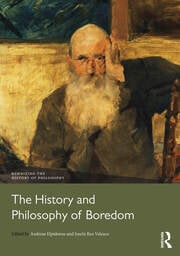
Andreas Elpidorou, Josefa Ros Velasco, Eds. The History and Philosophy of Boredom, Routledge, 2025

Description
From Lucretius’s horror loci and Buddhist drowsiness to the religious boredom of acedia and the philosophical explorations of Kant, Schopenhauer, Kierkegaard, and Heidegger, boredom has long been a subject of philosophical fascination. Its story, unfolding through millennia, encompasses apathy, weariness, disaffection, melancholy, ennui, tedium, and monotony. Today, boredom assumes new forms: the drudgery of precarious work, the alienation of neoliberalism, the emptiness of leisure, and the overstimulation of our hyperconnected, technologically saturated lives.

The History and Philosophy of Boredom is an outstanding collection, exploring boredom’s intellectual history from its early origins in classical thought to its contemporary manifestations. Containing eighteen specially commissioned chapters by an international team of contributors, the volume is organized into four thematic parts:

-Ancient Philosophical Perspectives
-Religious and Medieval Explorations
-Modern Philosophical Investigations
-Critical and Interdisciplinary Approaches

Topics include boredom in Socratic dialogue, Daoist and Buddhist traditions, Stoicism, and Cynicism; the religious significance of boredom in Judaism and early Christianity; boredom’s role in the works of Kant, Kierkegaard, Schopenhauer, Mill, and Nietzsche; philosophical pessimism; phenomenological approaches; boredom as a political phenomenon; and boredom’s intersections with capitalism, socialism, racial identity, and transhumanism.

The History and Philosophy of Boredom is indispensable for students and researchers in the history of philosophy, emotion studies, phenomenology, and moral psychology. It will also interest scholars in religion, classics, sociology, and the history of psychology.

Prozorov, S. (2023). Foucault and Agamben on Augustine, Paradise and the Politics of Human Nature. Theory, Culture & Society, 41(1), 23-37.

https://doi.org/10.1177/02632764221140811 (Original work published 2024)

Abstract
This article focuses on Foucault’s and Agamben’s readings of Augustine’s account of human nature and original sin. Foucault’s analysis of Augustine’s account of sexual acts in paradise, subordinated to will and devoid of lust, highlights the way it constitutes the model for the married couple, whose sexual acts are only acceptable if diverted by the will away from desire and towards the tasks of procreation. While Agamben rejects Augustine’s doctrine of original sin and reclaims paradise as the original homeland of humanity, his reappropriation of paradise remains conditioned by our turn towards our true nature, from which we have been estranged by sin. Agamben’s politics of reclaiming paradise necessarily involves the demand for obedience to this originary model of human nature. It therefore follows to the letter Augustine’s description of paradisiacal sex, in which the will prevails over desire by applying itself to and curtailing itself.

Demelius, Y., & Yoshida, Y. (2025). Technologies of the YouTuber self: Digital vigilantism, masculinities and attention economy in neoliberal Japan. Global Crime, 26(2), 120–147.

https://doi.org/10.1080/17440572.2025.2451833

ABSTRACT
This paper investigates YouTube vigilantism in contemporary Japan. While studies have discussed the relationship between vigilantism and the public police and technology’s role in the weaponisation of visibility, attempts to explain the rise of such activities from the perspectives of identity and culture have been scarce. The present study addresses this by exploring vigilante YouTubers in contemporary Japan who share footage of the exposure and occasional arrest of individuals who engage in illegal or illicit activities. It applies Foucault’s technologies of the self as a theoretical framework and examines the notions of masculinity and entrepreneurship in neoliberal Japan by focusing on the conceptualisation of vigilantes’ identities using social media. The analysis reveals that vigilantes’ activities are motivated by the ambition to legitimise their masculinity, moral superiority, and respectable social roles in contemporary Japan, in which hegemonic masculinity, rigid gender-role expectations, and the concept of a well-functioning ‘proper’ society are re-negotiated.

KEYWORDS:
Digital vigilantism YouTuber attention economy technologies of the self masculinity Japan

Lindholm, S. (2025). Giovanni Botero’s biopolitical populationism: Rethinking the history of biopower. Philosophy & Social Criticism

https://doi.org/10.1177/01914537251324164

Abstract
The Italian political thinker and polymath Giovanni Botero (1544–1617) was a famous proponent of what is known today as populationism, the idea of maximizing the number of people within a political community. In this article, I claim that Botero’s populationism and his other population political arguments act as early examples of what Michel Foucault calls biopolitics—the wide-ranging set of interventions used to optimize and maximize the population. At first glance, it is evident that populationism is reminiscent of biopolitics. However, to establish a solid connection between Botero’s political thought and the discussion regarding this life-affirming power, one must also partake in the current debate on the history of biopolitics. This is because the phenomenon has traditionally been seen as something that was not yet at play during Botero’s era of early modernity and started to emerge only later, during the 18th century.

Patrick Boucheron, The Archaeologist and the Historian: Dialogue with Giorgio Agamben, Translated by Matthew Collins, Journal of Italian Philosophy, Volume 8 (2025), 117 – 123

Open access

Original text: Boucheron, P. (2017/1–2), ‘L’archéologue et l’historien. Dialogue avec Giorgio Agamben’, Critique, 836–37, pp. 164–71. Available at https://doi.org/10.3917/criti.836.0164 (accessed 13th August 2024). This conversation between Patrick Boucheron and Giorgio Agamben took place in French.

Preface
The œuvres of Giorgio Agamben and Patrick Boucheron have unfolded at quite a distance from one another. What do the Italian philosopher and French historian have in common? Perhaps precisely what seems to separate them: the language [langue] and languages [langues], French and Italian, that they share. Not only this, but also the field of mediaeval and Renaissance Italy, which both prefer to survey, although not exclusively. Of particular note is the importance that they accord to writing and to the diversity of its regimes in the exercise of thought. There is also a conviction shared by both which encapsulates the Foucauldian term ‘archaeology’, according to which it is necessary to interrogate the traditions of history if one wishes to forge concepts to parse the present. Archaeology, for Agamben and Boucheron, is inseparable from political concerns […]

Paolo A. Bolaños, Figurations of French Critical Theory, Kritike Volume 16 Number Four (February 2025) 128-136

DOI:10.25138/18.4.a6

Abstract:
In this brief article, I merely present a schematic presentation of the “figurations” of French critical theory. I rehearse the historical and institutional circumstances of French academia that produced progressive thinkers, such as, Michel Foucault, Gilles Deleuze, Jacques Derrida, inter alia. I, then, highlight the privileged position of philosophy in French society and how such privilege nurtured the culture of social and political critique and praxis in France. The influence of G.W.F. Hegel, Karl Marx, and Friedrich Nietzsche on French intellectuals is given relative attention. Moreover, I identify Hegel, Marx, and Nietzsche as the link between French critical theory and the Frankfurt School. Towards the end, I argue that French critical theorists share with their Frankfurt counterparts the normative assumptions of critical theory laid out by Max Horkheimer in the 1930s: the anthropological, the practical, and the emancipative.

Keywords:
Critical theory, Frankfurt School, French philosophy, theory and praxis