Foucault News

News and resources on French thinker Michel Foucault (1926-1984)

Sheehey, B.
Ethics beyond transparency: Resisting the racial injustice of predictive policing
(2020) Techne: Research in Philosophy and Technology, 24 (3), pp. 256-281.

DOI: 10.5840/techne202087128

Abstract
This paper responds to recent work highlighting the problematic racial politics of predictive policing technologies. Drawing on Michel Foucault’s account of ethics as counter-conduct, I develop a set of ethical techniques for resisting the racial injustice at work in predictive policing. This framework has the advantage, I argue, of not reducing the ethical issues of predictive policing solely to epistemic concerns of transparency. What I suggest is that we think about the ethics of technology less as an epistemic problem than as a problem for action or practice. By thinking of ethics in terms of resistant practices, we can begin to consider a notion of responsibility that holds us and the technologies we bind ourselves to accountable for the harms created by this bond. © 2020 Philosophy Documentation Center. All rights reserved.

Author Keywords
Algorithms; Ethics; Foucault; Predictive policing; Racial injustice

Gane, Nicholas. “Nudge Economics as Libertarian Paternalism.” Theory, Culture & Society, (April 2021).
https://doi.org/10.1177/0263276421999447.
Open access

Abstract
Given the growing prominence of nudge economics both within and beyond the academy, it is a timely moment to reassess the philosophical and political arguments that sit at its core, and in particular what Richard Thaler and Cass Sunstein call libertarian paternalism. The first half of this paper provides a detailed account of the main features of this form of paternalism, before moving, in the second half, to a critical evaluation of the nudge agenda that questions, among other things, the gendered basis of paternalistic governance; the idea of ‘nudging for good’; and the political values that underpin nudge. The final section of this paper builds on the existing work of John McMahon by asking whether libertarian paternalism should be understood as a new, hybrid form of neoliberalism, or, rather, as a post-neoliberal form of governance that has emerged out of, and flourished in, the post-crisis situation.

Keywords behavioural economics, libertarian paternalism, neoliberalism, nudge, Sunstein, Thaler

Catherine Malabou – “Foucault’s last seminars: the ‘other politics'”

http://www.egs.edu​ Catherine Malabou, Professor of Philosophy at The European Graduate School / EGS. Saas-Fee, Switzerland. April 22, 2021. Open Public Lecture co-hosted by The European Graduate School and Fakultet za medije i komunikacije, Beograd for the students of the Division of Philosophy, Art & Critical Thought and Fakultet za medije i komunikacije, Beograd.

Niki Kasumi Clements, Foucault’s Christianities, Journal of the American Academy of Religion, Volume 89, Issue 1, March 2021, Pages 1–40,
https://doi.org/10.1093/jaarel/lfab024
Open access

Abstract
The publication of Michel Foucault’s Les Aveux de la chair (History of Sexuality, Volume 4: Confessions of the Flesh) thirty-four years after his death highlights and complicates the relevance of Christian texts—notably from the second through fifth centuries—to Foucault’s forms of critical analysis between 1974 and 1984, as his interests migrate from monastic disciplines to pastoral power to governmentality to the care of the self. What begins as suspicion towards confession as a tool of Catholic power anticipating modern psychoanalysis becomes a critical genealogy of subjectivity from western antiquity to modernity. To frame Foucault’s dynamic engagement with forms of Christianity, I establish three stages over his last decade as he moves from diagnosing mechanisms of power to analyzing ethics as care of the self. Tracing Foucault’s textual and critical developments enables better analysis of Confessions of the Flesh and affirms methodological possibilities in the study of religion today.

Glouftsios, G.
Governing border security infrastructures: Maintaining large-scale information systems (2020) Security Dialogue,

DOI: 10.1177/0967010620957230

Abstract
This article explores the maintenance of large-scale information systems that are used for, among other purposes, border security in the European Union. My argument is that information systems do not always operate according to their design scripts. They materialize as unruly, unstable and failing infrastructures that are governed through maintenance in order to correct any identified functional anomalies and address potential future failures by adapting them to emerging technologies and the service needs of end-users (e.g. border guards, police). To conceptualize the maintenance labour through which information systems are governed, I synthesize ideas developed in Michel Foucault’s work on biopolitics and governmentality with contributions that explore the agentic forces and proclivities of technoscientific matter. By unearthing the very mechanics of maintenance processes, I make two contributions to the literature that interrogates the digitization and smartening of border security. First, I demonstrate that attending to maintenance permits a more complete understanding of the agency of information systems. Second, I broaden the research agenda that explores border security as practice by directing attention towards the often invisible, but politically significant, labour of maintainers who, by rendering information systems functional, sustain the power to govern international mobility by digital means. © The Author(s) 2020.

Author Keywords
Border security; information systems; maintenance; Michel Foucault; New Materialisms

Gordon Hull, Foucault, Marx and Prophecy: the 11th “Thesis on Feuerbach”, New APPS: Art, Politics, Philosophy, Science, 22 April 2021

Foucault thinks Marxism is bossy. In Society must be Defended, he lays down the gauntlet clearly enough: totalizing theories get in the way of useful things at the local level. As he notes, one should beware of:

“the inhibiting effect specific to totalitarian theories, or at least – what I mean is – all-encompassing and global theories. Not that all-encompassing and global theories haven’t, in fairly constant fashion, provided – and don’t continue to provide – tools that can be used at the local level; Marxism and psychoanalysis are living proof that they can. But they have, I think, provided tools that can be used at the local level only when, and this is the real point ,the theoretical unity of their discourse is, so to speak, suspended, or at least cut up, ripped up, torn to shreds, turned inside out, displaced, caricatured, dramatized, theatricalized, and so on. Or at least that the totalizing approach always has the effect of putting the brakes on” (SMD 6).

That is, when you insist on your theoretical unities, you get in the way of actually doing anything. What we need are to unearth “subjugated knowledges” and specific histories, and such activity requires the “removal of the tyranny of overall discourses” (SMD 8).
[…]

L’historien français Marc Ferro est mort
Par Philippe-Jean Catinchi, Le Monde, 22 avril 2021

Spécialiste du XXe siècle, de la Grande Guerre à Vichy et à la décolonisation, il a été pionnier dans l’utilisation des images comme source historique. Agé de 96 ans, il est décédé le 21 avril.

Internationalement reconnu pour ses travaux sur le XXe siècle, de la Grande Guerre à la décolonisation, en passant par la révolution russe et Vichy, ainsi que pour son exploration pionnière sur l’image comme sujet d’histoire, l’historien Marc Ferro est mort le 21 avril, à l’âge de 96 ans, à Saint-Germain-en-Laye (Yvelines), entouré des siens.
[…]

Foucault link
Sheila Schvarzman, Constructing history on television: Marc Ferro and newsreels in Histoire Parallèle, Tempo vol.20 Niterói 2014 Epub Jan 30, 2015
https://doi.org/10.1590/TEM-1980-542X-2014203622en
Article originally in Portuguese. English version (Original version at this link as well)

ABSTRACT
In 1989, when Europe was being transformed after the fall of the Berlin Wall and the expansion of satellite communications, La Sept, a Franco-German TV channel, came into being. Histoire Paralèlle, a TV show hosted by Marc Ferro with newsreels shown in both countries, 50 years before, became the most watched program of the station, comparing the images the ways in which German and French started the war, as it should be seen and experienced by their fellow citizens. The program became a socialized process of understanding and historical rewriting, besides standing before the conflict between memory and history, a question that guided the historiography of the 1990s. This article analyzes Histoire Paralèlle, examining the relationship that it established with the historiography and filmic production of the historian. Therefore, its theoretical assumptions are re-discussed and historicized in the context of Ferro’s works and through the analysis of three of his programs.

Key words: history; Marc Ferro; newsreels
[…]
With the aim of having a point of view about these issues, the magazine interviewed Michel Foucault, “whose systematic work is to replace what the official text represses, what is being agitated hidden in the damn files of the dominant class”.19 Foucault shows that control over popular memory was at risk in that moment, which had been happening since the 19th century through reading and basic schooling. Upon this control,

“the historical knowledge that the working class has on itself does not stop decreasing […] Now, cheap literature is not enough anymore. There are much more effective ways, i.e. television and cinema. I also believe that (control for teaching, TV and cinema) was a way of re-codifying popular memory that exists but does not have a mean to be formulated. Then, people are shown with not what they were, but what they should remember they were.”

The magazine tried to dismantle the cinematographic language mechanisms so that its working is clear and it could be reverted into a “conscious and engaged” cinema, having power over “reality effect” of the image for the fair cause.
[…]

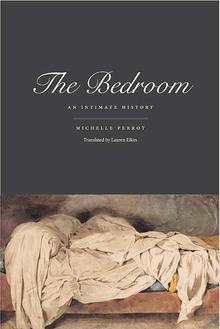
The Bedroom by Michelle Perrot review – an intimate history by Kathryn Hughes, The Guardian,
Tue 11 Dec 2018

Details for book

The bedroom, says French superstar historian Michelle Perrot, is the place where everything important has already happened. From the days when early man first rolled a boulder in front of his cave and told neighbours to knock first, to hospital rooms, ladies’ boudoirs, prison cells and Proust’s cork-lined grime box, the bedroom is the place where we are most authentically, and explosively, ourselves. Perrot sets out to locate what she calls the “multiple genealogies” of the bedroom, “the melodic lines where religion and power, health and illness, body and spirit, love and sex interweave”. This sounds so dreamy and yet so thrilling – thanks in part to Lauren Elkin’s exquisite translation – that you can’t wait to push open the door and get cracking on this search for God, love, rest and death.
[…]

Foucault’s Confessions,
May 4-June 3 2021
Tuesdays and Thursdays at 11 a.m.,
free and open to the public.
For more information and to register, visit foucaultsconfessions.org.

(See also this news item on the Rice University site)

Over five weeks in the month of May and the beginning of June, an international group of scholars will engage the work of Michel Foucault at the intersection of ethics, power, and Christianity in the context of the 2018 Éditions Gallimard publication of Les Aveux de la chair and its 2021 translation as Confessions of the Flesh. Foucault’s work and biography are not without controversy and we invite both critical and charitable engagement from speakers and audience members.

This series of virtual talks will take place on Tuesdays and Thursdays at 11:00 Houston/12:00 NYC/18:00 Paris & Johannesburg. Each session will last one hour, featuring a speaker’s paper for 30-45 minutes, and followed by discussion. These twice-a-week talks will promote continuity as a series, without the constraints of a virtual marathon. Many of these talks will be recorded and will constitute an ongoing resource for viewers around the world.

We are particularly enthusiastic about the conversations between speakers on Foucault’s “last decade” (1974-1984) rethinking bodies, sexuality, and biopolitics, historical forms of ethics as care of the self and of the other, possibilities for resistance to oppressive norms, and theoretical challenges “to think differently, instead of legitimating what is already known.” Contextualizing Foucault’s Confessions of the Flesh is vital for the reading of this book and the general understanding of its relation to his developing theories of subjectivity, sexual ethics, and truth-telling. Les Aveux de la chair includes research from his 1978-1982 lectures, is based on the draft manuscript submitted to Gallimard in 1982, and includes Foucault’s handwritten edits in 1984.

Four decades after Foucault drafted this History of Sexuality, Volume IV, we can appreciate his formidable influence on the production of discourses in both academic scholarship and cultural formations as well as apply pressure to some of his historical and theoretical claims. We can also level necessary critiques of his own abuses of power and the conceptual limitations of his theorizations of subjectivity on the basis of gender, race, ethnicity, age, and class. This series on Foucault’s Confessions of the Flesh takes up this charge critically, charitably, and in a committed manner.

This series is hosted by the Department of Religion at Rice University, with the support of the Rockwell Fund and through the assistance of Marcie Newton and Diana Heard. We thank the Humanities Research Center at Rice University for their invaluable support. We look forward to seeing how this conversation continues over time.

– Niki Kasumi Clements & James Faubion

Program

Tuesday, May 4
James Bernauer: “Fascinating Flesh: Revealing the Spiritual Foucault”

Thursday, May 6
Peter Brown: In Conversation

Tuesday, May 11
Philippe Chevallier: “The Birth of Confessions of the Flesh”

Thursday, May 13
Mark Jordan: “Lust in Paradise: On the Origin of Sexualized Selves”

Tuesday, May 18
Lynne Huffer: “Foucault’s Queer Virgins”

Wednesday, May 19
Niki Kasumi Clements: “Foucault’s Christianities”

Thursday, May 20
Elizabeth A. Clark: “Contextualizing Foucault’s Augustine”

Tuesday, May 25
Arianna Sforzini: “Rebellious Flesh: Virgins, Consecrated Women, and the Radicality of Conversion”

Thursday, May 27
Daniele Lorenzini: “Foucault’s Genealogy of Modern Knowledge About Sexuality: From São Paulo to Confessions of the Flesh”

Tuesday, June 1
Martina Tazzioli: “‘If the Truth is Turned Against the Colonised’: Exhaustive Verbalisation and the Impossibility of Truth-Telling”

Thursday, June 3
Achille Mbembe: In Conversation
Followed by series commentary from James D. Faubion

Luis de Miranda's avatarCREALECTICS

Call for Chapters for a collective book (including a symposium)

Possibility, (Re)Generation, Care: Perspectives on Philosophical Health

Edited by Luis de Miranda[1]and Elisabetta Basso

This book is the first of its kind to explore the emerging concept of philosophical health in contemporary contexts of care as distinct from, yet complementary to physical and psychological forms of health.We envisiona prioriphilosophical healthasa state of fruitful coherence between a person’s ways of thinking and speaking and their ways of acting, such that the possibilities for a good life are increased and the needs for self- and intersubjective flourishing satisfied.This is however an open, emerging concept, and the present book is dedicated to exploring its full potential.

The question of care has today become a central philosophical issue. Most researchers have emphasized the relational and intersubjective character of the experience of care (care can be defined as a relationship with…

View original post 2,159 more words