Foucault News

News and resources on French thinker Michel Foucault (1926-1984)

Review of Stuart Elden: The Early Foucault on Phenomenological Reviews 20 September 2021.

Stuart Elden’s The Early Foucault is the third of a four-volume study of the origins and development of Michel Foucault’s thought. This book is the first one regarding the period it covers, basically the 1950s, but it is the third to be published. It will be soon followed by a fourth and final book, that will cover the ‘archaeological’ period and Foucault’s forays into art history and literary criticism. External factors explain the disconnect between the order of production and the chronology. Elden’s first two books dealt with the publication of Foucault’s lectures at the Collège de France. The publication of the Lectures began in 1997, with the publication of the sixth lecture, Il faut défendre la société (1975-1876). Additional volumes followed it, released not in the order of their delivery by Foucault, but on the availability of audio recordings of the lectures. Foucault’s preparatory notes and other ancillary materials later supplemented and eventually displaced the recordings. Elden’s earlier books responded to the availability of the Lectures and the will to integrate the new material into a coherent picture. The First Foucault and the forthcoming book on Archaeology deal with the archive material made available to the public in recent years. This material includes reading and preparatory notes, lectures of the period before his appointment to The College de France, manuscripts in different degrees of development, philosophical diaries, bibliographies, etc.

read more

Mengmeng GAO Bibliothèque historique de la Ville de Paris (BHVP), 2 octobre 2021, Paris.

Date et horaire exacts : Le samedi 2 octobre 2021
de 19h à 2h
gratuit
Surveiller et Punir – Vidéo

Mengmeng GAO est originaire de Pékin (Chine), où elle est née en 1986. Elle vit et travaille à Paris.

L’œuvre Surveiller et punir prend source dans le livre du même nom de Michel Foucault. Le philosophe y énumère les mesures du XVIIe siècle pour intervenir dans les épidémies. Via une animation en noir et blanc dérivée de l’art des mangas comme des dessins animés de Kentridge, l’artiste part du constat que nos mesures actuelles de prévention des épidémies ne sont pas si différentes de celles-ci. Elles sont simplement plus humaines et plus douces. Cependant, le paradoxe est que plus les méthodes sont douces, plus elles sont déprimantes.

Bibliothèque historique de la Ville de Paris (BHVP) 24 rue Pavée Paris 75004
1 : Saint-Paul (227m) 8 : Chemin Vert (461m)

Five intellectual fashion statements from history that anticipated today’s dark academia trend, The Conversation, UK
September 17, 2021

Writing with a quill pen dipped in ink, sitting in the flickering of candlelight in a book-lined study, and vintage tweed paired with knitted jumpers and brogues have all become the height of fashion for autumn 2021.

Known as dark academia, this trend has brought the hallowed halls of ancient universities to the digital worlds of TikTok and Instagram. On Instagram, the tag #darkacademia now has over 1 million posts, and Grazia has named the aesthetic as autumn 2021’s biggest trend. The TikTok generation has keenly embraced the tweedy cosiness of scholarly life.
[…]

5) Philosophes
In the early 20th century, French philosophers and popular playwrights alike propelled the turtleneck into the spotlight as the anti-establishment, intellectual garment of the age. From Audrey Hepburn in Funny Face to philosopher and accidental style icon Michel Foucault, the turtleneck was the epitome of cerebral style.

[…]

read more

stuartelden's avatarProgressive Geographies

CFP: ‘Whatis anAuthor?’:Critical Reflections on Authors and Authority in Critical Security Studies

Full details in pdf – For enquiries and expressions of interestplease contact the guest editors Tina Managhan (tmanaghan@brookes.ac.uk) and/or Dan Bulley (dbulley@brookes.ac.uk).

View original post

ACCESS Vol 41 2021
IN MEMORIAM Jim Marshall
Nesta Devine, Elizabeth Gresson, Mark Olssen, Ruth Irwin, Eve Coxon, Ho-Chia Chueh & Richard Heraud

[…]
As the Dean of Education at the University of Auckland, Jim made a succession of excellent hires, building an extraordinary Faculty of Education that competed with Illinois for honours by producing world class research. During this period, he threw his weight behind the new Indigenous Research Institute, which Linda Tuhiwai Smith and Graeme Smith began in the Faculty of Education, and which eventually became its own independently funded institute attached to the Māori Department in the Faculty of Arts.

Following his close reading of Foucault and with attention to the relationship between power and policy, Jim developed his critique of the concept of busnocratic rationality which anticipated the development of New Public Management. He was very interested in how students internalise these banal operations of power through techniques such as physical and intellectual excellence, the gym, revealing the self through ‘reflection’ and ‘truth’.

“Technologies of domination act essentially on the body, and classify and objectify individuals. The key to technologies of the self is the belief, now common in Western culture, that it is possible to reveal the truth about one’s self. By telling the truth about one’s sexuality, where the “deepest” truth is embedded in the discourse and discursive practices of sexuality, individuals become objects of knowledge, both to themselves and to others. In telling the truth, one knows oneself and is known to others in a process which is both therapeutic and also controlling.” (Marshall, 1996, p. 271)
[…]

Collective obituary for James D. Marshall (1937–2021)

Michael A. Peters, Colin Lankshear, Lynda Stone, Paul Smeyers, Linda Tuhiwai Smith, Roger Dale, Graham Hingangaroa Smith, Nesta Devine, Robert Shaw, Nesta Devine, Bruce Haynes, Denis Philips, Kevin Harris, Marc Depaepe, David Aspin, Richard Smith, Hugh Lauder, Mark Olssen, Nicholas C. Burbules, Peter Roberts, Susan L Robertson, Ruth Irwin, Susanne Brighouse, & Tina Besley
Published online: 15 Jul 2021 , Educational Philosophy and Theory, DOI: 10.1080/00131857.2021.1948399

[…]
His work on ‘A Critical Theory of the Self ‘was intellectually outstanding: he focussed on Foucault and Wittgenstein – two of the greatest intellectuals of our times: one a deeply conservative Austrian counter-Enlightenment thinker; the other, a French intellectual, a Nietzschean ‘Communist’ who historized Marx. Actually, both of them were among the most brilliant thinkers of the century. It’s an interesting combination and Jim was one of the first to combine them in his work. Without being too academic can I say that Jim managed to embrace with consummate ease both sides of analytic and continental philosophy. It showed his flexibility as a thinker, his openness and his ability to embrace new ideas – from the heart of analytic philosophy inaugurated by Russell, Wittgenstein and Frege to Foucault, one of the most left-wing thinkers of his time. That’s a huge shift in thinking. He was a philosophical authority on moral education and the punishment of children. He wrote a prodigious amount on science and educational theory, on neoliberal reforms to education, on policy analysis, and on a whole range of philosophers including Dewey, Rorty, Wittgenstein, Foucault, R.S. Peters. The corpus of his work stretched over many themes in education and philosophy with both a practical and theoretical bent. I did a rough count: Jim produced some 27 books and over 200 academic papers, often for blue-ribbon journals. But this was far from Jim’s mind as he remarked, ‘It’s all runs on the board’. ‘We will leave the counting of our published papers to the officials once we are dead.’ He was consumed by the process of writing and regarded it very seriously but he was never one to push his own barrow. He was modest and self-effacing. He was a generous man when it came to authorship, more intent on mentoring others than grabbing the stage for himself. And he demonstrated his commitment to collegiality through the many collaborations and research partnerships he initiated and was part of, especially with junior colleagues. I published two papers with him and Miles Shepheard in 1981 when we were completing our Masters; Miles in Education and I in Philosophy.
[…]

Claire Devarrieux, Mort de l’éditeur Bruno Roy, maître de maison, Libération, publié le 20 septembre 2021

Le fondateur des éditions Fata Morgana est mort à 81 ans. Créée en 1966, son entreprise, loin des pratiques parisiennes, a publié Michel Foucault, Jonathan Littell ou Roger Gilbert-Lecomte.

Il a publié Emmanuel Levinas et Michel Foucault, Henri Michaux, Roger Caillois, Philippe Jaccottet, il y a peu Pierre Bergounioux et Eric Chevillard. Editeur prestigieux et confidentiel, Bruno Roy est mort le 15 septembre, ont annoncé ce lundi famille et amis dans un communiqué. Il avait 81 ans. Il était le fondateur des éditions Fata Morgana, sises dans l’Hérault, à Saint-Clément-de-Rivière.

[…]

David Beer, The making of Foucault (2021), On David Beer’s blog The Fragment, 9 September 2021

How do thinkers happen? We can start with a quite obvious negative. It would seem that they don’t arrive fully formed or with a preset direction to their thinking. It is tempting to imagine that they do, especially for those figures we most admire. We might like to imagine them as knowing exactly where they were heading, from the outset. It is comforting to think of thinkers as being assured and as having both a plan and a cast iron sense of direction. This assumed assuredness lends a sense of inevitability to their ideas. Of course, despite any impressions we might cling to they are much more likely to bump against options, to equivocate and to steadily find their feet. Thinking is contingent, it is shaped by circumstance. And not every avenue is followed. Thinkers leave untrodden paths along the way and may even have some doubts too. Even Foucault.

In a series of books published over the last five years, Stuart Elden has been meticulously sifting his way through the writings, lectures, notes, letters and other archival miscellanea of Michel Foucault. The results are expansive and full of insight, telling us of the ideas whilst also giving glimpses into the working practices through which they were made. The four volume intellectual history of Foucault that he has been working on, with three volumes published so far and a fourth in process, has been built out of a mass of traces. A prolific writer and worker like Foucault leaves much to explore and many narratives to question.

Read more

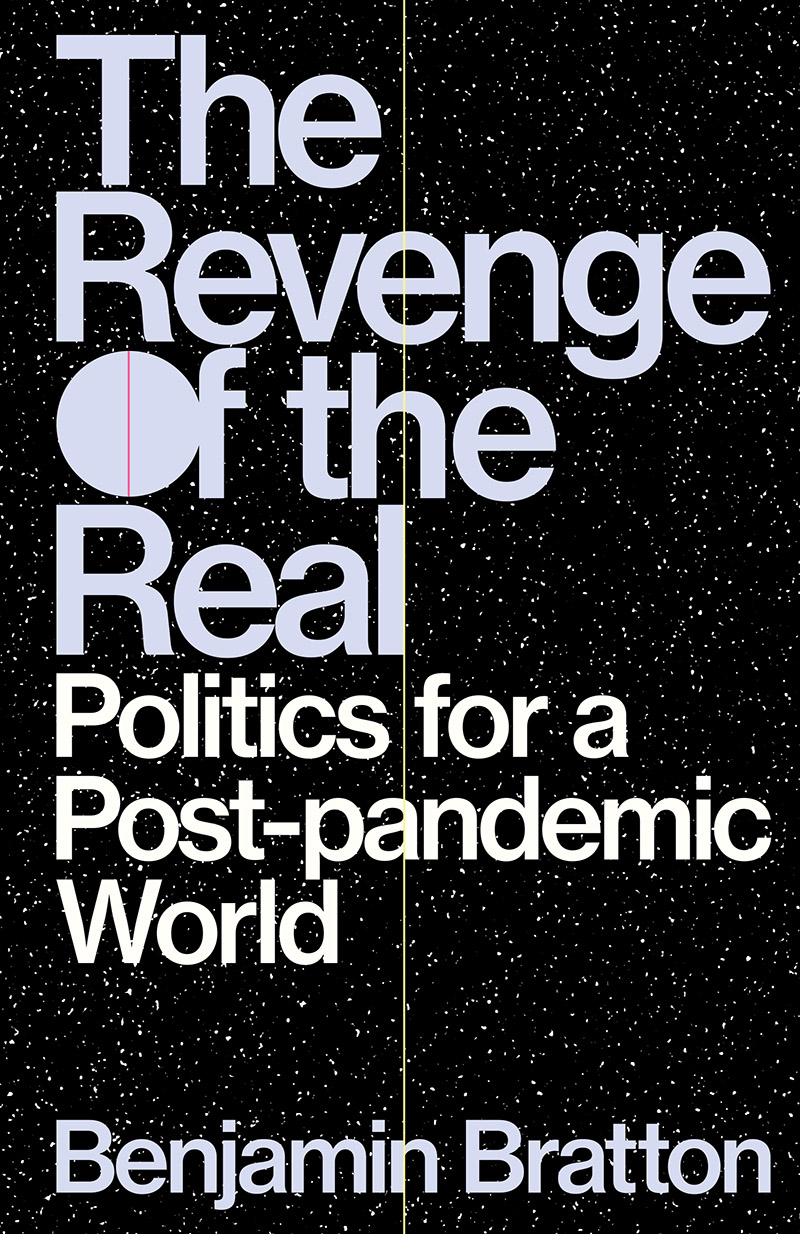
Benjamin Bratton, The Revenge of the Real. Politics for a Post-Pandemic World, Verso, 2021

Review by Geoff Shullenberger in The Washington Examiner

The future of politics after the pandemic

COVID-19 exposed the pre-existing conditions of the current global crisis. Many Western states failed to protect their populations, while others were able to suppress the virus only with sweeping social restrictions. In contrast, many Asian countries were able to make much more precise interventions. Everywhere, lockdown transformed everyday life, introducing an epidemiological view of society based on sensing, modeling, and filtering. What lessons are to be learned?

The Revenge of the Real envisions a new positive biopolitics that recognizes that governance is literally a matter of life and death. We are grappling with multiple interconnected dilemmas—climate change, pandemics, the tensions between the individual and society—all of which have to be addressed on a planetary scale. Even when separated, we are still enmeshed. Can the world govern itself differently? What models and philosophies are needed? Bratton argues that instead of thinking of biotechnologies as something imposed on society, we must see them as essential to a politics of infrastructure, knowledge, and direct intervention. In this way, we can build a society based on a new rationality of inclusion, care, and prevention.

Giorgi Vachnadze, The Phenomenological Panopticon and the Historical a Priori: Towards a Genealogy of the Transcendental Subject, Epoché, Issue #37 February 2021

A teleological conception of history begins with Hegel and terminates with Foucault. The following text will not concern itself with Hegel and the Hegelian interpretation of history, it will not be an extensive analysis of the notion of historical teleology, nor will it attempt to discuss every thinker who has used this notion. Neither will it attempt to lay down a comprehensive history nor theory of the Subject. Instead, we will focus on a comparison between the historical and philosophical methodologies of Edmund Husserl and Michel Foucault, and their respective theories of the Subject, while extending the antagonism between the two thinkers into a critique of phenomenology and the phenomenological subject as an instance of what Foucault terms governmentality.

Read more

Krarup, Troels. “Archaeological Methodology: Foucault and the History of Systems of Thought.” Theory, Culture & Society 38, no. 5 (September 2021): 3–24. https://doi.org/10.1177/0263276420984528.

Abstract
Existing accounts of Foucault’s archaeological methodology have not (a) contextualized the concept properly within the intellectual field of its emergence and (b) explained why it is called ‘archaeology’ and not simply ‘history’. Foucault contributed to the field of ‘history of systems of thought’ in France around 1960 by broadening its scope from the study of scientific and philosophical systems into systems of ‘knowledge’ in a wider sense. For Foucault, the term ‘archaeology’ provided a response to new methodological questions arising from this initiative. Archaeological methodology had already been developed into a distinct comparative approach for the study of linguistic and cultural systems, notably by Dumézil. Foucault redevised archaeological methodology for the post-Hegelian tradition of studying ‘problems’ prevalent in the history of systems of thought. The article thus furnishes the groundwork for a ‘sociological archaeology’ or ‘problem analysis’ that is not particularly dependent on Foucault as a social theorist of power.

Keywords
archaeology, Foucault, French epistemological school, history of systems of thought, methodology, problem analysis, problematization