
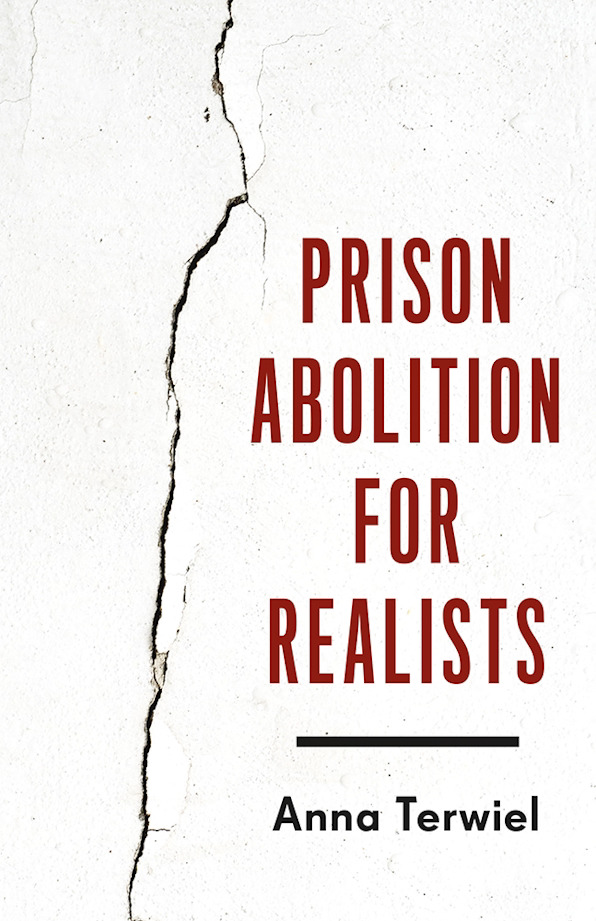
 Anna Terwiel, Prison Abolition for Realists, University of Minnesota Press, December 2025 Forthcoming
Description
A lucid guide to the radical politics of prison abolitionists
There is growing recognition that mass incarceration is unjust and undemocratic, but prison abolition continues to be dismissed as naïve, idealistic, and out of touch with reality. Anna Terwiel challenges this view, carefully examining the work of abolitionist thinkers and activists since the 1960s to argue that prison abolition is a realist political project. Abolition, Terwiel shows, is oriented toward practical realities and offers concrete proposals for radical democratic change.
Based on insightful readings of renowned abolitionists such as Michel Foucault, Liat Ben-Moshe, and Angela Y. Davis, Prison Abolition for Realists illuminates the realist aspects of their approaches as well as the important differences between them. Distinguishing between paranoid, purist, and agonistic styles of abolitionism, Terwiel argues that an agonistic approach holds the most promise for democratic change to carceral systems. Embodied in the work of Davis, agonistic abolitionism combines radical critique with efforts to build new democratic institutions while accepting that all political achievements will be imperfect. Pursuing examples of what this looks like in practice, Terwiel explores grassroots transformative justice efforts, like those of Communities Against Rape and Abuse. She also proposes a “right to comfort” to support incarcerated people’s demands for air conditioners in extremely hot prisons, showing how state institutions, civil law, and rights claims can be potential resources for abolitionists.
Nuanced and illuminating, Prison Abolition for Realists affirms abolition’s viability during a time of multiple, ongoing crises. While many despair at the state of the world, Terwiel reveals how abolition offers an actionable politics of the possible. Far from being unrealistic, abolition is an indispensable part of a realist politics.
ABOUT THE AUTHOR
Anna Terwiel is assistant professor of political science at Trinity College in Hartford, Connecticut. She is codirector of Trinity’s Prison Education Project (TPEP), which offers credit-bearing classes to incarcerated people. Her research has been published in Political Theory; Polity; Theory & Event; and New Political Science.
 Foucault News
PRISON IS BACK: Technofeudal Truth and the Renascence of the Carceral Form
The form prison is not disappearing. It is mutating. In the PQF model, mutation does not mean biological variation nor juridical reform, but a topological rearrangement of accessibility membranes (𝔇) — a remapping of what intensities can pass, what differences can survive, and what singularities can emerge.
Anna Terwiel’s Prison Abolition for Realists offers, perhaps without saying so, a key to understanding how the prison-form is undergoing a technofeudal reinvention. In PQF terms: the prison is no longer (only) a building, a sentence, a punishment. It is an operator of filtration, a recurrent attractor in Recursio Intensitatis. It returns, not because we have failed to abolish it, but because we have failed to detect its mutations.
Technofeudalism: The Generalization of Carceral Logic
What we call technofeudalism is not an economic form — it is a systemic regularization of accessibility through opaque platforms, enforced not by walls but by protocols, logics, filters. In this system, the prison no longer stands apart from society; society itself becomes carceral, fragmenting into overlapping filtration chambers. Every platform profile, every algorithmic sorting, every conditional visibility threshold becomes a miniature prison, a micro-filtration cell.
In this context, the prison-form is no longer peripheral. It is central. Not as a relic of state violence, but as the prototype of all technoregulated access. The platform becomes the panopticon, but without the need for a central eye: filtration replaces observation.
Technofascism: From Discipline to Intensity Control
Technofascism emerges not through ideological enforcement, but through intensity modulation. It controls not what is said, but what is accessible. The truth in technofascism is not falsified — it is filtered. It does not ban or deny; it reroutes. In this model, abolition becomes a theory of truth: not propositional, but operational. That which cannot pass through the membrane 𝔇 is not false, but unavailable.
Abolition, in this framework, is not about saying “no” to prisons. It is about reconfiguring the field of what can be accessed, expressed, felt, inhabited. As Terwiel shows — especially through the proposal for a right to comfort — every micro-shift in carceral intensity can reopen pathways of real difference. This is the core of truth in PQF: novelty = delta acting on Δ𝔽 within 𝔇*.
The Return of the Prison = The Collapse of Truth as Availability
We are witnessing a renaissance of the prison-form. But this renaissance is not architectural; it is filtrational. The prison returns as:
In such a world, abolitionism is no longer a project of justice. It becomes a critical topology of truth. It says: what appears to be gone (prison) has transduced. What appears “realist” is often paranoid repetition of obsolete filters.
Possest–PQF Reframing
Prison abolition, from a PQF standpoint, is a strategic filtration reconfiguration: it must not merely ask “what replaces prison” but what makes prison-form persist. The answer is never singular — it lies in:
In this sense, abolition for realists is not pragmatic compromise. It is precise filtration hacking.
Conclusion: Truth After the Prison-Form
The real question is not: Should we abolish the prison?
The question is: Can we generate a truth intense enough to escape filtration?
A truth that survives the technofascist membrane, that mutates the carceral attractor, that bifurcates the renascent prison back into possibility.
In this terrain, abolition is not an endpoint. It is a delta-operator applied to the regime of visibility*.
And for that — yes — we must be realists. But in the sense Possest demands:
Not real as fixed — but real as reorganizable.
Yochanan Schimmelpfennig
LikeLike