
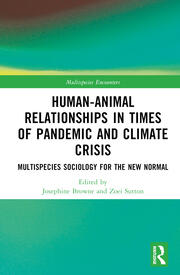
 Cudworth, E. Resisting Zoopolis: Bordering species relations as a response to COVID-19 (2024) Human-Animal Relationships in Times of Pandemic and Climate Crises: Multispecies Sociology for the New Normal, Edited By Josephine Browne, Zoei Sutton, Routledge, pp. 133-150.
Abstract
Human publics are now more aware than ever of the presence and threat of zoonotic pandemics, originating in non-human animals; with microbial agents leaping from animal to human bodies. The dominant discourses constituting zoonotic politics have reflected our colonial present, with peoples and practices from the continents of Africa and Asia being demonized. The dominant discourse during the pandemic was also driven by the contradictory demands of the Capitalocene for business as usual. In light of this, the predominant political response to the zoonotic pandemic has been bordering and rebordering practices – restricting travel and mobility for some humans, attempting to limit trades in live animals and increasing surveillance of everyday practices at food markets. What COVID-19 illustrates, however, is that bordering, whether constituted by high politics, or cultural, economic and social activities, is a process to be found in a multiplicity of places and one which reveals the extent of our bio-insecurity.
Zoonotic politics necessarily extends Foucault’s biopolitics to include the non-human lifeworld as an object of power; and in pandemic times, the idea that politics is post-human rather than a discreet sphere of human activity gains traction. The awareness of rapidly developing new strains of pandemic disease has given salience to zoonotic discourses of bordering, however, rather than opening up to the critical voices demanding a different kind of zoonotic politics.
Yet, species borders are inevitably leaky – we live among other creatures, and zoonoses are illustrations of biomotility – their pathogens make us up, in the flesh. Our lack of acknowledgement of the lives of other animals whom we raise or hunt to kill and eat, whose habitats we destroy and encroach upon and whose populations we squeeze to the point of breaking has led us to the current human health crisis. A post-humanist politics seeks not to attempt to border the leaky boundaries of species, but to insist on a reordering of species relations and an opening up of the polis to the myriad creatures that constitute our world. To this end, this chapter reflects on the notion of zoopolis, arguing for a creaturely politics in which species binaries and boundaries are reconfigured
 Foucault News