
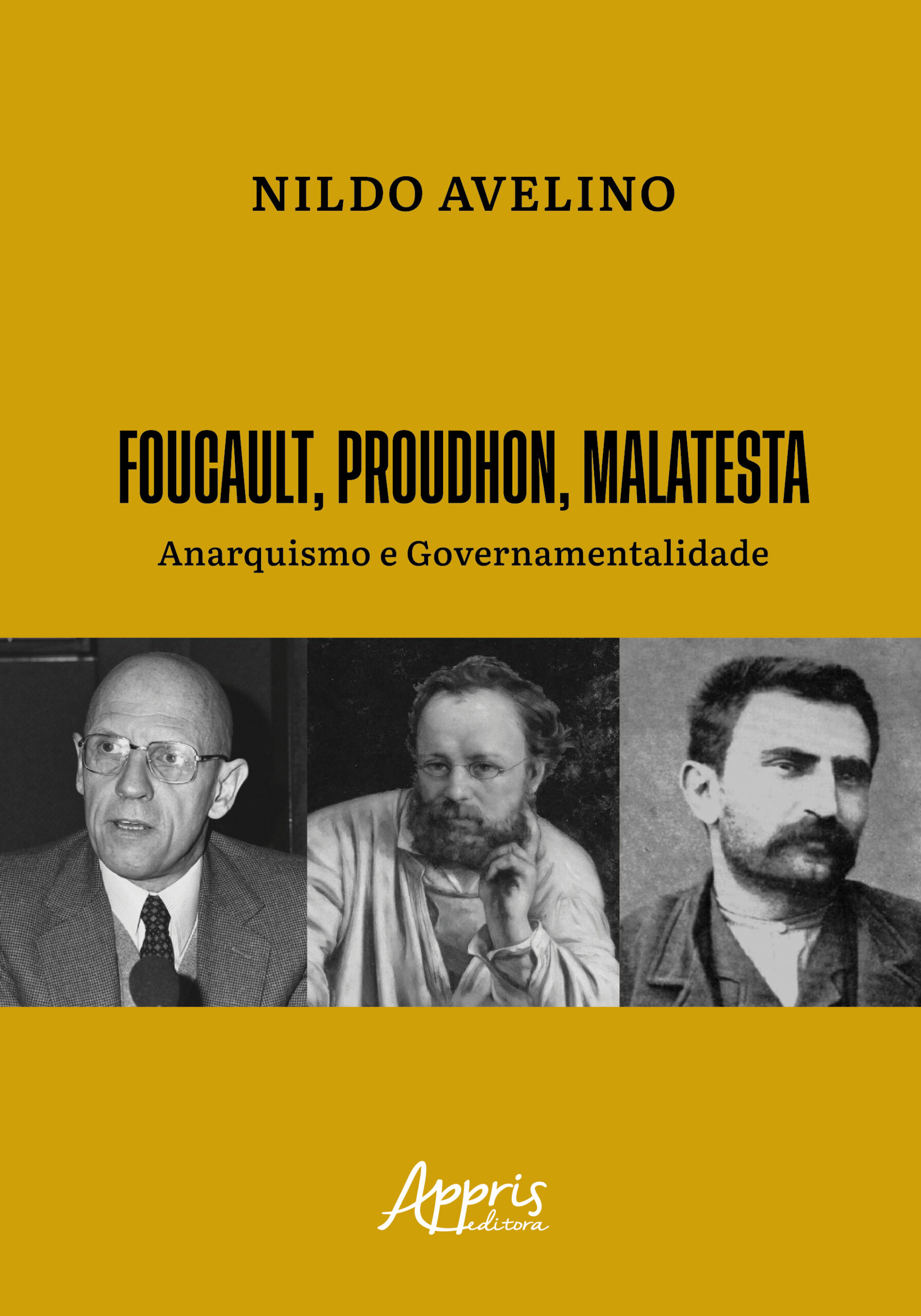
 Nildo Avelino, Foucault, Proudhon, Malatesta: Anarquismo e Governamentalidade, Appris Editora, 2024
O livro Foucault, Proudhon, Malatesta: anarquismo e governamentalidade investiga as reflexões do anarquista francês Pierre-Joseph Proudhon e do anarquista italiano Errico Malatesta sobre o exercício do poder governamental, utilizando uma abordagem dos estudos da governamentalidade, noção elaborada por Michel Foucault para designar o campo estratégico das relações de poder que busca converter o que elas têm de móvel, transformável e reversível, em estados de dominação. Partindo do fato que, no Ocidente, as relações de poder foram constituídas de tal modo por uma proliferação indefinida de técnicas e mecanismos governamentais, que fizeram seu exercício assumir formas sempre mais excessivas e intoleráveis, o autor enfatiza a importância de se estudar essa prática complexa e singular que consiste em governar os indivíduos, transformada pelas sociedades modernas em um dos seus mais essenciais atributos. Mais do que uma prática imemorial, o autor afirma que o governo ganhou um desenvolvimento sem precedentes com a formação dos Estados modernos. Nesse processo, a soberania tomou emprestado do governo a perenidade do seu caráter natural e a permanência da sua natureza providencial: Estados nascem e morrem, mas o governo é eterno. E da sua eternidade, o governo remeterá sempre para a violência de uma força dominadora. No entanto, o autor mostra como o anarquismo foi a única tradição política, na história do Ocidente, que buscou direcionar, especificamente contra o governo, a crítica implacável de um saber que sondou sua existência insidiosa. Embora as resistências ao poder governamental sejam encontradas desde o início da formação do Estado moderno, foram os anarquistas que, jamais cessando de denunciá-lo, produziram, nas lutas em torno e contra ele, a enorme sistematização de um saber antigovernamental. Em suma, trata-se de uma obra importante para pensar, a partir do tríptico Foucault-Proudhon-Malatesta, a potencialidade extraordinária de produção de novas subjetividades presente nas formas de luta contemporâneas contra o governo. O livro não somente nos convida a constituir a nós mesmos como sujeitos transgressivos, mas também mostra o quanto é urgente, em nossa atualidade, a tarefa de constituir a si mesmo como sujeito anárquico.
Description (English)
The book Foucault, Proudhon, Malatesta: Anarchism and Governmentality, investigates the reflections of the French anarchist Pierre-Joseph Proudhon and the Italian anarchist Errico Malatesta on the exercise of governmental power, using an approach from governmentality studies, a notion elaborated by Michel Foucault to designate the strategic field of power relations that seeks to convert what they have of mobile, transformable, and reversible, into states of domination.
Starting from the fact that, in the West, power relations have been constituted in such a way by an indefinite proliferation of governmental techniques and mechanisms, which have made their exercise assume increasingly excessive and intolerable forms, the author emphasizes the importance of studying this complex and singular practice that consists in governing individuals, transformed by modern societies into one of their most essential attributes. More than an immemorial practice, the author affirms that the government gained unprecedented development with the formation of modern states. In this process, sovereignty borrowed from the government the perpetuity of its natural character and the permanence of its providential nature: States are born and die, but government is eternal. And from its eternity, the government will always refer to the violence of a dominating force.
However, the author shows how anarchism was the only political tradition in Western history that sought to direct, specifically against the government, the relentless criticism of a knowledge that probed its insidious existence. Although resistances to governmental power are found since the beginning of the formation of the modern state, it was the anarchists who, never ceasing to denounce it, produced, in the struggles around and against it, the enormous systematization of an anti-governmental knowledge. In short, it is an important work for thinking, from the Foucault-Proudhon-Malatesta triptych, the extraordinary potential for the production of new subjectivities presents in contemporary forms of struggle against the government. The book not only invites us to constitute ourselves as transgressive subjects but also shows how urgent, in our present time, the task of constituting oneself as an anarchic subject.
 Foucault News