
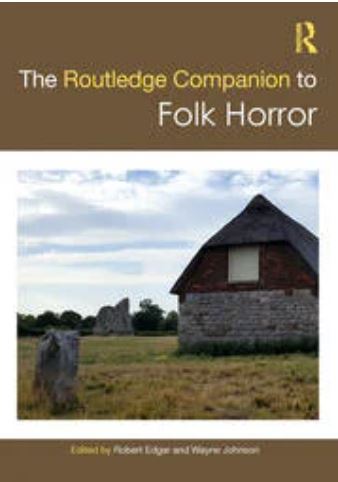
 Corcoran, M.
‘Leave Something Witchy’: Evolving Representations of Cults and New Religious Movements in Folk Horror (2023) in Robert Edgar, Wayne Johnson (eds) The Routledge Companion to Folk Horror, Routledge, 2023 pp. 65-76.
Abstract
The Folk Horror sub-genre, as it is popularly understood, emerged alongside heightened public and media fascination with cults. In British and American Folk Horror from this period, a transnational engagement with cultic activities appears as a dominant theme. Works as diverse as The Blood on Satan’s Claw (1971), The Wicker Man (1973), The Devil’s Rain (1975), and The Dark Secret of Harvest Home (1978) depict pagan cults and satanic groups as a threat to society. These texts often engage in a process of ‘enfreakment’ whereby normal, well-adjusted members of society are positioned in opposition to deviant, destructive cults. Conversely, during the Folk Horror revival of the 2010s, works such as Apostle (2018), Midsommar (2019), and The Other Lamb (2019) present a more nuanced view of cults. In this context, cults act not merely as perversions of mainstream culture but, rather, as what Michel Foucault terms heterotopias, or counter-sites, in which ‘all the other real sites that can be found within the culture, are simultaneously represented, contested, and inverted’. In these post-millennial works, cults are no longer framed as monstrous deviations from the social norm but, instead, act as multivalent sites in which individuals and communities can explore complex issues relating to gender, sexuality, family, and identity. © 2024 selection and editorial matter, Robert Edgar and Wayne Johnson; individual chapters, the contributors.
 Foucault News