
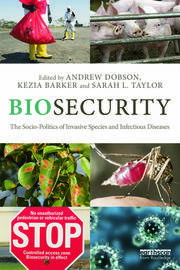
 Andrew Dobson, Kezia Barker, Sarah L. Taylor (eds) Biosecurity: The Socio-Politics of Invasive Species and Infectious Diseases, Routledge, 2013
Description
Biosecurity is the assessment and management of potentially dangerous infectious diseases, quarantined pests, invasive (alien) species, living modified organisms, and biological weapons. It is a holistic concept of direct relevance to the sustainability of agriculture, food safety, and the protection of human populations (including bio-terrorism), the environment, and biodiversity. Biosecurity is a relatively new concept that has become increasingly prevalent in academic, policy and media circles, and needs a more comprehensive and inter-disciplinary approach to take into account mobility, globalisation and climate change.
In this introductory volume, biosecurity is presented as a governance approach to a set of concerns that span the protection of indigenous biological organisms, agricultural systems and human health, from invasive pests and diseases. It describes the ways in which biosecurity is understood and theorized in different subject disciplines, including anthropology, political theory, ecology, geography and environmental management. It examines the different scientific and knowledge practices connected to biosecurity governance, including legal regimes, ecology, risk management and alternative knowledges. The geopolitics of biosecurity is considered in terms of health, biopolitics and trade governance at the global scale. Finally, biosecurity as an approach to actively secure the future is assessed in the context of future risk and uncertainties, such as globalization and climate change.
Contents
Part 1: Framing Biosecurity
1. Introduction: Interrogating Bio-insecurities
Kezia Barker, Sarah Taylor and Andrew Dobson
2. A World in Peril? The Case for Containment
Daniel Simberloff
3. Power over Life: Biosecurity as Biopolitics
Bruce Braun
Part 2: Implementing Biosecurity
4. Governing Biosecurity
Andrew Donaldson
5. Legal Frameworks for Biosecurity
Opi Outhwaite
6. Biosecurity: Whose Knowledge Counts?
Gareth Enticott and Katy Wilkinson
7. Biosecurity Management Practices: Determining and Delivering a Response
John Mumford
Part 3: Biosecurity and Geopolitics
8. A Neoliberal Biosecurity? The WTO, Free Trade and the Governance of Plant Health
Clive Potter
9. Viral Geopolitics: Biosecurity and Global Health Governance
Alan Ingram
This chapter examines tensions surrounding the development and reworking of global health governance in response to concerns about emerging infectious diseases since the 1980s. It focuses in particular on how tensions have emerged at the intersections between technologies of government – what, following Michel Foucault, may be termed apparatuses of security – that have been created in response to newly formed infectious disease epidemics and struggles over the international political economy. The widespread adoption of the term ‘global health governance’ can be understood as a result of a convergence between struggles over globalisation and growing unease about emerging infectious diseases. The intensification and expansion of international trade and travel, combined with environmental change, population growth, urbanisation and shifts in farming practices, is generally understood to have transformed the ecological matrix within which humans, animals, plants and microbes co-exist and co-evolve. The intensified interactions and transactions associated with globalisation are commonly understood to have heightened the risk of disease emergence into human populations and its subsequent spread. In response to these quantitative and qualitative shifts in epidemiological space and time, materialised through a series of infectious disease outbreaks and epidemics. Health bureaucrats, scientists, politicians, activists, and corporate and military entities have collaborated and struggled over the creation of new organisations, networks and strategies, fostering the emergence of the field of global health (Lakoff and Collier, 2008).
In a lecture course given at the Collège de France in the late 1970s, Michel Foucault (Foucault, 2007) described the consolidation of such clusters of institutions, rationalities, tactics and technologies in response to crisis or emergency situations as the formation of apparatuses or mechanisms (words that provide an approximation to the word dispositif that Foucault used) of security. In an interview given around the same time, Foucault elaborated further on what he meant by this term: What I’m trying to pick out with this term is, firstly, a thoroughly heterogeneous ensemble consisting of discourses, institutions, architectural forms, regulatory decisions, laws, administrative measures, scientific statements, philosophical, moral and philanthropic propositions – in short, the said as much as the unsaid. Such are the elements of the apparatus. The apparatus itself is the system of relations that can be established between these elements.
10. Biosecurity and Bio-terror: Reflections on a Decade
Brian Rappert and Filippa Lentzos
Part 4: Transgressing Biosecurity
11. Biosecurity and Ecology: Beyond the Nativism Debate
Juliet Fall
12. Introducing Aliens, Re-introducing Natives: A Conflict of Interest for Biosecurity?
Henry Buller
13. The Insecurity of Biosecurity: Re-making Emerging Infectious Diseases
Stephen Hinchliffe
14. Conclusion: Biosecurity, the Future and the Impact of Climate Change
Sarah Taylor, Andrew Dobson, and Kezia Barker
 Foucault News