
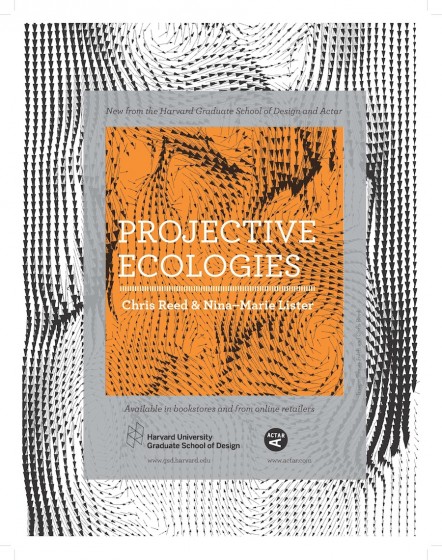
A review of Projective Ecologies, edited by Chris Reed and Nina-Marie Lister. 2014. Second edition 2020. ISBN: 1940291127. ACTAR, Harvard Graduate School of Design. 314 pages.
Review by Anne Trumble
Several months ago, I reviewed Landscape Imagination, a collection of essays by James Corner, a professor at University of Pennsylvania and the landscape architect who designed New York City’s celebrated High Line. Composed over twenty years, his essays examine the many factors hindering the advancement of the cultural medium of landscape. One factor Corner repeatedly addresses is the hoary old dichotomy between nature and culture still pervasive in landscape architecture—the belief in a pristine nature separate from humans.
[…]
Projective Ecologies aims to recover a critical sense of ecology for the design professions because they operate at the intersection of nature and culture—particularly landscape architecture, since its medium holds unique environmental, social, and existential opportunities and responsibilities. Emerging from a multi-year research initiative at Harvard’s Graduate School of Design, Reed and Lister drew on Foucault’s The Archaeology of Knowledge to present three “parallel genealogies,” or intellectual traditions, dealing with the concept of ecology: natural sciences, the humanities, and design.
 Foucault News
Now that has to be a singular way of reading past history and coming to conclusions.
LikeLike