
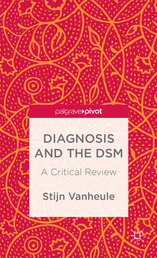
 Stijn Vanheule, What we can learn from Michel Foucault on DxSummit.org The Global Summit on Diagnostic Alternatives: An Online Platform for Rethinking Mental Health
Update October 2025. Link above is to the archived page on the Wayback Machine
The text below is based on the author’s book: Stijn Vanheule (2014). Diagnosis and the DSM – A critical Review. London & New York: Palgrave Macmillan.
Extract
….
As a consequence, in Foucault’s view madness is not so much a natural kind, i.e., an entity governed by natural laws, but what he calls “a reification of a magical nature.” In his view, psychiatry did not arise because medical doctors had suddenly discovered an underlying biomedical reality that could be linked to the behaviors of the so-called insane. On the contrary, psychiatry came into existence as it brought its own object into being: disciplinary practices first delineated a group of outcasts that were amenable for adaptation to society, and later defined them as proper objects for scientific study: “What we call psychiatric practice is a certain moral tactic contemporary with the end of the eighteenth century, preserved in the rites of asylum life, and overlaid by the myths of positivism”. By qualifying madness as a reification Foucault stresses that the early alienists, just like modern psychiatrists, turned their concept into an object. As a consequence ‘madness’ was no longer treated as an abstraction that can be used to make sense of reality, but as a biological or psychological reality that simply awaits clinical detection and scientific discovery. Such reification is a direct effect of adopting psychiatric discourse. Through the use of specific language, the concept under discussion is materialized, or as Nietzsche put it: “it is enough to create new names and estimations and probabilities in order to create in the long run new ‘things.’”
Meanwhile this notion of reification slowly became recognized as a problem in psychiatry. What is more, DSM-based diagnosis in particular was at last accused of promulgating such reification, thus giving rise to what Steven Hyman, a former president of the US National Institute of Mental Health, calls “an unintended epistemic prison.” Indeed, while the diagnostic categories of the DSM are nothing but conventional groupings of symptoms or “heuristics that have proven extremely useful in clinical practice and research”, people still tend to think of them as real entities. For example, reification is evident when people think of ‘ADHD’ or ‘schizophrenia’ as underlying diseases that give rise to characteristic symptoms, while in fact these labels are nothing but umbrella terms used to designate a collection of symptoms commonly associated with the condition. Reification produces the added problem of the so-called disorders being understood as quasi-material conditions that cause symptoms, while in fact they only indicate that a (certain) minimal number of category-specific symptoms have been observed in an individual. In other words, DSM diagnoses do not explain anything beyond this idle descriptive classification, yet people tend to invest belief in them as real entities, which is clearly absurd.
Read more
Stijn Vanheule, Ph.D., is a clinical psychologist, associate professor at Ghent University (Belgium), and psychoanalyst in private practice (member New Lacanian School for Psychoanalysis). He is the author of the books The Subject of Psychosis: A Lacanian Perspective (2011) and Diagnosis and the DSM: A critical Review (2014), and of multiple papers on Lacanian and Freudian psychoanalysis, psychoanalytic research into psychopathology, and clinical diagnosis.
 Foucault News