
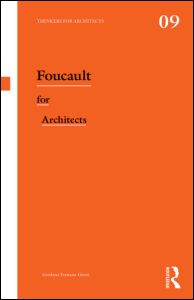
 Gordana Fontana-Giusti, Foucault for Architects, Routledge, May 2013
The author is also conducting an inaugural public lecture at 6 pm on the 24th of May 2013 at the University of Kent, Canterbury, Faculty of Humanities to coincide with the publication of the book.
Pdf flyer for event
Description
From the mid-1960s onwards Michel Foucault has had a significant impact on diverse aspects of culture, knowledge and arts including architecture and its critical discourse. The implications for architecture have been wide-ranging. His archaeological and genealogical approaches to knowledge have transformed architectural history and theory, while his attitude to arts and aesthetics led to a renewed focus on the avant-garde.
Prepared by an architect, this book offers an excellent entry point into the remarkable work of Michel Foucault, and provides a focused introduction suitable for architects, urban designers, and students of architecture.
Foucault’s crucial juxtaposition of space, knowledge and power has unlocked novel spatial possibilities for thinking about design in architecture and urbanism. While the philosopher’s ultimate attention on the issues of body and sexuality has defined our understanding of the possibilities and limits of human condition and its relation to architecture.
The book concentrates on a number of historical and theoretical issues often addressed by Foucault that have been grouped under the themes of archaeology, enclosure, bodies, spatiality and aesthetics in order to examine and demonstrate their relevancy for architectural knowledge, its history and its practice.
Contents
Introduction Part 1: Positioning 1.1 Context 1.2 Resisting Boundaries 1.3 Architecture Unspoken
Part 2: Archaeology 2.1 Human Sciences, Knowledge and Architecture 2.2 Archaeology as Difference
Part 3: Enclosure 3.1 Madness 3.2 The Asylum 3.3 The Clinic 3.4 The Prison
Part 4: Bodies 4.1 The History of Sexuality 4.2 Sexuality, Knowledge and the Structure of Aesthetic Experience 4.3 Biopower 4.4 Bodies, Architecture and Cities
Part 5: Spatiality/Aesthetics 5.1 Spatiality and its Themes 5.2 Avant-Garde and the Language of Space 5.3 Deleuzian Century 5.4 Ad Finem
 Foucault News
One thought on “Gordana Fontana-Giusti, Foucault for Architects (2013)”