
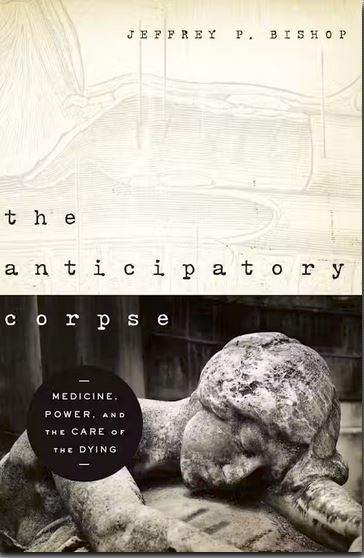
 Jeffrey P. Bishop, The Anticipatory Corpse. Medicine, Power, and the Care of the Dying, University of Notre Dame Press. 440p $35
Description
In this original and compelling book, Jeffrey P. Bishop, a philosopher, ethicist, and physician, argues that something has gone sadly amiss in the care of the dying by contemporary medicine and in our social and political views of death, as shaped by our scientific successes and ongoing debates about euthanasia and the “right to die”—or to live. The Anticipatory Corpse: Medicine, Power, and the Care of the Dying, informed by Foucault’s genealogy of medicine and power as well as by a thorough grasp of current medical practices and medical ethics, argues that a view of people as machines in motion—people as, in effect, temporarily animated corpses with interchangeable parts—has become epistemologically normative for medicine. The dead body is subtly anticipated in our practices of exercising control over the suffering person, whether through technological mastery in the intensive care unit or through the impersonal, quasi-scientific assessments of psychological and spiritual “medicine.”
The result is a kind of nihilistic attitude toward the dying, and troubling contradictions and absurdities in our practices. Wide-ranging in its examples, from organ donation rules in the United States, to ICU medicine, to “spiritual surveys,” to presidential bioethics commissions attempting to define death, and to high-profile cases such as Terri Schiavo’s, The Anticipatory Corpse explores the historical, political, and philosophical underpinnings of our care of the dying and, finally, the possibilities of change.
This book is a ground-breaking work in bioethics. It will provoke thought and argument for all those engaged in medicine, philosophy, theology, and health policy.
extract..
Bishop takes his central thesis from the observation of the French philosopher Michel Foucault that medicine made a dramatic turn in the late 18th century. In a particularly striking chapter of his masterful book The Birth of the Clinic, entitled “Open Up a Few Corpses,” Fou-cault wryly observes that with the development of pathological anatomy, the primary subject of medicine, concerned as it is with the care of the living, paradoxically became the dead human body. What doctors began to see when they saw living patients, Foucault argues, was what could be seen only at autopsy. Bishop skillfully portrays how this conception has played itself out into the 21st century, focusing on how medicine cares for the dying.
 Foucault News
wonderful abstract and summary
LikeLike